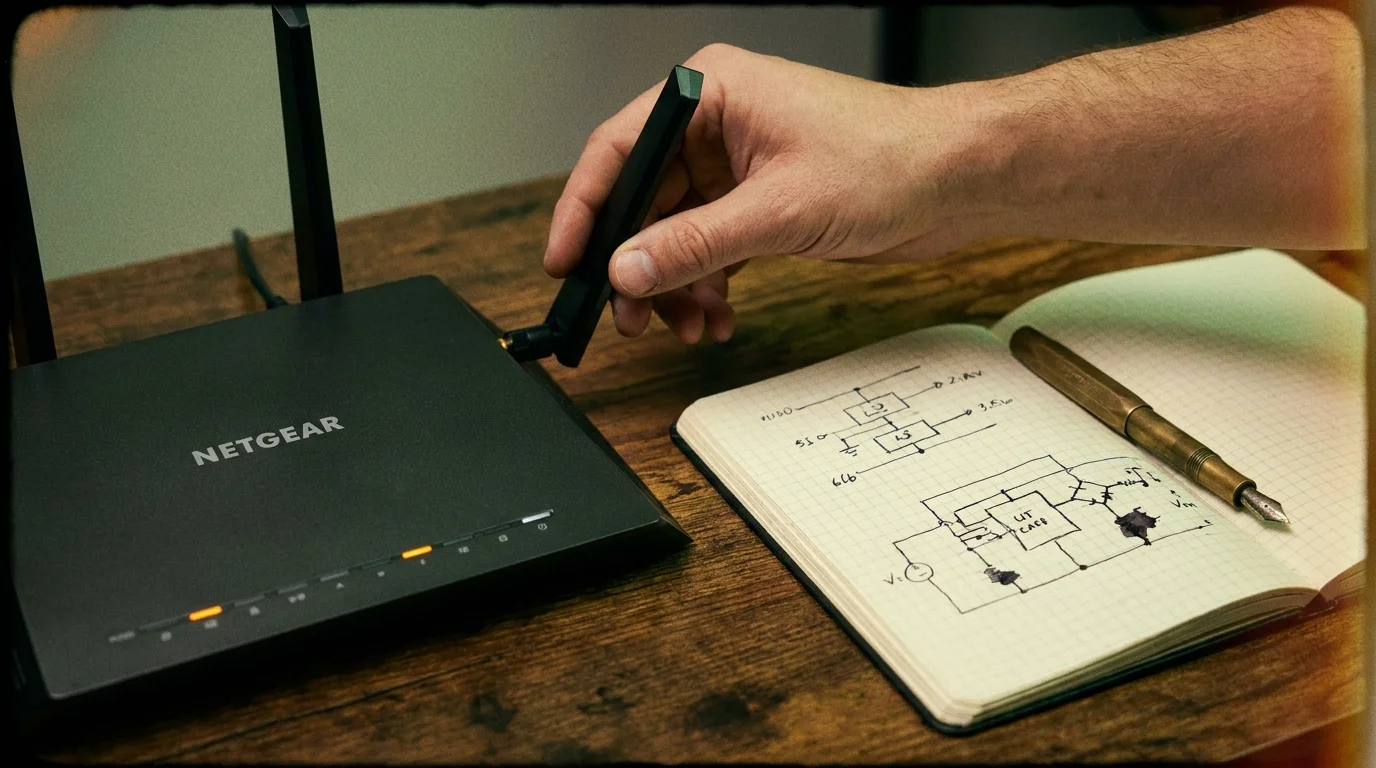
It is twenty minutes past eight on a rainy Tuesday evening. You sink into the living room armchair, tea steaming on the side table, and press play on the season premiere everyone at work discussed. Across the room, your Netgear Nighthawk sits on a media console, its angular wings and matte-black facets glowing with crisp white indicators. It looks like a grounded military jet, built to tear through gigabytes of raw data effortlessly.
Then the stutter begins. The screen freezes on a half-rendered face, the spinning gray ring pulses, and the stream degrades into a muddy wash of pixelated shadows and sluggish audio. Your immediate impulse is familiar: reach for your phone, open an electronics app, and browse three-hundred-dollar mesh satellite kits to rescue your home from supposed dead zones.
Before you spend a dime on fresh plastic and wall warts, look closely at what that machine is actually doing. Your router is not gasping for raw transmission strength; it is attempting to breathe through a thick wool blanket. By broadcasting across an excessively wide, congested slice of wireless air, it is colliding with every neighboring television, phone, and smart meter on the block.
The Illusion of the Wide Open Road
We are conditioned to equate bigger numbers with unyielding speed. When you open a modern router dashboard, options like 80MHz or 160MHz channel widths sound like spacious highways designed for unthrottled performance. On an empty test bench in an isolated laboratory, that wide swath of spectrum delivers blistering burst speeds.
In a real neighborhood, an 80MHz channel is less like a highway and more like driving a six-lane combine harvester down a crowded residential street. Radio frequencies do not honor property lines. Every time your neighbor’s router broadcasts a backup or their television buffers a 4K frame on that identical wide swath, your Nighthawk halts its transmission. It pauses, drops a handful of data packets, and re-transmits.
That microscopic stutter repeats hundreds of times per minute. While a raw download might eventually finish, real-time video feeds cannot endure the pause. The stream stumbles, resolution plummets, and your hardware takes the blame for atmospheric gridlock.
Marcus Vance, a forty-three-year-old home networking contractor based in Columbus, Ohio, encounters this exact scenario on nearly every residential service call. Homeowners routinely call him to run physical Ethernet through finished plaster because their flagship routers drop calls in the kitchen. In nine out of ten visits, Marcus pulls up a stool, types a local IP address into a browser, and narrows their 5GHz channel width from 80MHz down to 40MHz. Without laying an inch of copper or mounting an auxiliary pod, the dropped packets cease immediately, the signal penetrates two extra drywall partitions, and the family gets uninterrupted streams everywhere.
- Samsung Galaxy S24 displays trap buyers paying premiums over identical older glass
- PayPal SMS alerts conceal malicious credential traps targeting rushed smartphone screens
- Samsung One UI toggles silence background location polling saving drained battery bars
- Fitbit Charge 6 buzzes numb wrist nerves prompting phantom pocket vibrations
- Motorola 125W TurboPower adapters degrade phone battery cells through intense charging heat
Dialing In: Spectral Strategies for Different Spaces
There is no universal toggle that fits every dwelling. Your home’s geometry and the invisible density around you dictate how wide your wireless lanes ought to be.
The High-Density Apartment or Townhome
When your phone discovers thirty available Wi-Fi names from your couch, wide channels are fatal to streaming. In these environments, switch your 5GHz band strictly to a 40MHz or even 20MHz width. You will sacrifice theoretical speed tests that look impressive in screenshots, but you will exchange phantom speed for an unbreakable, low-jitter stream that never buffers.
The Sprawling Suburban Layout
If your main challenge is reach rather than interference from neighbors, wide channel widths are still working against you. Wider bands spread the router’s output power across a wider frequency footprint, which dramatically reduces the effective range of your signal. Dropping to 40MHz concentrates that same radio energy into a tighter, punchier beam that cuts through brick fireplaces, kitchen tile, and subflooring.
The Hardwired Media Anchor
If your streaming box sits within six feet of the Nighthawk, keep your wider 80MHz profile isolated exclusively to devices that genuinely move hundreds of raw gigabytes daily. For everything else, consistency beats peak capacity every hour of the day.
The Channel Retune: A Mindful Fifteen-Minute Protocol
Adjusting this setting does not require an IT degree. It requires fifteen quiet minutes and a simple web browser connected to your local network.
First, open your laptop and navigate to your router’s gateway address—typically routerlogin.net or 192.168.1.1. Enter your administrative credentials to reach the primary dashboard. From there, select the Advanced tab and click into Wireless Setup.
Locate the section labeled 5GHz Wireless Settings. By default, Netgear often locks this to an auto-sensing 80MHz or higher. Use the drop-down menu to restrict the channel width to 40MHz.
Next, move your channel selection away from ‘Auto’. Routers tend to crowd default channels like 36 or 149. Pick an underutilized control channel—such as 44, 48, or 157—to give your streaming devices their own lane.
Your Tactical Toolkit
- Gateway Address: 192.168.1.1 or routerlogin.net
- Target 5GHz Channel Width: 40MHz (Up to 300-450 Mbps real-world throughput, easily supporting multiple concurrent 4K streams)
- Target 2.4GHz Channel Width: 20MHz (Eliminates interference for smart home sensors and doorbells)
- Channel Selection: Non-overlapping channels (1, 6, or 11 on 2.4GHz; 44 or 157 on 5GHz)
- Time Required: Under 15 minutes, with one mandatory router reboot
Once you click Apply, the router will reboot its radio modules. The physical LEDs will blink amber before settling into solid white. Reconnect your television, queue your video, and watch how quickly the scrub bar fills with buffered data.
Reclaiming Stillness in an Invisible Atmosphere
We are constantly encouraged to cure technical friction by buying more things. When audio drops or video stutters, our consumer reflex tells us that our equipment is aging or insufficient, urging us toward newer boxes with more antennae and heftier price tags.
Yet true reliability in home technology rarely comes from raw brute force. It emerges when you take an intentional moment to understand the invisible landscape running through your rooms. By reigning in your router’s frequency width, you calm the digital storm around you, proving that precision and patience outshine excess power every single time.
“A narrower, clean transmission lane will outrun an overloaded superhighway every day of the week.” — Marcus Vance
| Key Point | Detail | Added Value for the Reader |
|---|---|---|
| Default 80MHz Width | Spreads signal wide; picks up severe neighbor interference. | Helps identify why top-tier routers drop connections in normal homes. |
| Manual 40MHz Setting | Concentrates radio energy into a focused, low-interference band. | Eliminates playback buffering and packet loss without spending money. |
| Mesh System Alternative | Adds multiple broadcasting nodes throughout the living space. | Saves $200-$400 by avoiding hardware you likely do not need. |
Frequently Asked Questions
Will switching from 80MHz to 40MHz make my internet feel slower?
No. A stable 40MHz channel comfortably delivers over 300 Mbps. Since an ultra-high-definition 4K video stream requires only 25 to 35 Mbps, your everyday browsing and streaming will actually feel significantly faster because packet loss is gone.Why does Netgear set the channel width so wide by default?
Manufacturers set these options to advertise maximum peak speeds on product packaging. These benchmark numbers look incredible in lab environments where no other Wi-Fi networks exist, but they struggle in real-world neighborhoods.Does this adjustment help smart home accessories like plugs and lights?
Yes. By narrowing your 2.4GHz band to 20MHz and clearing congestion on your 5GHz bands, you remove wireless cross-talk, keeping smart switches, security cams, and thermostats reliably connected.What if my streaming stick does not allow me to choose between 2.4GHz and 5GHz?
In your Nighthawk settings, you can assign distinct names to your 2.4GHz and 5GHz networks. Connect your video players directly to the tuned 5GHz network for uninterrupted throughput.How often do I need to readjust these channel settings?
Unless you perform a factory reset on your router, these settings remain permanently saved. You will only need to revisit them if a neighbor sets up an exceptionally loud access point on your specific channel.