A cold drizzle taps against your windshield while the dashboard clock blinks down the minutes before your dinner reservation. You step out onto the slick pavement, duck your head against the damp evening air, and walk briskly toward the dull gray aluminum kiosk standing sentinel at the curb. The city street hums behind you as you reach into your pocket for your phone.
A laminated square catches your eye, positioned neatly below the credit card slot with bold letters reading “Quick Pay – Scan Here.” You lift your phone, align the camera viewfinder, and let the device automatically capture the pixelated maze. A notification ribbon appears at the top of your screen, ready to whisk you away to an unassuming checkout page where you plan to tap in sixteen digits and be on your way.
Curbside parking meters were once purely mechanical beasts of heavy springs, steel tumblers, and brass coins. Today, they run on silent data pathways, and that unthinking trust has quietly transformed public streets into lucrative grounds for visual theft without a single wrench touching the meter’s chassis.
The Tactile Illusion: Why Paper Trumps Hardware Tampering
For decades, card skimming required sophisticated hardware: false bezels snapped over card slots, microscopic pinhole cameras wired to miniature batteries, and physical pick tools. Modern pavement thieves have abandoned heavy tools for a two-cent vinyl adhesive.
Instead of hacking the encrypted computer nestled inside the cast-metal casing, criminals simply hijack your peripheral vision. They construct an elegant mimicry of civic authority, matching city colors, municipal font weights, and department logos, then paste their counterfeit portal directly over the real instructions. Because our eyes are trained to treat physical infrastructure as inherently legitimate, we rarely inspect the seam between the metal plate and the paper riding on top of it.
Think of it as a fake skin grafted onto a familiar face. The municipal hardware remains entirely intact, uncompromised, and oblivious, while your phone’s browser loads a clone site designed solely to pocket your card number, billing zip code, and security code before bouncing you to an error message.
- Kasa smart bulbs drop Wi-Fi connections after power outages until toggling physical switches
- International travel eSIMs block expensive carrier roaming fees and restore fast foreign navigation
- Echo Dot speakers record private room conversations until users disable audio history permissions
- Galaxy camera settings strip aggressive digital sharpening to rescue grainy evening photos
- Coffee shop Wi-Fi networks intercept unencrypted login tabs without private DNS toggles
The Curbside Audit: What City Technicians Notice First
Marcus Vance, a 42-year-old municipal parking systems technician in Austin, spends his mornings surveying battery levels and thermal printer rolls across two hundred curbside terminals. He spots counterfeit stickers before he even steps out of his utility van.
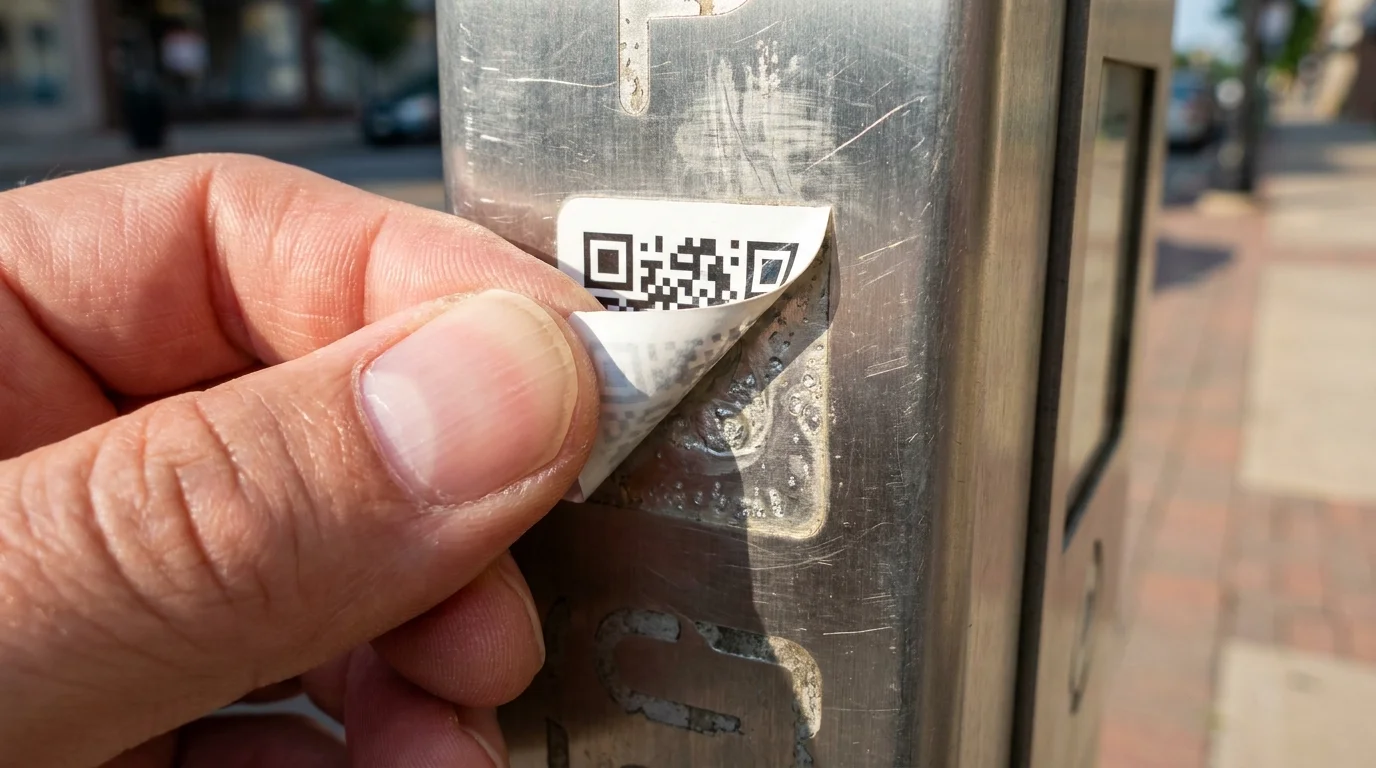
“Legitimate city utility plates are almost always silk-screened directly onto the powder-coated aluminum or recessed behind hardened polycarbonate shields,” Marcus explains while peeling a fresh matte decal off a downtown meter. “When a driver gets stung, it is usually because the scammer laid down a thick vinyl sticker with raised, peeling edges right over the official payment zone. If you can catch your thumbnail on the border of a QR code, you are not paying the city—you are paying a stranger halfway across the continent.”
Tailoring Your Guard: Three Curbside Scenarios
The danger shifts depending on how and where you park. Protecting your financial perimeter requires distinct adjustments based on your environment.
For the Rushed Daily Commuter
When you are fighting morning traffic and scrambling toward an office elevator, adrenaline overrides caution. You want speed over scrutiny, which makes you the primary target for fake curbside decals.
Bypass the camera entirely. Download your city’s verified parking application (such as ParkMobile, PayByPhone, or your municipality’s proprietary app) directly from the official app marketplace before leaving the house. Manually key in the four- or five-digit zone number stamped on the metal signpost. A sticker can easily lie about a link, but a malicious actor cannot redirect a zone query inside a secured, sandboxed application.
For the Out-of-Town Traveler
Arriving in an unfamiliar city leaves you vulnerable because you do not recognize the authentic local payment portal branding. Fraudsters take advantage of airport parking zones, tourist districts, and downtown entertainment corridors by creating generic pages that look plausibly official.
Before you ever place your thumb on your payment autofill, glance up at the street signs lining the block. Real city signage carries standardized department seals and phone numbers. If the web address prompted by your camera shows a hyphenated commercial URL or a generic domain extension like .top, .live, or .app instead of a recognized municipal dot-gov or the established regional platform, close the browser immediately.
Mindful Verification: The Curbside Defense Protocol
Securing your transaction takes less than five seconds once you build the physical habit into your parking routine. Treat every payment pillar like an unverified terminal until your senses confirm its authenticity.
Follow this quick mechanical sequence before interacting with any public kiosk:
- Run your thumb across the graphic: Genuine kiosks use flush, continuous metal plates or screen-printed instructions; if you feel a distinct raised ridge or layered vinyl film, step back.
- Scrutinize the camera preview banner: Look at the domain name inside the browser bubble before tapping it; legitimate municipal portals never use URL shorteners like bit.ly, tinyurl, or odd regional codes.
- Verify site security and autofill behavior: A fraudulent mirror site will almost never trigger your phone’s native credit card autofill securely or support native Apple Pay or Google Wallet tokens.
- Look for the green or blue physical NFC chip symbol: Tapping your device against the built-in contactless sensor routes data through encrypted payment rails that a sticker cannot intercept.
• Inspection Time: 3 seconds to run a finger over the label edge.
• Domain Audit: Reject any URL containing more than two subdomains or unfamiliar country codes.
• Default Defense: Keep physical credit cards with zero-fraud-liability policies active for physical insertion when decals look questionable.
Restoring Friction to a Frictionless World
Technology promises to smooth away every minor delay in our daily movement, whispering that faster is always better. But when convenience strips away our natural wariness, it leaves our personal data exposed on public street corners.
Pausing for two breaths at a parking kiosk to feel the metal, read the browser address, and question a misplaced sticker is not an inconvenience. It is a deliberate reclamation of your digital boundaries in physical space. When you learn to spot the slight tear in the seam, the street stops being a hazard and becomes a place where you walk with calm confidence.
“A payment terminal should feel like solid civic infrastructure; the moment it feels like a peel-and-stick label, treat it as compromised.”
| Verification Layer | The Red Flag | The Secure Habit |
|---|---|---|
| Physical Touch | Raised sticker edges, bubbled paper, or vinyl slapped over metal plates. | Feel for flush, factory-printed metal surfaces or protected glass panels. |
| Camera Preview URL | Shortened links (bit.ly), strange suffixes (.cc, .top), or excessive hyphens. | Confirm a recognizable domain or official .gov address before tapping. |
| Payment Rail | A webpage demanding manual entry of raw card digits and CVV codes only. | Prioritize built-in NFC tap-to-pay hardware or sandboxed municipal apps. |
Curbside Scam Defense: Frequently Asked Questions
Can scanning a fraudulent QR code compromise my phone without entering card details?
Simply scanning a code usually just opens a web page, but malicious landing pages can occasionally prompt stealth downloads or phishing permissions. If a scanned link opens a prompt asking to install a profile or download an unknown file, cancel it immediately.What should I do if I already entered my card details on a fake kiosk site?
Contact your card issuer right away using the number on the back of your card to freeze the account and dispute pending charges. Monitor your statement for small micro-charges that scammers often run to test card validity before attempting large unauthorized purchases.Why don’t cities remove QR codes entirely to stop these scams?
Many municipalities have begun phasing them out, but thousands of kiosks still rely on them to save drivers from standing in rain or cold. Until every terminal is updated, cities rely heavily on driver reports and physical maintenance sweeps to strip rogue stickers.Is tapping my physical card safer than scanning a QR code on the kiosk?
Yes, inserting an EMV chip or using the contactless tap pad on the kiosk machine is significantly safer. Physical point-of-sale hardware uses hardware-level encryption that cannot be altered simply by pasting a sticker over the machine’s face.How do I report a suspicious sticker I find on a public meter?
Take a photo of the meter number and kiosk, avoid peeling it off yourself to preserve potential evidence, and call your city’s non-emergency line or parking enforcement dispatch to send a technician out.