You walk down the hallway at two in the morning, your hand brushing against the cold, brushed metal of a wall plate. When your index finger presses the toggle, there is no sluggish lag, no buffering spiral, and no silent prayer that a distant data center in northern Virginia responds. Instead, your ear catches the faint, crisp snap of a miniature mechanical contact engaging behind the drywall, and the room instantly bathes in soft, warm amber light.
Across the room, the fiber-optic gateway blinks an erratic amber error pattern—your internet connection dropped an hour ago during a passing squall. Yet your hallway path illuminates with zero hesitation, executing a motion rule created three months ago. True architectural resilience demands independence from remote data centers.
For years, mainstream consumer tech trained us to accept an absurd compromise: asking permission from an overseas server farm simply to illuminate the bathroom. We replaced simple copper circuits with fragile software subscriptions, turning everyday fixtures into rented conveniences that stall whenever an ISP stumbles. Rebuilding your living space around localized hardware restores real, tactile sovereignty to your walls.
The Illusion of Connected Convenience: Renting Your Own Wall Switches
Consider the architecture of a standard Wi-Fi smart switch. When you tap the glass faceplate, that switch packages your command into an encrypted packet, sends it through your router, pushes it across town to your internet service provider, and routes it to a proprietary corporate cloud. That server processes the payload, verifies your account tokens, and beams an instruction back through the exact same pipe to switch on a light bulb located three inches from your hand.
This loop resembles mailing a letter to another country just to ask your partner to pass the butter at dinner. Bypassing cloud latency eliminates friction completely. When that outside cable line gets clipped by utility crews, your home drops into a state of sudden, expensive paralysis.
Z-Wave smart switch relays flip this model inside out. By operating on a dedicated sub-gigahertz frequency band (specifically 908.42 MHz in North America), these modules build an independent, self-healing mesh network entirely contained within your property lines. The physical relay does not know what an IP address is, nor does it care if your ISP exists. It receives a localized radio signal directly from an adjacent wall switch or an on-premises coordinator, snapping its copper contacts shut in less than fifty milliseconds.
- Apple AirDrop sharing protocols trap personal photo libraries inside closed mobile ecosystems
- Whisper AI transcription scripts strip chaotic voice memos into clean text outlines
- Apple TV 4K hardware switches toward dedicated local smart home command hubs
- Google Assistant settlement claims expose covert microphone recording logs across smart speakers
- Sony A7 V sensors deliver rapid burst tracking while roasting hot copper heatsinks
The Field Reality: Why Marcus Rewired His Colonial
Marcus Vance, a 42-year-old embedded systems engineer living in the wooded hills outside State College, Pennsylvania, learned this lesson during an ice storm in 2023. While his neighbors stood in freezing, dark living rooms struggling with apps that displayed endless reconnecting spinners, Marcus watched his baseboard heating zones, stairwell lights, and water shutoff valves coordinate seamlessly from an isolated battery-backed controller in his basement utility closet. By replacing cloud-tethered Wi-Fi plugs with in-wall Z-Wave relays tucked behind his existing vintage switch plates, he retained the physical charm of his 1920s home while guaranteeing that no automated safety trigger would ever wait on an internet handshake.
Matching the Hardware to Your Physical Architecture
Every home presents distinct wiring realities, from cramped shallow metal utility boxes to multi-gang switch arrays. Selecting the right physical relay format determines whether your installation feels like an invisible upgrade or an endless struggle with wire nuts.
The In-Wall Micro Relay (For the Preservationist)
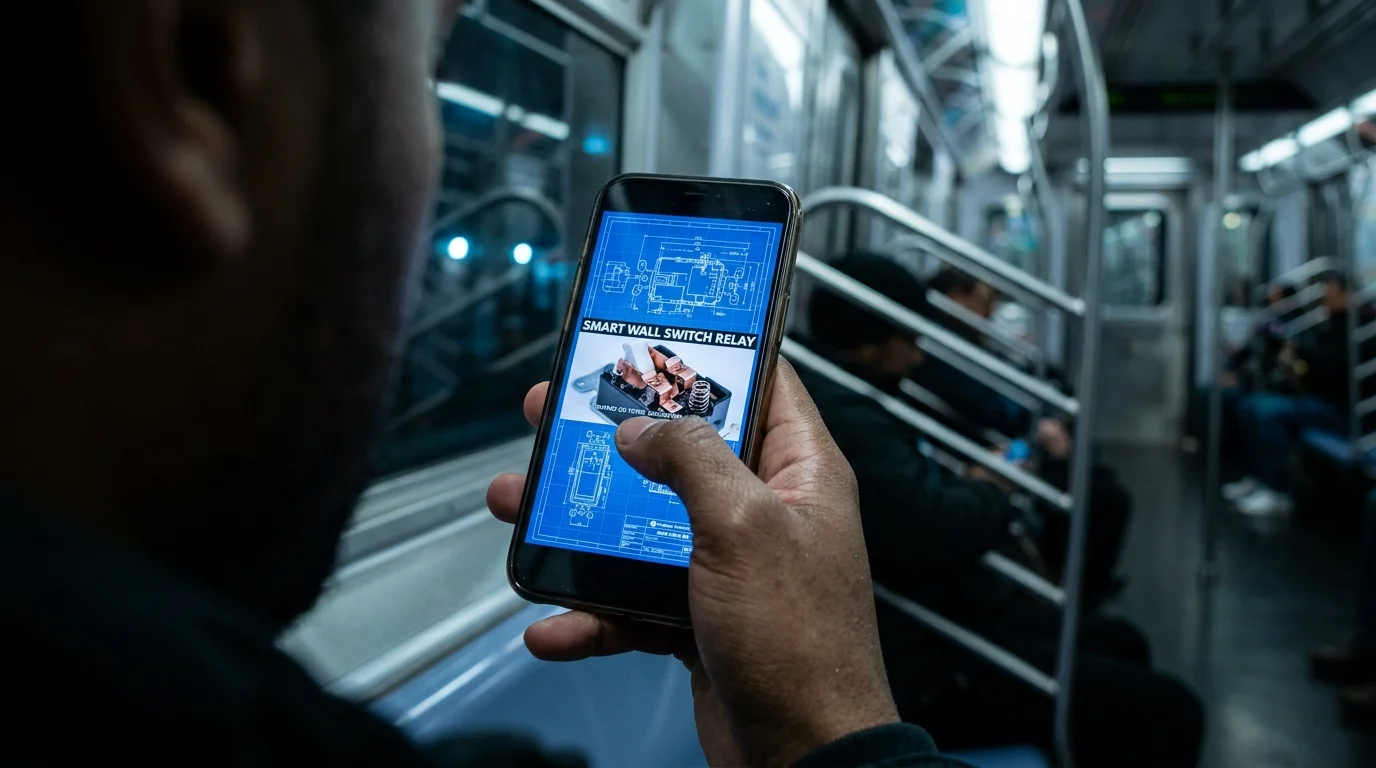
These compact, blue or black resin-potted squares slide directly behind your existing dumb mechanical switches inside the junction box. You keep your original brass toggles, porcelain plates, or decorative wall switches, preserving your home’s historic character while modernizing the circuit behind the plaster. Original switches retain tactile control even if the smart radio fails entirely.
The Decora Wall Dimmer Module (For the Daily Tactile User)
Replacing both the switch face and the internal switching mechanism, these units offer an integrated rocker with subtle LED status indicators. They provide immediate physical feedback, smooth magnetic low-voltage dimming curves, and configurable multi-tap scenes—such as tapping the bottom paddle three times to lock the exterior doors and shut down all lower-floor circuits.
The Heavy-Duty Dry Contact Relay (For Infrastructure Control)
Housed in rugged outdoor enclosures or dedicated electrical subpanels, these high-amperage relays handle heavy inductive loads like pool pumps, 240V electric water heaters, and whole-house ventilation fans. They isolate high-voltage power switching from low-voltage automation logic, preventing electrical noise from interfering with delicate home microcontrollers.
Building the Zero-Lag Local Blueprint
Deploying a robust, local-first switching network requires mindful layout rather than raw brute force. Because sub-gigahertz signals cut through drywall and timber framing far more efficiently than crowded 2.4GHz Wi-Fi, a modest collection of mains-powered relays naturally forms a reliable web across your floor plan.
Follow these practical guidelines when constructing your local lighting backbone:
- Map your neutral wires first: Confirm the presence of continuous white neutral conductors inside each target switch box using a calibrated multimeter before purchasing your relays.
- Establish direct device associations: Program your Z-Wave switches to talk directly to your bulb sockets or auxiliary switch modules using Direct Association Groups. This allows a switch to control a remote fixture even if your central hub crashes or shuts down.
- Keep the 2.4GHz spectrum clear: Offloading your home’s automated switches to the 908.42 MHz band clears valuable Wi-Fi bandwidth for high-throughput video streams and work laptops, preventing RF congestion bottlenecks.
- Include powered repeater nodes every thirty feet: Every mains-powered in-wall relay acts as a signal repeater, automatically recalculating packet routes around physical obstacles like concrete chimney breasts or metal ductwork.
Your Local Automation Toolkit:
- Operating Frequency: 908.42 MHz (North American Z-Wave Plus v2 standard).
- Switching Latency: Under 50 milliseconds via direct association.
- Required Box Depth: Minimum 2.25 inches for micro-relays behind standard mechanical switches.
- Local Controllers: Open-source on-premises hubs (such as Home Assistant with a dedicated Z-Wave USB stick or Hubitat Elevation).
The Quiet Peace of True Infrastructure Ownership
There is a profound, grounding comfort in knowing that the physical infrastructure sheltering your family belongs solely to you. When you silence the persistent pinging of cloud servers and cut the digital cords tethering your light switches to corporate balance sheets, your home transforms into an authentic sanctuary.
You no longer dread sudden end-of-life emails announcing that a camera manufacturer is sunsetting cloud servers, nor do you scramble to adjust schedules when a monthly subscription fee doubles. The mechanical relay snaps inside your wall, the light turns on, and the outside world stays where it belongs—firmly outside your door.
"True home automation should feel like invisible architecture: dependable, silent, and entirely under your physical command."
| Key Point | Detail | Added Value for the Reader |
|---|---|---|
| Physical Relay Isolation | Mechanical contacts sever the load locally without internet connectivity. | Lights operate instantaneously during external network outages. |
| Sub-GHz Frequency Band | Transmits across 908.42 MHz rather than standard 2.4GHz bands. | Completely avoids Wi-Fi congestion and penetrates building materials cleanly. |
| Direct Device Association | Devices communicate peer-to-peer without querying the central coordinator. | Zero-delay switching that survives even a total central hub hardware failure. |
Frequently Asked Questions
Do Z-Wave switches still work if my home internet goes down?
Yes. Because Z-Wave relays process all automation logic, physical inputs, and direct commands locally on your internal mesh, your switches, scheduled routines, and linked sensors continue operating without interruption during an internet outage.Can I install a micro-relay if my older home lacks neutral wires in switch boxes?
While most modern Z-Wave micro-relays require a dedicated neutral wire to keep their internal radio powered, several manufacturers produce specialized no-neutral dimmer relays that draw a tiny, unnoticeable trickle of current through resistive lighting circuits.What happens to my physical switch toggles when a relay is installed behind them?
Your original mechanical switches remain fully functional. Flipping the wall toggle mechanically triggers the micro-relay input terminal, toggling the light instantly while simultaneously reporting the new state to your local smart hub.Why choose Z-Wave over standard Wi-Fi switches?
Wi-Fi switches flood your home wireless router with dozens of individual IP connections and depend heavily on external cloud servers. Z-Wave offloads all device traffic onto a private, low-power frequency mesh that never slows down your family’s personal internet bandwidth.What hardware is needed to manage a local Z-Wave network?
You only need your chosen Z-Wave switch relays and a single local hub—such as a dedicated Z-Wave Plus USB antenna plugged into a small home server running Home Assistant, or a standalone local hub like Hubitat. No monthly service fees or subscriptions are required.