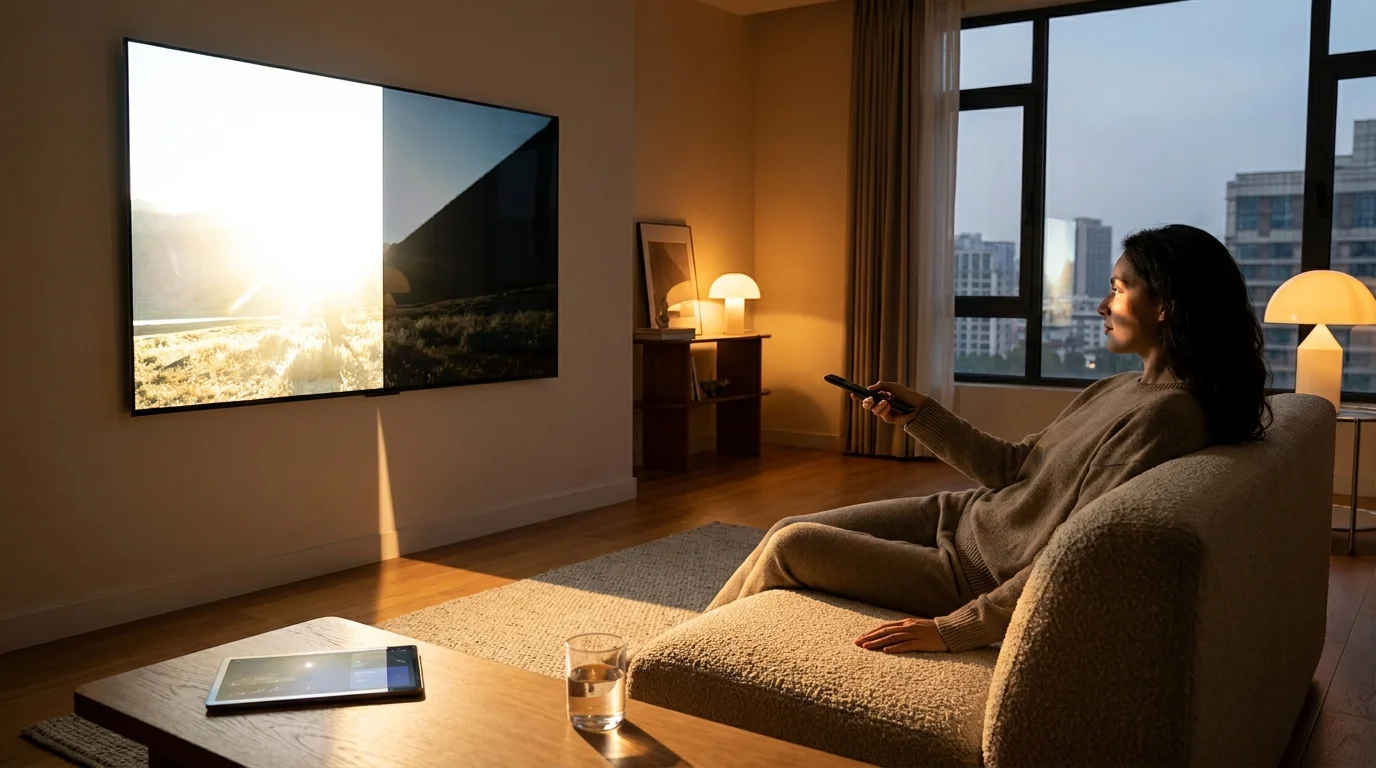
You sink into the couch after sundown, the living room pitch-black except for the hyper-realistic glow of your new display. A sweeping desert landscape unfolds in 4K HDR—golden dunes, blinding white sunlight bouncing off sandstone, crisp shadows carved into the dirt. For forty seconds, the image is breathtaking. Then, almost imperceptibly, the light begins to drain away. The golden sands turn to a muddy beige, the sky pulls back into a dull overcast gray, and the brilliance simply dies while the characters stand still, whispering across a long dialogue sequence.
You blink, wondering if your eyes are playing tricks or if the film director made a bizarre creative choice. You press pause, bringing up the playback bar, and the screen instantly snaps back to full, blazing luminance. That jarring flicker confirms your suspicion: your display deliberately pulled the plug on its own picture quality while you were watching.
This silent sabotage is the byproduct of modern display governance. When you purchase an organic light-emitting diode television, you pay top dollar for inky blacks and needle-sharp specular highlights. Yet deep within the manufacturer’s silicon, invisible safety algorithms work around the clock to aggressively dim the picture, suffocating legitimate high-dynamic-range content to protect the panel from its own physical chemistry.
The Ghost on the Dimmer Switch: How ASBL Misreads the Frame
Every premium OLED panel operates on a fundamental thermal wire. Because each self-lit pixel produces its own light and heat, sustaining massive brightness across large portions of the screen accelerates organic decay. To prevent permanent image retention—commonly known as burn-in—manufacturers ship their firmware with hardcoded protection protocols known as Temporal Peak Luminance Control (TPC) and Global Sticky Reduction (GSR), collectively referred to as Auto Static Brightness Limiting (ASBL).
In theory, these algorithms exist to spot news tickers, station bugs, and static video game scoreboards. In practice, the algorithm acts blind to cinematic intent. When a camera lingers on an extended shot with subtle movement—a tense dinner conversation, an expansive landscape, or a dim hallway sequence—the processor misinterprets the slow scene as a frozen still image. It starts a hidden countdown timer, gradually pulling luminance down by as much as 40 to 60 percent over ninety seconds.
Instead of acting like a delicate safety net, the firmware behaves like a nervous landlord flicking off breakers whenever the power bill spikes. You end up watching reference-grade media through a digital veil, completely robbed of the dynamic contrast you bought the screen to experience in the first place.
- Dell XPS 15 repairs demand cheap battery swaps reversing swollen touchpads
- Arctic Liquid Freezer coolers block blistering processor heat without bubbling pump hums
- LibreOffice suite tools stop clunky macro crashes without expensive recurring enterprise subscriptions
- DisplayPort 2.1 cables strip blurry visual flicker using thick braided copper shielding
- Netflix streaming algorithms trigger aggressive video compression derailing crisp 4K playback
The Calibration Desk: A Burbank Colorist’s Quiet Rebellion
Marcus Vance, a 42-year-old post-production colorist working out of Burbank, spends twelve hours a day fine-tuning HDR10 and Dolby Vision passes for streaming releases. In his mastering suite, reference monitors cost as much as a compact car, but his home setup relies on the same consumer OLED panels hanging in living rooms across the country.
“We spend weeks balancing the luminance curve of a single sequence so that moonlight glints off a car hood with exact physical realism,” Marcus explains. “Then I go home, put on the retail stream, and watch the TV crush those exact specular highlights into dishwater gray because two actors talked for three minutes without moving across the frame. The display isn’t malfunctioning; it is actively fighting the master file.”
Marcus keeps a specialized service remote tucked inside his coffee table drawer. By accessing the underlying factory menus, professionals like Marcus routinely neutralize these autonomous limiters to force the hardware to honor the incoming signal rather than its overprotective safety curves.
Choosing Your Stance: Purists, Gamers, and Casual Viewers
Not every viewer handles panel management the same way. Modifying factory behaviors involves balancing risk against visual authenticity, and different rooms demand different priorities.
For the Dedicated Cinephile
If your television lives in a light-controlled room where you exclusively watch high-bitrate films, ASBL is your primary visual enemy. Disabling TPC and GSR via service protocols allows long, moody master shots and blinding specular highlights to retain their intended luminance from cut to cut without artificial pumping.
For the HDR Console Gamer
Static user interfaces in open-world role-playing games and sports titles present a genuine retention hazard. Gamers who log hundreds of hours in single titles benefit from leaving GSR active, which targets fixed HUD elements, while dialing back overall peak brightness limiters to prevent the entire game world from darkening during inventory management.
For the Multi-Purpose Household
In living rooms where daytime talk shows, news channels with scrolling banners, and streaming video share the screen, the factory safeguards provide real longevity insurance. Here, the solution is not disabling the firmware safeguards entirely, but optimizing user-facing picture modes to mitigate how often the sensors trigger.
Mindful Calibration: Taming the Traps Without Voiding Your Peace of Mind
Reclaiming visual clarity does not require reckless modifications. You can significantly minimize aggressive dimming behavior through precise picture mode adjustments and thoughtful menu management.
- Switch to Film Presets: Move away from standard or vivid modes. Use ‘Filmmaker Mode’ or ‘Cinema Home’ where automatic dynamic contrast algorithms are deactivated by default.
- Disable Energy Saving Steps: Modern displays ship with energy-saving modes enabled to pass regional efficiency standards. Turn off ‘Auto Energy Saving’ and set ‘Energy Saving Step’ to off under support menus.
- Adjust Peak Brightness Safely: Keep OLED Pixel Brightness at baseline reference points (typically 100 for HDR, 80 for SDR) but turn off ambient light sensing, which compounds ASBL by dropping luminance when room lights shift.
- The Service Menu Protocol: Advanced users with dedicated service remotes access the underlying system menu (In-Start) to toggle ‘TPC Enable’ and ‘GSR Enable’ to ‘Off’. This permanently disables automatic static dimming while preserving normal thermal limits.
Always photograph your original factory values before changing any setting within hidden configuration menus. A single misplaced press on a service remote can alter factory white balance offsets that require professional hardware to restore.
The Bigger Picture: Trusting the Medium
Display technology has reached a point where the physical panel capabilities outpace the cautious programming meant to protect them. The ongoing friction between factory firmware and pristine picture quality is a reminder that consumer electronics are tuned for worst-case showroom abuses rather than attentive home viewing.
Taking ownership of your display settings bridges that divide. When you pull back the artificial firmware restraints, your screen ceases to be an anxious appliance constantly babysitting its own components. It becomes what it was engineered to be: an invisible window into the creative vision of the artists who framed every beam of light.
“True visual fidelity is not about making a display as bright as a lightning strike, but ensuring the panel never steals the light when the story demands it.”
| Limiter Protocol | Factory Behavior | Real-World Impact |
|---|---|---|
| TPC (Temporal Peak Luminance) | Dims entire screen during slow or static scenes after 60–90 seconds. | Prevents dialogue and slow pans from turning murky and unreadable. |
| GSR (Global Sticky Reduction) | Detects static high-contrast areas and lowers local luminance zones. | Protects panel health against HUDs and logos without flattening the entire frame. |
| ABSL (Average Picture Level Limiter) | Drops peak brightness when full-screen white exceeds power/thermal ceilings. | Maintains consistent color temperature across bright outdoor sequences. |
Frequently Asked Questions
Does disabling ASBL via the service menu void my TV warranty?
Accessing the service menu can leave logs in internal memory that authorized repair technicians can review. While toggling TPC or GSR rarely causes physical damage under normal video playback, manufacturers reserve the right to deny warranty claims for panel burn-in if factory protection limits were altered.Why doesn’t the TV dim when there is fast action on screen?
The algorithm constantly compares pixel changes across the entire frame. Fast action, camera cuts, and high-motion sequences trigger the motion threshold, resetting the internal timer and signaling to the processor that the image is active video rather than a static computer desktop or paused screen.Can recent official firmware updates fix this issue?
Yes, select newer OLED models have received official firmware patches that refine the algorithm sensitivity, making the TV better at distinguishing between low-movement film scenes and frozen screens without requiring manual service menu intervention.What is the difference between ABL and ASBL?
ABL (Automatic Brightness Limiter) is an instant hardware defense that limits brightness on full-field white screens to manage power draw. ASBL (Auto Static Brightness Limiter) is a software timer that slowly dims static or slow-moving content over several minutes.Is there a safer alternative to using a service remote?
Yes. Turning off ambient light sensors, disabling all eco-energy saving modes, and watching content in dedicated cinema picture presets significantly reduces the severity of auto-dimming without touching underlying factory service controls.