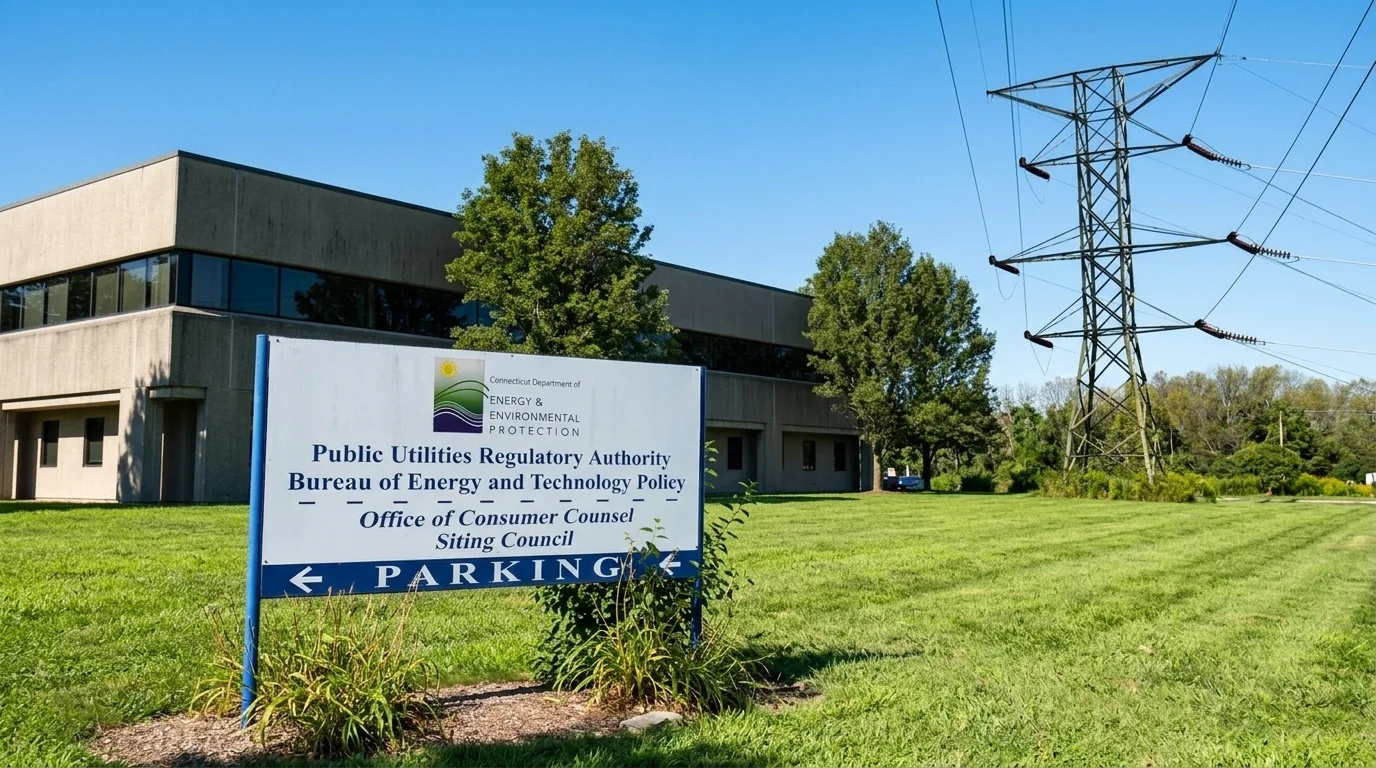
Connecticut Attorney General William Tong and Consumer Counsel Claire Coleman petitioned the state’s Public Utilities Regulatory Authority (PURA) on October 13, 2026, to launch an investigation into how local electric, gas, and water utilities deploy artificial intelligence. The filing comes on the same day federal energy regulators issued a warning that integrating automated tools into power grid networks could expose critical infrastructure to heightened cybersecurity threats and operational errors.
According to the Connecticut Attorney General’s office, major regional utility providers including Eversource and Avangrid have publicly acknowledged using AI tools, yet the exact scope and operational details of those deployments in Connecticut remain unknown to state regulators. While the state’s announcement outlines the framework for a broad regulatory review, Hartford Business reports that the filing is a formal request and does not establish that PURA has officially opened an investigation.
Scope of the Proposed Utility Inquiry
The joint petition asks state regulators to compel electric, gas, and water utilities to catalog every AI system currently operating within their networks. Under the proposed inquiry, utility companies would have to disclose the specific objective of each algorithm, the degree of human oversight governing automated decisions, and the internal protocols managing system deployments. As reported by CT News Junkie, officials also want PURA to audit all data security safeguards and historical cybersecurity breaches across utility networks, regardless of whether those incidents originated from AI systems.
Tong and Coleman requested that the regulatory examination evaluate eight specific operational areas:
- Storm response operations
- Customer-facing software systems
- Infrastructure asset management
- Energy load and water demand forecasting
- Equipment procurement for electric and water resources
- Daily operations and maintenance of the power grid, generation plants, and water treatment facilities
- Third-party vendor software and contractor access
- Advanced Metering Infrastructure (smart meters)
“It’s not a question of whether our utilities are using AI—we know they are,” Tong stated in the filing announcement. “We need to know exactly where, why and how it is being deployed, and what safeguards are in place to ensure the security and stability of our critical energy systems and infrastructure.”
- Trump Accounts Sell Micron Shares and Buy Up to $25.3 Million in Meta Stock
- Waymo Plans First Canadian Robotaxi Service in Toronto by 2028
- U.S. Retailers Face Backlash Over AI Pricing Tools as States Enact New Rules
- Riot Games Overhauls Valorant Esports With 15 Host Cities and 2027 Manila Pacific Cup
- RentAHuman Platform Tests the Reality of AI Agents Hiring Human Workers
Federal Grid Warnings and Cybersecurity Threats
The state petition coincides with heightened scrutiny from federal oversight bodies regarding software automation in the energy sector. According to CT Insider, cybersecurity auditors at the Federal Energy Regulatory Commission (FERC) recently warned that utilities are increasingly introducing AI tools into protected network environments that support the nation’s bulk power system.
In its 2026 cybersecurity audit findings, FERC noted that improperly controlled AI software inside secure utility networks can create access-control vulnerabilities, mask malicious network traffic, and allow attackers to conduct reconnaissance or move laterally across vital control systems. Despite these federal warnings and the state petition, current reporting from CT Insider indicates there is no evidence that AI tools have caused a cybersecurity breach or operational failure at any Connecticut utility to date.
Academic researchers point out that connecting automated software to public utilities magnifies pre-existing security challenges. Sean O’Brien, director of the Cybersecurity and Computer Science Programs at Yale University and founder of Yale’s Privacy Lab, told CT Insider that the technology sector has often rushed AI deployment without adequate testing. O’Brien noted that while securing internet-connected software has always been difficult, organizations are now granting AI platforms broad network access and the authority to execute actions at a massive scale.
Forecasting Failures and Operational Reliability
Beyond network security, Connecticut officials are scrutinizing how algorithmic errors and inaccurate outputs—commonly referred to as hallucinations—could disrupt physical utility operations and emergency preparations. While corporate adoption is climbing—with the Attorney General’s petition noting that 47 percent of U.S. employees report their organizations have integrated AI tools and 72 percent of S&P 500 companies disclosed at least one material AI risk in 2025—real-world utility deployments have already demonstrated points of failure.
In their petition, Tong and Coleman highlighted out-of-state incidents where reliance on automated weather modeling compromised utility emergency preparations. In California, recent wildfires grew to ten times the size predicted by an AI forecasting tool utilized by a local utility. The officials also noted that during a February 2026 nor’easter in the Northeast, conventional meteorological models outperformed AI-driven weather forecasts in predicting the severity and footprint of the storm. It remains unknown whether any Northeastern utilities relied on those underperforming AI models to stage repair crews prior to the February storm.
An AI safety and security researcher at the University of New Haven told CT Insider that integrating automated systems into public utilities presents distinct challenges across cybersecurity, operational reliability, and consumer protection. To prevent grid disruptions, the researcher advised that utilities must subject their models to stress testing under extreme weather and demand conditions while maintaining strict human oversight and manual fallback procedures.
What This Means for Utility Ratepayers
For residential and commercial utility customers, the push for regulatory oversight centers on balancing operational cost savings against service reliability and data privacy. Utilities routinely use software to forecast electricity demand, integrate renewable generation, spot aging transformer equipment before it fails, and evaluate transmission grid upgrades. Consumer Counsel Coleman noted in the petition announcement that while technological innovations can improve grid efficiency and lower baseline costs for ratepayers, those efficiencies cannot come at the expense of system safety or consumer protections.
Because utilities manage sensitive customer billing records and real-time household consumption data via smart meters, introducing third-party AI vendors into customer service and metering systems also raises privacy questions. As Issues in Science and Technology observed in a Summer 2026 governance analysis, automated systems optimized purely for technical efficiency often conflict with broader public interest goals unless regulators establish firm operational boundaries early in the deployment process.
Frequently Asked Questions
Has PURA opened a formal investigation into Connecticut utilities?
Not yet. The October 13 filing by the Attorney General and Consumer Counsel is a formal petition asking PURA to initiate a proceeding. PURA must review the request to determine whether to open a formal docket and establish a timetable for utility disclosures.
Which Connecticut utilities are known to use artificial intelligence?
State officials noted that both Eversource and Avangrid have referenced using AI in public statements and online materials. However, regulators do not currently know which specific software tools are in use at the state’s electric, gas, and water companies, or whether those tools connect directly to operational grid technology and customer databases.
How will regulators evaluate the safety of utility AI systems?
If PURA approves the review, regulators are expected to examine which operational decisions remain under human control, what manual fallback procedures exist if an algorithm fails during an emergency, how third-party software vendors are vetted, and how customer data privacy is protected against breaches.
Sources
- CT.gov – PURA Petition for Probe of Artificial Intelligence Use by Public Utilities
- CT Insider – AI is entering Connecticut’s utility systems. Officials want to know the risks
- CT News Junkie – Officials Seek Probe Into AI Use By Public Utilities
- Hartford Business – Tong, consumer counsel seek review of CT utilities’ AI use
- Connecticut Inside Investigator – AG and OCC petitions PURA for use of AI by public utilities
- Issues in Science and Technology – Escaping AI’s Measurement Trap Forum