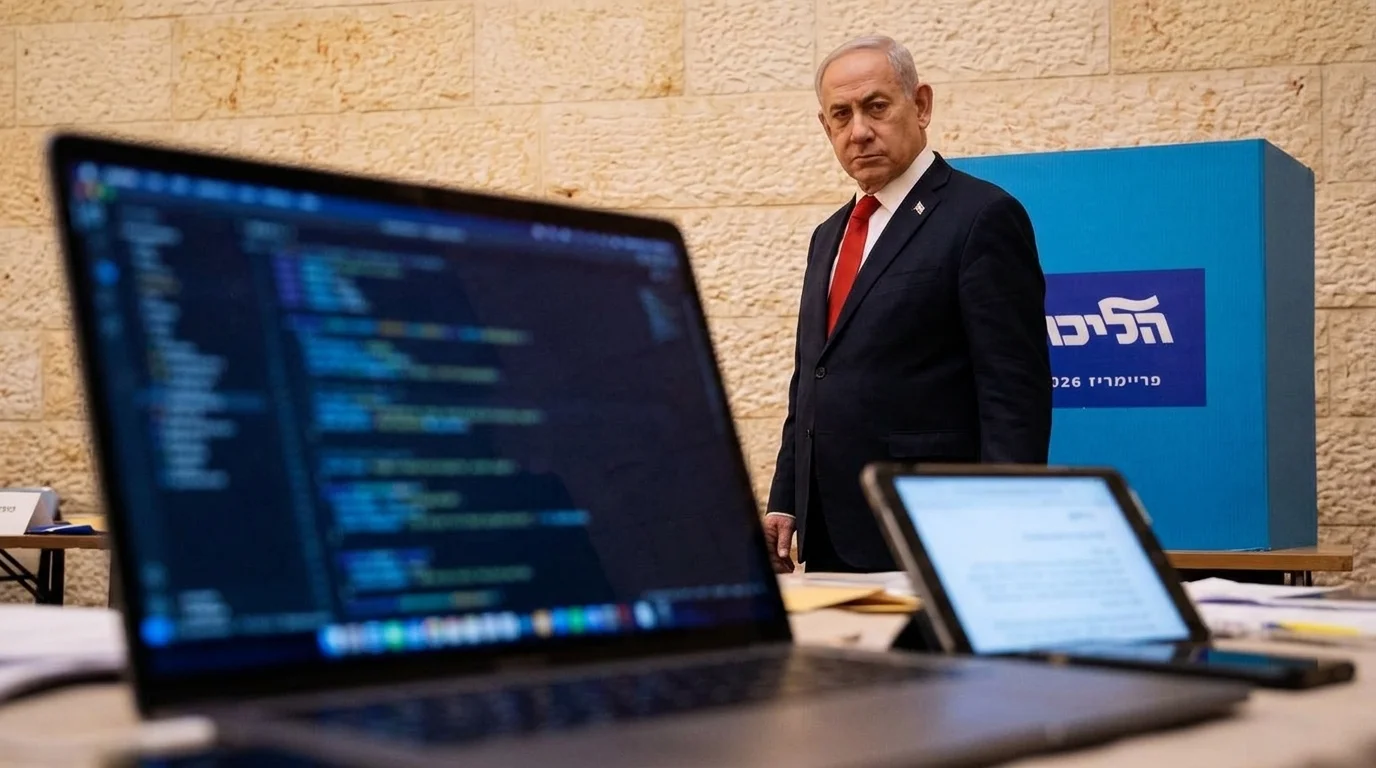
Rapid adoption of artificial intelligence tools and automated workflows is introducing significant operational security risks inside Israel’s political establishment, according to an October 19 analysis by The Jerusalem Post. The report examines how informal software development, exposed source code, and third-party messaging integrations surrounding Yonatan Urich, a longtime adviser to Prime Minister Benjamin Netanyahu, highlight a growing vulnerability for political operatives: self-inflicted data exposure.
The security concerns came into sharp focus following the October 11 circulation of leaked private WhatsApp correspondences attributed to Urich. While the exact technical mechanism behind the leak remains unconfirmed, the incident coincides with revelations that Urich used AI assistance to build a custom media-monitoring program and left critical credentials publicly accessible online, according to Ground News and Israeli media reports. For cybersecurity analysts and political observers, the episode illustrates how generative AI enables non-engineers to rapidly deploy functional software without standard enterprise security controls.
Exposed Code and Third-Party Integrations
At the center of the technical scrutiny is an automated media-tracking program reportedly developed by Urich with the assistance of Anthropic’s Claude AI. According to The Jerusalem Post, the tool was designed to scan roughly 50 news sources every 90 seconds for mentions of Benjamin Netanyahu, his wife Sara Netanyahu, the Likud party, and political rivals, automatically routing summaries and alerts to designated WhatsApp groups.
While the AI model assisted in writing the code, the underlying vulnerabilities stemmed from basic operational security failures rather than a flaw in the AI platform itself. A September 24 investigation by Haaretz, summarized in the Jerusalem Post analysis, revealed that the source code for the monitoring program had been left publicly accessible on GitHub. Embedded within that public repository were private telephone numbers, WhatsApp group identifiers, and active access tokens that could potentially allow unauthorized parties to view group metadata or intercept messaging traffic.
Compounding the code exposure was the architecture used to deliver the automated alerts. Citing reporting from the Israeli tech publication Calcalist, The Jerusalem Post noted that Urich linked his personal WhatsApp account to Ultramsg, an external automation service whose website identifies it as operating out of the United Arab Emirates. Connecting a personal messaging account to a third-party gateway grants the external provider broad permissions to route correspondence and media, creating an expanded attack surface outside government security perimeters.
- GAO Releases 2027-2032 Strategic Plan to Audit Federal AI and Hire Tech Specialists
- NYC Public Schools Halts Generative AI Use Through 8th Grade for 2026-27 Year
- AI Skills Carry Nearly $18,000 Wage Premium as Data Questions 120,000 AI Job Cuts
- Public Radio Affiliates Air Plain-English Guide to Decode Complex AI Jargon
- DHS Orders Federal Agencies to Remove Chinese AI Platform DeepSeek Over Security Risks
Despite the timing, differing reports exist regarding how the private messages actually surfaced online. A summary by Ground News notes that the WhatsApp conversations began circulating after the AI tool’s code was left public, a sequence that suggests a direct link. However, The Jerusalem Post cautions that no public forensic investigation has established the exact cause of the October 11 leak. Security analysts note that while exposed GitHub tokens and third-party API gateways represent severe risks, the messages could also have been obtained via traditional vectors such as phishing, spyware, compromised cloud backups, or physical device access.
ChatGPT Queries and Operational Footprint
The scrutiny surrounding Urich’s digital practices extends beyond custom code repositories to his direct interactions with commercial chatbots. In a separate matter publicized on October 12 and October 14, Israeli broadcaster Channel 12 disclosed police investigative records showing that Urich had consulted OpenAI’s ChatGPT in September 2024 regarding strategies to improve the public image of Qatar in Israel, according to The Jerusalem Post.
Those query records surfaced through law enforcement channels during the so-called “Qatargate” investigation and were not exposed via the GitHub repository or the WhatsApp automation tool. Together, the incidents demonstrate how political operatives increasingly rely on consumer-grade AI platforms as sounding boards and software generators, creating persistent digital audit trails in the process.
Israeli security agencies have taken note of the potential fallout. According to Ground News, the Shin Bet internal security service opened an inquiry to determine whether any materials capable of harming the Prime Minister’s security were compromised in the leaks, though the agency had found no evidence of direct physical security breaches as of mid-October. Nonetheless, the Jerusalem Post analysis stresses that even when private chats lack classified documents, they map out informal influence networks, media relationships, and internal decision-making processes that are highly valuable to political adversaries and foreign intelligence services.
The Broader Context: Israel’s ‘First AI Election’
The internal security lapses come against the backdrop of Israel’s October 27 legislative elections, which political scientists are describing as the country’s first AI election, according to Deutsche Welle. Political campaigns across the spectrum have integrated generative tools into their daily operations to produce synthetic media, automate voter outreach, and track public sentiment.
Researchers at the Ze Be AI project at the Open University of Israel tracked more than 44,000 social media posts across Facebook, Instagram, X, and TikTok between late July and mid-October, finding that over 14% of the campaign material utilized AI in some capacity, Deutsche Welle reports. Netanyahu’s Likud party accounted for more than 1,800 of those AI-generated posts—representing roughly a quarter of the party’s analyzed social media output—including a controversial 19-second synthetic video depicting rival candidate Gadi Eisenkot that drew over 1 million views.
While Israel’s Central Elections Committee enacted a rule in July mandating labels on AI-generated or manipulated campaign advertisements, oversight remains limited. According to The Times of Israel, a vast share of Israeli political discourse occurs within closed WhatsApp and Telegram groups where fact-checkers and election monitors have minimal visibility. Furthermore, surveys cited by The Times of Israel and Deutsche Welle indicate that roughly one-quarter of Israeli respondents would consider using AI chatbots or online services to help inform their voting decisions.
This reliance on conversational AI is reshaping campaign strategy globally. In the United States, political technologists are actively building systems like CampSight to monitor and influence how large language models describe local candidates, noting that brief interactions with chatbots can measurably shift voter preferences, according to Marketplace.
Frequently Asked Questions
Did an AI platform breach cause the leak of the political adviser’s WhatsApp messages?
No. Available reporting from The Jerusalem Post indicates that while Anthropic’s Claude was reportedly used to help write code for a media-monitoring tool, there is no evidence of a breach within the AI provider’s systems. The security vulnerabilities stemmed from user practices, specifically leaving source code containing access tokens public on GitHub and linking a personal messaging account to an external automation vendor.
Has an investigation confirmed how the WhatsApp conversations were obtained?
According to The Jerusalem Post, no public forensic finding has definitively established how the messages leaked on October 11. While exposed GitHub credentials and third-party messaging integrations presented clear vulnerabilities, analysts note that phishing, spyware, compromised cloud backups, or secondary devices remain possible vectors.
Do Israeli election rules regulate private AI tools and messaging groups?
Israel’s Central Elections Committee introduced a rule in July requiring campaigns to label AI-generated or manipulated media, according to Deutsche Welle. However, The Times of Israel notes that such rules primarily target public synthetic media rather than chatbot influence or unmonitored distributions inside private WhatsApp and Telegram channels.
Sources
- The Jerusalem Post – ‘The user is hacking himself’: How AI exposes Israel’s political inner circles – analysis
- Ground News / The Media Line – Alleged Private WhatsApp Conversations of Yonatan Urich Circulated on Social Media
- Deutsche Welle – How AI is shaping Israel’s election campaign
- The Times of Israel – Policing only deepfakes, Israel leaves chatbot-trusting voters exposed to real AI threat
- Marketplace – Candidates campaign for AI attention