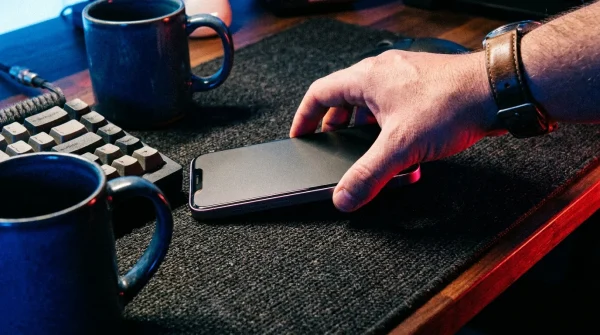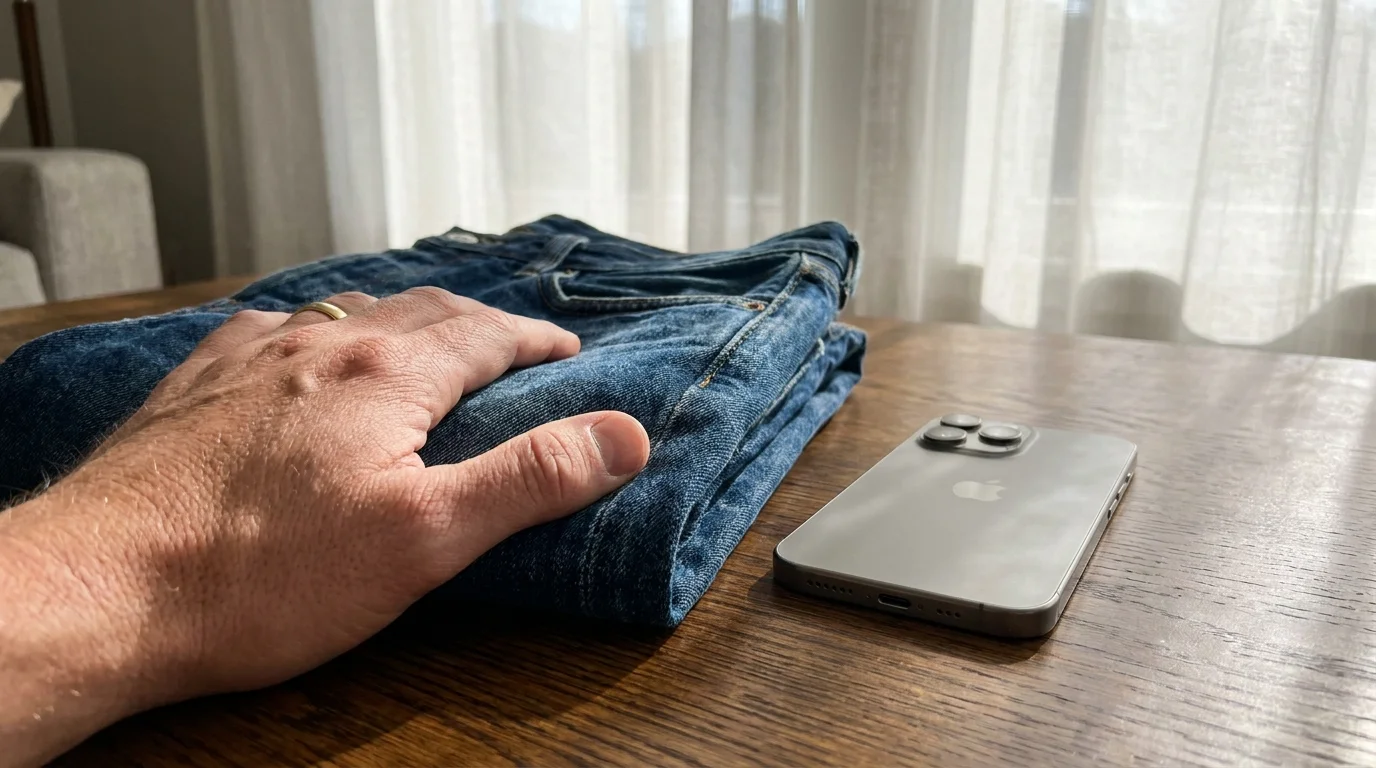
Afternoon light cuts across an empty polished oak tabletop, catching the dull sheen of an iPhone lying flat and face down. Twelve feet away, you are leaning against a kitchen counter in your dark denim trousers. You feel it with pinpoint precision: two rapid, mechanical thumps directly against your right thigh. The vibration carries the exact frequency, weight, and cadence of an incoming direct message, tactile and undeniable.
Your palm immediately slaps your thigh, fingers clutching empty weave. You look over at the oak table. The phone sits motionless, its glass cold, its screen completely dark. Your skin swore it felt the mechanical kick of a linear actuator, but your pocket was empty the entire time.
You have not suffered a neurological glitch, nor are you imagining things in a vacuum. What you just experienced is an involuntary somatosensory misattribution—a physical manifestation of how modern linear resonant hardware recalibrates the human nervous system. Your brain has simply taken everyday physical friction and translated it into digital urgency.
The Architecture of Tactile Hallucination
For decades, phone pagers and early flip phones relied on eccentric rotating mass (ERM) motors—clunky, spinning counterweights that rumbled like miniature blenders trapped inside plastic shells. Modern smartphones abandoned that clumsy buzz in favor of precision linear actuators. The iPhone Taptic Engine operates more like a miniature loudspeaker cone, firing magnetic pulses along an axis in fractions of a millisecond. It does not shake; it taps. It produces crisp, localized haptic clicks that mimic the sensation of pressing real buttons, turning virtual dials, and receiving physical prods against skin.
Because these pulses are designed to feel organic, your brain integrates them directly into your body schema. Signal detection theory explains this cognitive trade-off with ruthless simplicity: when your survival or social connection depends on detecting subtle cues, your nervous system deliberately dials up its internal gain. The brain treats sensory data from your thigh like a radar operator working during a storm, willing to tolerate dozens of false alarms rather than miss a single true target.
Underneath your skin, tiny sensory nerve endings called Pacinian corpuscles respond to rapid pressure changes and vibrations between 100 and 300 Hertz. This happens to match the resonant frequency of modern consumer haptic engines. A minor muscle fasciculation from mild dehydration, the seam of your denim shifting as you pivot your hip, or the fabric rubbing against an office chair suddenly registers along the exact same sensory pathway. Your sensory cortex fills in the blanks, deciding you just received an urgent notification.
The Sensory Threshold Shift
Dr. Paul Vance, 48, a clinical neurophysiologist who studies human-machine somatic integration in Seattle, describes this reaction as an adaptive sensory reflex. In his assessments, subjects who keep high-cadence notification settings active demonstrate a measurable lowering of their tactile perception threshold along the specific patch of skin where their phone typically rests. Their brains develop a hyper-vigilant predictive filter, actively converting mundane biological twitches into simulated hardware pulses before conscious awareness can intervene.
- Apple Messages spam filters derail aggressive text scams halting frantic lock screen buzzing alerts
- Samsung One UI RAM Plus toggles block virtual memory thrashing halting sluggish app stutter
- TikTok mobile app updates quietly switch microphone access sparking warm pocket battery drain
- iPhone 15 Pro titanium frame traps blistering heat while firmware quietly caps peak gaming speeds
- Discord connection servers collapse nationwide forcing endless spinning connection loops across desktop voice channels
The phantom sensation is not a sign of exhaustion; it is an involuntary conditioned response. The body learns the language of the machine so deeply that it begins speaking it without the machine present.
Deconstructing Your Daily Haptic Load
Not everyone experiences phantom vibrations in the same way. The phenomenon shifts depending on your physical environment, your daily hardware habits, and how you distribute your attention across the workday.
The High-Paced Communicator
If your profession requires immediate replies to client alerts or project boards, your central nervous system stays locked in a state of high vigilance. For you, phantom vibrations manifest as distinct double-pulses during quiet moments—often right as you step away from your desk to pour a glass of water. Because your mind expects continuous input, silence creates sensory static, and the brain misinterprets common muscle twitches as incoming alerts.
The Desk Worker
If your routine involves parking your phone facedown on a bare surface like an oak desk or mousepad while you type, your body experiences sensory displacement. The physical absence of weight in your pocket contrasts sharply with hours of habitual contact. The skin on your thigh retains a lingering sensory memory, misreading the friction of relaxed clothing against resting muscle as the familiar jolt of a desk notification echoing through your body.
The Kinetic Commuter
If you spend hours walking city blocks, riding subways, or driving over concrete expansion joints, external mechanical frequencies bombard your lower body. The rumble of transit tracks or the cadence of heavy footsteps closely mimics low-amplitude actuator buzzes. Your brain groups this environmental noise into familiar categories, convincing you that your phone is buzzing in your coat pocket when it is actually tucked deep inside your backpack.
Recalibrating Your Somatosensory Thresholds
Breaking this phantom reflex does not require abandoning your digital life. It simply takes intentional adjustments to reset the sensory baseline of your skin.
Begin by altering the physical geography of where your device lives during the day. When you shift the hardware, you break the somatic expectation mapped to that specific quadrant of your body.
- Rotate carry locations: Move your device from your dominant front trouser pocket to a back pocket, an interior jacket pouch, or a dedicated desk stand for two consecutive weeks.
- Prune system haptics: Turn off unnecessary tactile feedback for keyboard clicks, lock sounds, and app interface toggles to lower your baseline daily tactile dosage.
- Standardize contact intervals: Establish specific 15-minute windows each afternoon where the phone remains out of sight and out of reach, breaking the continuous feedback expectation.
Implement a brief physical reset whenever a phantom vibration strikes. Acknowledge the false alarm instead of immediately checking your pocket or scanning the desk. Lightly rub the palm of your hand against your thigh for three seconds; this floods the Pacinian corpuscles with broad, flat sensory input, immediately clearing the hyper-sensitive neural static that generated the ghost pulse.
The Tactile Reset Toolkit
- 72-Hour Haptic Mute: Navigate to Settings > Sounds & Haptics, and toggle ‘System Haptics’ off for three full days.
- Notification Triage: Restrict physical vibration privileges exclusively to direct phone calls and critical calendar alerts; silence all third-party app haptics.
- Focal Grounding: Place the device face-up at arm’s length on your desk during focused work blocks so your peripheral vision handles verification, freeing your skin from vigilance.
Reclaiming the Boundary of Your Skin
Phantom vibration syndrome is a modern proof of our incredible physical adaptability. Your body is so responsive, so eager to maintain connection with the tools you use, that it modifies its own sensory gates to ensure you never fall behind. Your nervous system adapts faster than any firmware revision, reshaping your sensory landscape to accommodate the micro-cadences of everyday design.
Recognizing the phantom thump for what it is—a misplaced nerve impulse, an eager predictive algorithm running inside your own mind—strips it of its urgency. When you leave your phone resting silently across an empty desk, your pocket should feel like nothing more than fabric against skin. Realizing that the quiet belongs entirely to you is where real focus returns.
The human nervous system is an elastic mirror; give it a predictable rhythm, and it will keep playing the beat long after the instrument goes quiet.
| Key Point | Detail | Added Value for the Reader |
|---|---|---|
| Sensory Misattribution | Pacinian corpuscles mistake fabric friction or minor muscle spasms for mechanical 200Hz alerts. | Validates that phantom vibrations are somatic reflexes, not psychological imagination. |
| Taptic Engine Profile | Linear resonant actuators produce sharp, localized acoustic pulses rather than diffuse motor shakes. | Explains why modern smartphones trigger more distinct phantom sensations than older hardware. |
| Spatial Separation | Leaving the phone on a distant desk decouples physical skin contact from alert anticipation. | Provides an immediate environmental tactic to break digital sensory hyper-vigilance. |
Frequently Asked Questions
Why do I feel phantom vibrations mostly in my thigh?
The skin on your upper thigh features a dense distribution of mechanoreceptors that rest directly against your trouser fabric. Because your phone typically sits pressed firmly against this area, your brain forms an acute predictive expectation there, making it the most common target for sensory misinterpretation.Does experiencing phantom vibrations mean I have high digital anxiety?
Not necessarily. While stress can heighten your body’s vigilance, phantom vibrations are primarily a natural mechanical byproduct of habituation. Anyone who uses a device with high-frequency tactile feedback can develop this conditioned sensory reflex regardless of baseline stress levels.Can changing my vibration pattern fix the phantom buzzes?
Yes. Customizing specific vibration cadences for close contacts or switching to longer, softer alerts disrupts the brain’s association with brief, sharp muscle twitches, significantly reducing false alarm triggers.How long does it take for phantom pocket vibrations to stop?
Most people experience a sharp reduction in phantom vibrations within five to seven days after moving their device to a different pocket or disabling non-critical system haptics.Do smartwatches produce the same phantom sensations on the wrist?
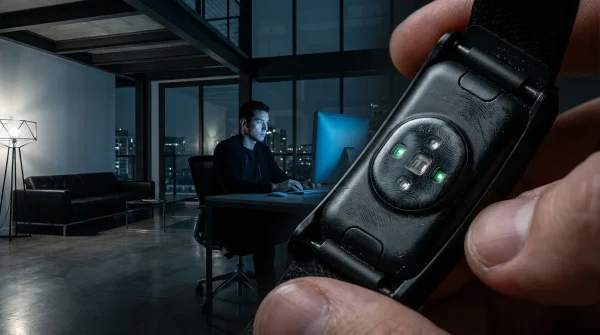
Yes. Phantom wrist vibrations are increasingly common among smartwatch users. The mechanism is identical: the brain misinterprets the tendon shifts or the slight movement of the watch band against the wrist bone as a software notification.