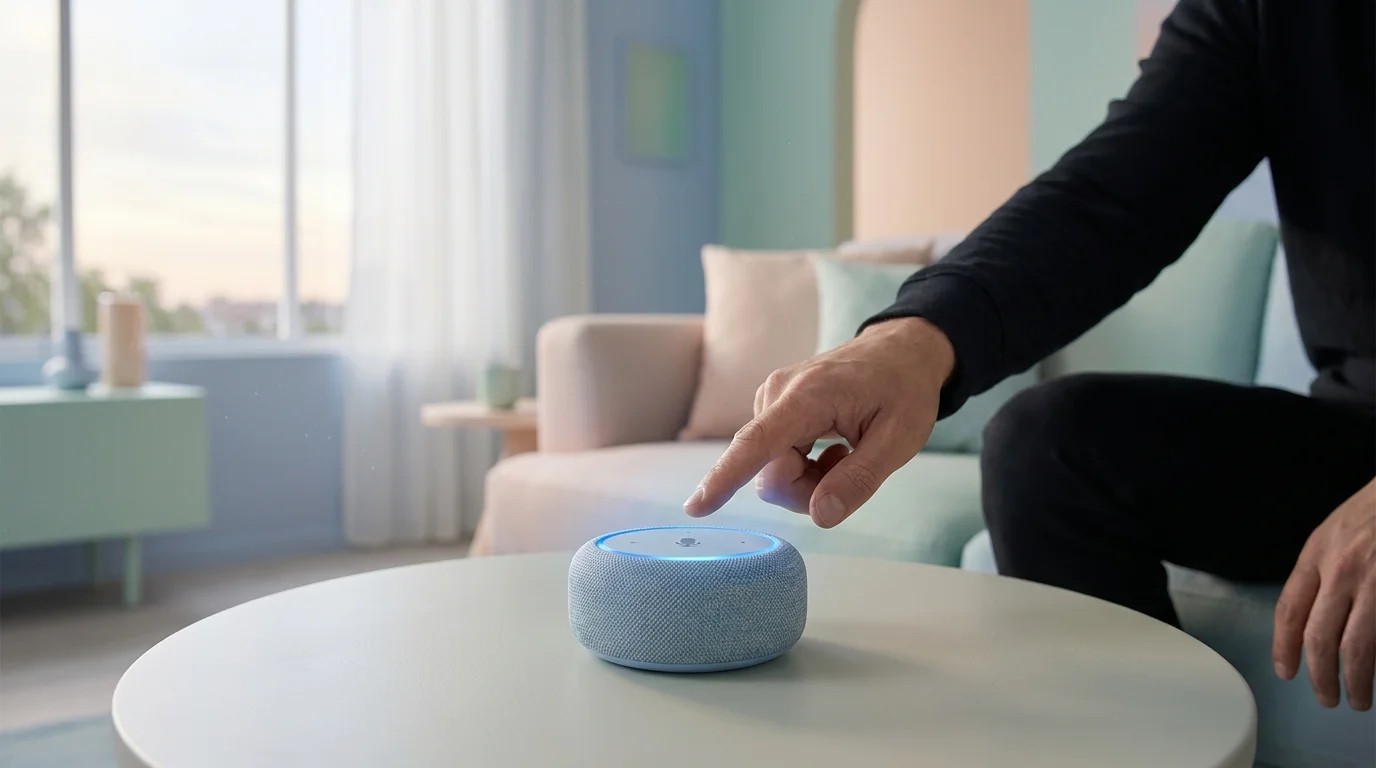
The dusk settles across your bedroom, casting long gray shadows across the nightstand. Out of the corner of your eye, a circular glowing blue LED ring flashes softly on a fabric-wrapped speaker puck resting beside a carafe of water. You did not speak to it. You were merely folding laundry, laughing at a phone conversation, or murmuring a passing thought to your partner across the sheets.
Yet that tranquil blue shimmer indicates that a digital diaphragm just twitched awake. In that fraction of a second, an onboard acoustic model mistook an ordinary syllable for a summon, opening an audio pipe directly to a server farm hundreds of miles away.
We tend to view these compact spheres as polite domestic servants that sleep soundly until summoned by their crisp, two-syllable wake phrase. But inside their molded acoustic chambers, multiple far-field microphones operate in a state of suspended anticipation, holding rolling milliseconds of ambient parlor sound in volatile memory. When speech phonetics loosely match the programmed trigger, that memory buffer converts into an indelible cloud audio file.
Without conscious intervention, those snippets of bedtime banter, private financial calculations, and half-muttered secrets stay preserved in remote servers indefinitely. Reclaiming control over your personal space does not mean banishing the convenience; it means learning how the listening architecture actually behaves.
The Acoustic Tripwire: Why Passive Listening Crosses the Line
Consider the microphone array not as an obedient ear, but as an overzealous guard dog reacting to rustling leaves against a windowpane. The machine does not comprehend meaning; it scans frequency bands and syllable cadence. When your television dialogue or casual chatter hits the right acoustic contour, the gate swings open instantly.
Manufacturers frame indefinite voice recording as a benevolent feedback loop for acoustic modeling. They tell you that cataloging your voice profile improves machine learning comprehension in loud rooms. What is left unsaid is that retention is an opt-out protocol: cloud storage defaults to keeping every captured scrap forever until you manually revoke permission.
This means your private habitat effectively subsidizes their acoustic dataset. When you treat the speaker as an appliance like a toaster, you accept its uncurated surveillance habits. Shifting your vantage point from passive consumer to active system auditor turns an unchecked surveillance tap into a strictly cordoned utility.
- iPhone 16 Pro camera lenses trap muddy digital artifacts under default sharpening profiles
- Starbucks Wi-Fi portals expose unencrypted device telemetry without rapid secure DNS toggles
- Dell UltraSharp monitors force neck strain without proper eye level riser alignment
- Calm app subscription trials trap drained checking balances behind confusing cancellation windows
- Back Market refurbished MacBooks demand immediate diagnostic audits exposing disguised swollen battery packs
The Forensic Audit: A Security Researcher’s Discovery
David Vance, a 39-year-old network systems analyst from Columbus, Ohio, decided to inspect his personal voice archive on a quiet Sunday afternoon. Over seven years of owning smart speakers across three rooms, David assumed his cloud history held little more than requests for local weather forecasts and kitchen timers. Instead, exporting his account archive yielded over 4,200 individual sound files, dozens of which contained complete, unprompted conversations.
Among the records were hushed discussions about David’s mortgage refinancing, a toddler’s temper tantrum during dinner, and twenty seconds of an argument with a contractor where no one had spoken the wake word. The audio fidelity was chillingly crisp, preserving every nuance of ambient house noise. That evening, David altered every privacy flag in his profile, establishing a hard wall between room convenience and unchecked cloud harvesting.
Tailoring Your Boundaries: Configurations by Living Space
Every corner of your home carries a different threshold of privacy vulnerability. A speaker positioned on an open kitchen island presents entirely different concerns than one sitting three inches from your pillow.
For the Shared Living Room
In high-traffic family zones, speakers pick up continuous cross-talk, children playing, and broadcast media. Here, false triggers occur several times a day. Set the wake word to a less common cadence like ‘Echo’ or ‘Computer’ rather than the default feminine name, cutting false triggers in half. Combine this with automatic deletion schedules that purge logs every three months so lingering guest speech never accumulates.
For the Bedside and Home Office
Intimate quarters demand absolute silence when private life unfolds. If a puck sits next to your bed or office desk, the physical mute switch should become your primary nightly habit. Depressing the hardware button disconnects the physical microphone circuit, illuminating a solid crimson ring that confirms the acoustic diaphragm is electrically dead. Furthermore, you must entirely prohibit cloud audio saves in your digital dashboard so accidental daytime triggers never create permanent records.
Mindful Application: Neutralizing the Audio Archive
Securing your acoustic perimeter takes less than five minutes when navigating the account portal. The path is deliberately buried behind multiple interface menus, but walking through it methodically ensures your room audio remains strictly local.
Pick up your mobile device, open the companion management app, and tap into the settings screen. Move through each layer deliberately, knowing that every toggled switch permanently revokes a cloud permission.
- Navigate to More, select Settings, and choose Alexa Privacy from the account submenu.
- Tap Manage Your Alexa Data to locate the primary cloud telemetry toggles.
- Select Choose how long to save recordings and change the active default to Don’t save recordings.
- Confirm the prompt, acknowledging that historical audio files will be permanently purged from cloud servers.
- Scroll down to Help improve Alexa and toggle off the permission allowing personnel to manually review your voice clips.
- Return to Review Voice History, select the date filter for All History, and tap Delete all my recordings.
Perform this audit every six months. Major ecosystem software updates occasionally introduce new opt-in machine learning initiatives that quietly seek your conversational data under revised wording.
The Tactical Toolkit
Retaining command of your acoustic environment requires keeping a few specific operational habits and hardware distances in mind:
- Air Gap Buffer: Keep speaker units at least 3 feet away from televisions and soundbars to stop entertainment audio from tripping synthetic phoneme triggers.
- Visual Audit Cue: Treat the red hardware mute light not as an error alert, but as an active privacy shield during sensitive conversations.
- Auditory Confirmation: Enable ‘Start of Request’ sound alerts in device audio settings, forcing the puck to chime audibly whenever its microphone engages.
The Bigger Picture: Reclaiming Domestic Sanctuary
Your living space should serve as an unmonitored sanctuary where thoughts can wander, voices can rise and fall, and everyday life can breathe without being etched into a database. Convenience ceases to be a luxury the moment it demands silent personal concessions.
When you take control of these hidden switches, you do not lose the magic of hands-free technology. Instead, you recalibrate the dynamic. The machine returns to what it was always meant to be: a responsive tool that works on your terms, listening only when invited, and forgetting the instant the command is complete.
True digital privacy in the home is not about rejecting convenience, but about establishing intentional boundaries where passive technology stops recording your life.
| Key Point | Detail | Added Value for the Reader |
|---|---|---|
| Microphone Triggering | Onboard phonetic matching causes accidental activations from ordinary speech. | Identifies why unexpected blue ring alerts happen during private moments. |
| Telemetry Storage | Default settings retain voice recordings indefinitely on company servers. | Reveals that conversational history accumulates without manual changes. |
| Privacy Remediation | Toggling account controls immediately purges historical clips and halts saves. | Offers immediate, permanent autonomy over your personal home audio. |
Frequently Asked Questions
Does disabling voice history degrade everyday speaker performance?
No. The device continues to execute alarms, weather inquiries, and smart home commands seamlessly. It merely deletes the sound file after parsing your command instead of filing it away.How do I know if my device is listening without my knowledge?
Look for the rotating blue light ring or enable the acoustic ‘Start of Request’ chime in your settings so the device announces every activation aloud.Does the physical mute button truly disconnect the microphone?
Yes. The physical button breaks the electrical circuit supplying power to the microphone board, providing true hardware-level privacy.Can human contractors actually listen to my past audio clips?
Unless you manually toggle off the ‘Help improve’ training permission, sampled clips can be reviewed by human annotators to train speech models.How often should I review my smart speaker privacy settings?
Checking your privacy dashboard twice a year ensures that newly introduced features or firmware updates have not altered your data retention preferences.