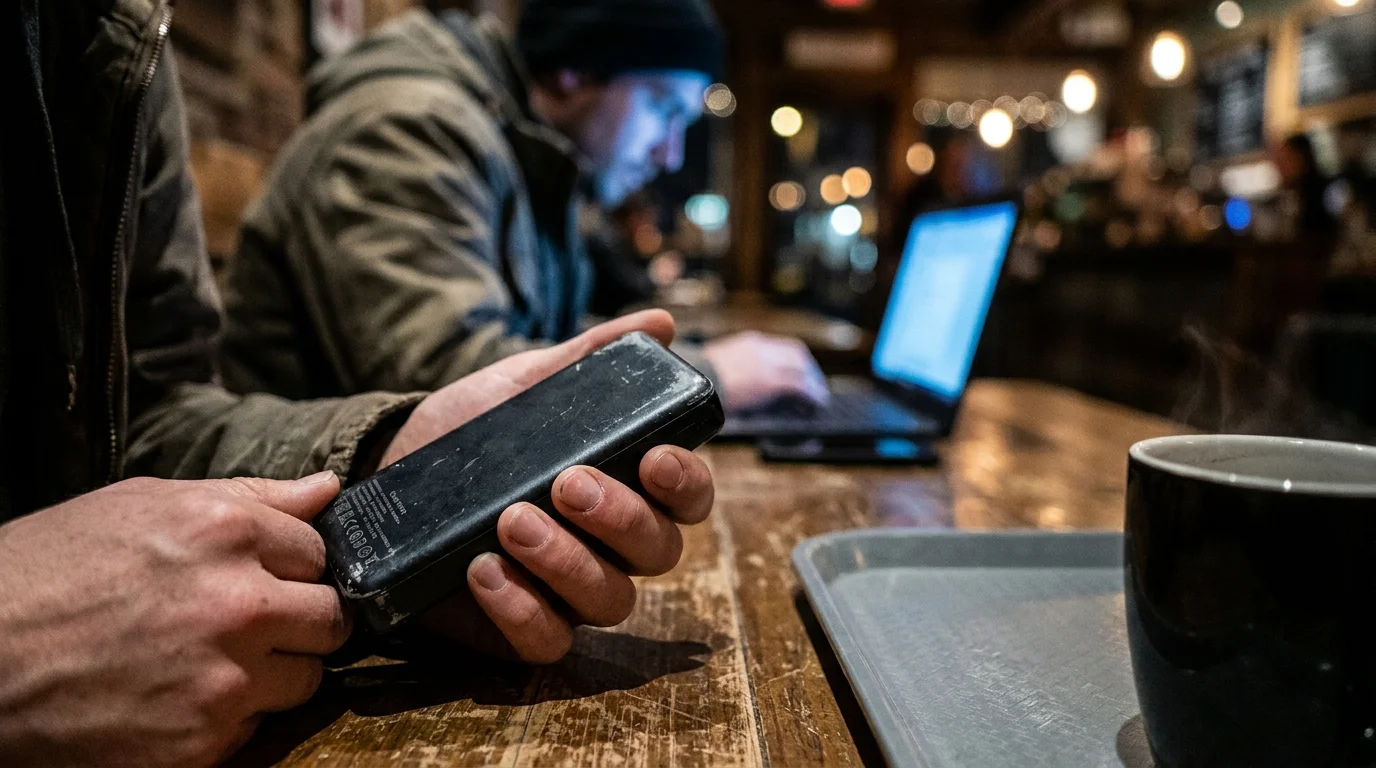
The security line at Terminal 3 moves in rhythmic shuffles, scored by the metallic squeak of roller bags and the hollow clatter of grey bins on stainless steel rollers. You drop your watch, your shoes, and your phone into the bin, dropping your matte-black Anker PowerCore into the corner like you have done on fifty flights before. It feels solid, dependable, and mundane—the silent companion that kept your laptop breathing on the overnight haul from Chicago to Frankfurt.
Then the bin halts inside the scanner tunnel. A gloved hand pulls it aside, fishing out the heavy rectangular brick and flipping it over beneath the harsh fluorescent lights of the inspection lane. Airport screeners scrutinize lithium batteries with increasing severity, looking past brand recognition to inspect tiny, faint technical typography stamped along the seam.
You expect a wave of the hand, but the officer shakes his head. The faint grey text on the underside of your charger has rubbed away over months of sliding across coffee shop tables and into neoprene sleeves. Without legible safety certifications or an explicit energy rating, international security protocol gives the screener zero leeway. The battery goes straight into the hazardous material disposal barrel, leaving you walking down the jet bridge facing a twelve-hour flight without a single watt of backup power.
Retail packaging conditions travelers to view portable chargers through the lens of device recharges: three full phone cycles, one tablet top-off, or rapid laptop delivery. Aviation safety regulators view that same hardware through a radically different metric: contained chemical energy capable of self-sustaining thermal runaway at thirty thousand feet.
The Math Behind the Gate: Translating Retail Specs to Aviation Law
Consumer electronics brands market their hardware using milliamp-hours because large numbers sell accessories. A battery stamped with ‘26,800 mAh’ feels substantially more capable to a buyer than one labeled ‘99 Wh,’ even though both describe the exact same physical energy capacity. The Federal Aviation Administration and the International Air Transport Association do not regulate current capacity over time; they regulate total energy potential expressed in watt-hours.
Think of milliamp-hours as the volume of water moving through a pipe, while voltage represents the pressure pushing it. A tiny hose spraying water under immense pressure carries far more volatile energy than a wide bucket spilling slowly across concrete. Watt-hours measure total stored punch, calculating how vigorously that internal lithium matrix will react if an internal separator wall fails in an unpressurized cargo hold or overhead bin.
The global baseline for commercial aviation is clear: any lithium-ion battery under 100 watt-hours is permitted in carry-on baggage without airline notification. Packs between 101 and 160 watt-hours require explicit, written airline pre-approval before check-in, capped strictly at two individual units per passenger. Anything exceeding 160 watt-hours—including heavy-duty outdoor power stations and oversized modular production batteries—is strictly forbidden on passenger aircraft under any circumstance.
- Amazon Echo Dot microphones record unintentional room chatter until voice history toggles flip
- iPhone 16 Pro camera lenses trap muddy digital artifacts under default sharpening profiles
- Starbucks Wi-Fi portals expose unencrypted device telemetry without rapid secure DNS toggles
- Dell UltraSharp monitors force neck strain without proper eye level riser alignment
- Calm app subscription trials trap drained checking balances behind confusing cancellation windows
The trouble begins when travelers purchase high-output bricks designed to power USB-C laptops. Premium multi-port Anker banks push right up against that 100 watt-hour legal ceiling, often landing at 99.6 or 99.9 watt-hours by design. When an airport screener cannot instantly read that specific decimal rating due to surface scuffs, the default regulatory assumption treats the unmarked battery as an uncertified hazard.
The Inspector’s Table: Insights from the Cargo Line
Marcus Vance, a 44-year-old aviation ground safety auditor based out of Dallas-Fort Worth, watches this breakdown repeat across every departure bank. His team monitors secondary bag screening and hazardous material reporting across transpacific departures, where heavy tech packs are standard issue for traveling engineers and digital nomads.
“Travelers believe that if a charger fits neatly in a backpack pocket or came from an airport kiosk, it has an automatic boarding pass,” Marcus explains while reviewing confiscated equipment logs. “They do not realize that screeners in Tokyo, London, or Singapore operate under zero-tolerance mandates. A faded regulatory label invalidates the most expensive charger on the shelf. If security staff cannot calculate the math on the plastic casing within five seconds, the device stays on the ground.”
Mapping Your Hardware: Three Travel Profiles
Understanding where your personal travel gear falls within transport regulations prevents painful gate-side forfeitures. Different trip demands call for different physical battery chemistries, and matching your equipment to your routing saves hours of checkpoint friction.
For the Weekend Light-Packer: If your transit profile revolves around short regional hops, city breaks, and single-day conferences, small pocket-sized banks (5,000 to 10,000 mAh) are practically bulletproof. These devices run on single or dual lithium cells operating at nominal 3.7 volts, yielding between 18.5 and 37 watt-hours. They sit so far below the international ceiling that screeners rarely look twice, making them ideal for brisk terminal navigation where convenience outweighs multi-day stamina.
The Long-Haul Remote Worker: High-capacity laptop companion packs (20,000 to 26,800 mAh) represent the critical friction zone. These heavy bricks deliver 74 to 99.1 watt-hours, engineered specifically to touch the absolute legal edge of unapproved flight transit. For flights through strict regulatory hubs—such as Beijing, Dubai, or Frankfurt—these units must feature pristine, crystal-clear factory text detailing their exact watt-hour specs directly on the plastic enclosure.
The Mobile Production Specialist: Photographers, field audio engineers, and drone operators frequently handle oversized modular bricks between 100 and 160 watt-hours. If your workflow demands this class of hardware, showing up unannounced at the security checkpoint invites immediate confiscation. You must notify your carrier forty-eight hours prior to departure, declare the hardware at the check-in desk, and carry physical documentation verifying carrier approval alongside insulated terminal protection caps.
The Pre-Flight Battery Audit: Practical Checkpoint Prep
Preparing your travel electronics requires the same attention you give to passport validity and visa requirements. A five-minute hardware audit at your desk eliminates security line arguments before they start.
Calculate the true rating of your hardware using standard aviation formulas before packing. If your charger lists capacity exclusively in milliamp-hours, calculate the watt-hours yourself using the nominal cell voltage (standardized at 3.7 volts for consumer lithium packs):
- Formula: (Milliamp-hours × Nominal Volts) ÷ 1,000 = Watt-hours
- Example: (26,800 mAh × 3.7V) ÷ 1,000 = 99.16 Wh
- Example: (20,000 mAh × 3.7V) ÷ 1,000 = 74.00 Wh
Once you verify that your battery falls below the 100 watt-hour threshold, inspect the casing under direct light. Preserve faint factory text stamps by applying a strip of heavy-duty clear packing tape over the specification block on the casing. This simple protective shield stops surface friction from wearing away the CE mark, the nominal voltage, and the watt-hour confirmation during rough bag transit.
Never pack loose lithium batteries in checked luggage. Checked bags enter unpressurized, fire-suppressed aircraft bellies where an undetected thermal runaway event cannot be reached by cabin crew extinguishers. Keep every lithium cell inside your carry-on bag, ensuring individual output ports are clean and isolated from loose metal items like keys, coins, or charging cable ends that could cause an external short circuit.
Tactical Toolkit for Air Transit
- Clear protective tape: Applied over factory specification blocks to prevent text erosion.
- Terminal covers or dedicated neoprene sleeves: Isolates USB-C and USB-A ports from foreign conductive debris.
- Manufacturer spec sheet: A downloaded offline PDF or screenshot of your specific Anker model page stored on your phone to resolve gate-side disputes.
- Airlines Special Baggage Declaration: Printed pre-approval paperwork if carrying hardware between 101 and 160 watt-hours.
Calm in the Departure Lounge
True travel confidence is rarely about packing more equipment; it stems from knowing precisely how your tools interface with the world around them. When you understand the safety realities that govern high-density lithium storage, you stop viewing security checkpoints as arbitrary obstacles and start navigating them as structured systems.
Stepping onto a long-haul flight with gear that is safe, verified, and legally compliant clears cognitive space for the journey ahead. Your bag slides smoothly through the scanner, your power remains securely tucked beside your seat, and you settle in for takeoff knowing your workstation will stay fully powered without a moment of friction at thirty thousand feet.
“Aviation safety regulations do not measure how convenient your charger is; they measure how much raw energy can destabilize in an overhead bin.”
| Key Point | Detail | Added Value for the Reader |
|---|---|---|
| 100 Wh Threshold | The global legal boundary for unrestricted carry-on power banks. | Eliminates risk of gate-side confiscation on standard commercial airlines. |
| Watt-Hour Conversion | Calculated as (mAh × 3.7V) ÷ 1,000 for standard consumer lithium cells. | Allows instant verification of unlabeled or ambiguous retail hardware. |
| Label Legibility | Screeners require readable physical factory print on the hardware casing. | Protects expensive tech accessories from automatic disposal policies. |
| Carry-On Mandate | Lithium batteries are strictly prohibited inside checked cargo luggage. | Prevents severe baggage delays, fines, and critical flight safety risks. |
Frequently Asked Questions
Can I bring a 30,000 mAh battery on a domestic flight?
Typically no. A standard 30,000 mAh lithium battery operating at 3.7 volts equals 111 watt-hours, which exceeds the standard 100 Wh limit and requires special airline pre-approval that is rarely granted for standard consumer power banks.What happens if the text on my power bank has worn off completely?
Security officers reserve the right to confiscate any battery whose specifications cannot be verified on the spot. If the label is illegible, screeners will treat it as non-compliant cargo regardless of the brand.Why are lithium batteries allowed in the cabin but banned from checked bags?
In the passenger cabin, flight attendants have specialized containment bags and extinguishers to quench lithium fires immediately. In the cargo hold, a thermal runaway event can burn unnoticed and penetrate surrounding luggage.How many power banks am I legally allowed to carry on board?
Most international regulators permit passengers to carry up to twenty spare batteries under 100 Wh for personal use, though individual airlines often impose stricter cabin limits (commonly two to four units).Does fast-charging capability affect airport security approval?
No. High-wattage power delivery (such as 65W, 100W, or 140W USB-C PD) describes charging speed, not stored capacity. Security screeners care strictly about stored capacity (Wh), not the speed of the output port.