A Friday evening sets in, the living room lights drop low, and your room settles into silence just as the display flares with the opening frames of an uncompressed 4K title. For months, the matte-black monolith sitting beside your media console remained completely imperceptible, venting warm air into the room with barely a murmur. But tonight, beneath the low orchestral swell of the opening score, a high-pitched mechanical drone begins to spool up like a distant jet engine.
You lean closer and feel an unexpected blast of intense heat pushing against your palm. The fan isn’t merely circulating air; it is fighting against an invisible barrier, sounding like someone desperately breathing through a heavy pillow. It is a frantic, resonant whine that signals your hardware is actively throttling its clock speeds to avoid thermal emergency shutdown.
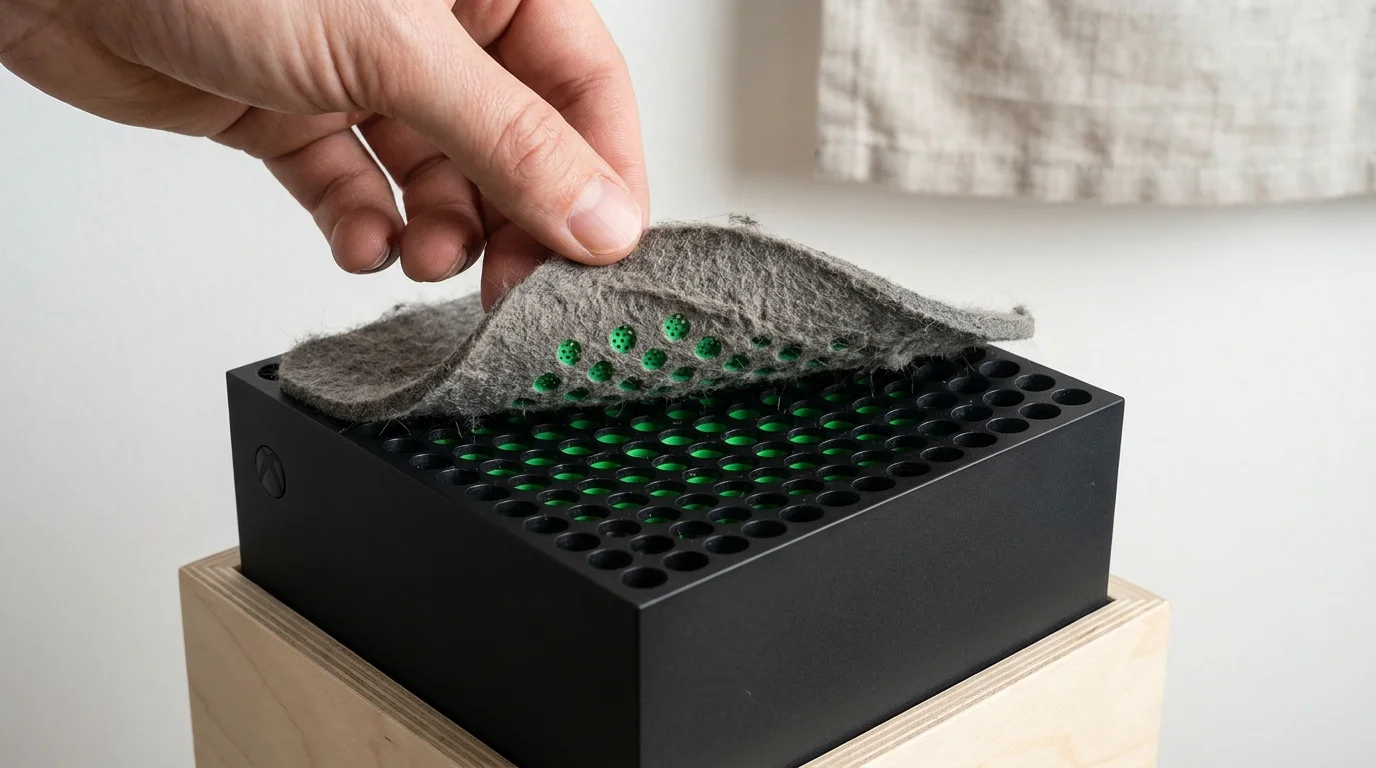
Look closely into the signature concave top lid under a flashlight. That subtle emerald hue painted along the inner rim is no longer crisp. Instead, a matted grey fiber blanket covers the circular exhaust ports, clinging to the plastic honeycomb like wet felt and trapping heat deep inside the silicon die.
The Monolith’s Chimney Illusion
Modern gaming consoles are engineered around a vertical convective chimney. Cool room air enters through the lower rear slots and bottom perimeter, travels upward over a split motherboard, strips heat from dense aluminum heatsink fins, and exits smoothly through the wide top exhaust. When the system sits undisturbed, this design delivers unmatched thermal efficiency with almost zero acoustic footprint.
However, that same vacuum creates a continuous floor-level intake loop. If your console sits on low shelving, an open hardwood floor, or anywhere near an area rug, it functions as a stationary air purifier. Over hundreds of hours, microscopic nylon rug fibers, ambient lint, and pet dander get drawn directly into the base intake vents, weaving themselves into a tight structural web across the cooling fins.
Many players assume that modern hardware stays clean unless placed inside a sealed cabinet. In reality, the intake vacuum is relentless. As that felt-like mat thickens, static pressure drops precipitously, forcing the single large axial fan to spin past its silent acoustic threshold just to push air through the choked core.
- Anker PowerCore batteries spark airport security confiscations exceeding airline watt hour limits
- Amazon Echo Dot microphones record unintentional room chatter until voice history toggles flip
- iPhone 16 Pro camera lenses trap muddy digital artifacts under default sharpening profiles
- Starbucks Wi-Fi portals expose unencrypted device telemetry without rapid secure DNS toggles
- Dell UltraSharp monitors force neck strain without proper eye level riser alignment
The View from the Repair Bench
Liam Vance, a 38-year-old hardware technician based in Seattle, spends his afternoons diagnosing consoles that suddenly black out during heavy gameplay loads. He notes that nearly eight out of ten overheating units that arrive at his counter have never had their warranty seals breached—they are simply suffocating under their own intake paths.
“People assume they need to completely disassemble the outer shell with Torx drivers the moment the fan gets loud,” Vance explains. “In almost every case, that is a mistake. The cooling assembly behaves like a lint trap in a clothes dryer; clear the perimeter intake slots and exhaust boundary from the outside before that fiber mat gets cooked solid against the radiator.”
Adapting Care to Your Living Space
Every living room exerts a unique environmental tax on vertical hardware. Tailoring your maintenance cadence to your specific layout prevents thermal throttling before it starts.
For the Low-Shelf Setup
If your console rests on a media bench less than twelve inches off the floor, dust settling rates are four times higher than on elevated surfaces. Check the lower rear slotted vents every four weeks. A quick sweep prevents airborne dust bunnies from migrating upward toward the vapor chamber.
For the Multi-Pet Household
Fine animal undercoats carry a natural static charge that makes fur cling tenaciously to plastic intake teeth. Inspect the top exhaust weekly. When stray hairs bridge the circular holes, they act as scaffolding for household lint, rapidly forming an impenetrable felt cover.
For the Hardwood Purist
Even without rugs, bare floors generate floating dust clusters whenever someone walks past the console. Raising the unit just two inches using firm silicone audio isolation feet prevents the base perimeter from inhaling sweeping debris.
Clearing the Vents Without Breaking Seals
Restoring acoustic silence does not require tearing down plastic clips or voiding factory protections. A deliberate, gentle exterior protocol clears the airflow channel without sending internal components spinning out of balance.
- Cut the power feed: Unplug the AC power cord and HDMI cable completely, then hold the front power button for seven seconds to drain the motherboard capacitors.
- Immobilize the fan blades: Slip a slender wooden toothpick gently through the top exhaust mesh to hold the fan blade stationary. Never allow a vacuum or compressed air stream to spin the internal fan freely, as this can induce reverse electrical current into the fan header.
- Clear the rear perimeter: Using a soft-bristled goat-hair or nylon detailing brush, sweep across the rear slotted intakes at an angle, pulling dust clusters outward rather than pushing them inward.
- Vacuum with low static draw: Attach a soft brush head to your household vacuum hose. Hold the nozzle two inches away from the top exhaust to lift away dislodged surface fibers without generating static discharge near sensitive ports.
- Wipe the intake rim: Finish by wiping the outer matte chassis with a slightly damp microfiber towel, ensuring zero moisture enters the intake grilles.
The Tactical Toolkit: Keep a natural-bristle lens brush (0.5-inch diameter), a pack of flat wooden toothpicks, and an anti-static microfiber cloth tucked inside your media cabinet for a two-minute monthly maintenance routine.
The Long-Term Dividend of Quiet Silicon
Taking ten minutes to clear an intake channel is rarely about basic housekeeping. It is about protecting the delicate solder joints under your graphics processor from aggressive thermal cycling, where temperatures swing wildly between cool idle and boiling loads.
When air moves uninhibited through the internal chimney, your console returns to what it was designed to be: an invisible, silent engine that lets you get lost in other worlds without the constant mechanical reminder of its struggle.
The quietness of your console is never an accident of engineering; it is an ongoing partnership between your room’s airflow and clean intake ports.
| Key Point | Detail | Added Value for the Reader |
|---|---|---|
| Airflow Architecture | Vertical chimney design pulling intake air from rear bottom ports. | Explains why floor placements clog twice as fast as elevated shelves. |
| Fan Protection | Secure the internal blade with a wooden pick during exterior cleaning. | Prevents back-EMF voltage spikes that burn out motor controllers. |
| Chassis Integrity | Clear exterior mesh slots without removing factory screws or stickers. | Maintains full manufacturer warranty protection and structural fit. |
Frequently Asked Questions
Can I use high-pressure canned air directly into the top vent?
Avoid blasting compressed air straight down into the top circular exhaust. Doing so drives the matted dust sheet deeper into the heatsink fins, compacting it into a solid blockage that cannot be removed without a full teardown.How do I know if my fan noise is normal or a sign of dust buildup?
A soft, steady rush of air during heavy rendering is normal. A high-pitched fluctuating whine, or a fan that immediately kicks into maximum speed within five minutes of loading a title, indicates airflow restriction.Does positioning the console horizontally solve the dust problem?
Laying the console flat changes the intake profile but does not stop dust accumulation. While it slightly reduces falling lint on the exhaust, the lower side vents remain close to shelf surfaces and still require regular brushing.Will clearing the vents fix random console shutdowns?
If your console powers down abruptly with an on-screen warning regarding ventilation or thermal protection, clearing the choked vents will usually resolve the emergency shutdown loop immediately.How often should this exterior cleaning process be performed?
In standard homes, a gentle exterior brush-down every ninety days keeps the cooling channels clear. In homes with shedding pets or thick carpeting, inspect the intake grilles every thirty days.