The damp heat of a garage gym at dawn smells of rusted iron plates and cold concrete. You are forty minutes into a steady, metronomic workout, breathing through your nose, your legs turning over with rhythmic ease. Then you glance down at your smartphone display or check your recovery dashboard, and the screen claims your heart is hammering at 182 beats per minute. You feel your neck pulse; it is calm, steady, barely clearing a relaxed jog. Yet the tracker insists you are on the threshold of cardiovascular failure.
That phantom spike is not a flaw in your conditioning, nor is it a sudden cardiac anomaly. When microscopic layers of sebum blend with salt, they transform into an accidental optical prism beneath the sensor, bending the green and infrared light away from your capillaries.
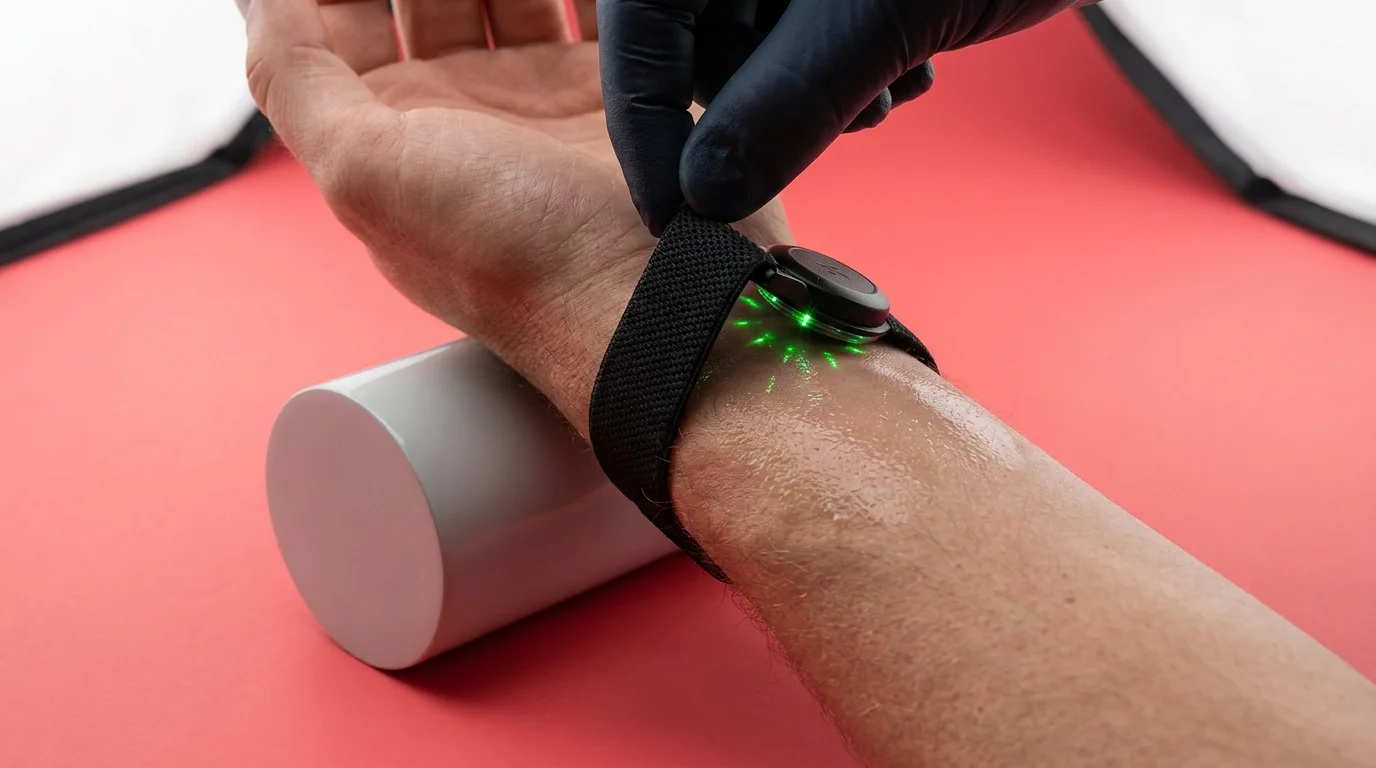
We wear these screen-free woven bands precisely because they promise invisible, continuous truth. You sleep in them, shower with them, and push through high-cadence intervals without a second thought. But behind that textured fabric weave sits a cluster of microscopic photodiodes attempting to read tiny blood volume pulses through translucent flesh. When everyday human grease meets intense perspiration, the clean optical window turns into an oily mirror.
The Liquid Prism: Why Salt and Sebum Blind Photodiodes
To understand why your wearable hallucinates wild spikes during moderate exertion, you have to picture how photoplethysmography works. The device floods your dermis with specific wavelengths of green and infrared light, measuring the minute fluctuations as blood surges and ebbs with every beat. Under dry, clear skin, that light travels in a direct, predictable beam straight into your capillary bed and reflects cleanly back to the photodiode receptors.
Introduce sweat, and the equation changes. Sweat alone is mostly water and dissolved sodium, which creates subtle signal scattering. But your skin also naturally exudes sebum, a dense lipid matrix designed to waterproof your dermal barrier. When sebum emulsifies with warm sweat, it forms a microscopic, translucent film with a radically different refractive index than air or dry skin.
Think of looking at a pebble resting at the bottom of a still, crystal pool versus trying to track that same pebble through churning, soapy dishwater. The light pulses from the sensor strike this greasy emulsion and scatter across the surface of your wrist rather than penetrating your tissue. Starved of an authentic vascular rhythm, the tracker’s onboard tracking algorithms enter a state of optical hunt. They lock onto the rhythmic swinging of your arm or the vibrations of your footfalls, mistaking mechanical movement for an explosive cardiac surge.
- Baseus GaN chargers scorch smartphone battery health without overnight trickle charging switches
- Microsoft Authenticator app blocks catastrophic SIM swap takeovers stripping vulnerable SMS codes
- Pixel Buds Pro silence crackling audio dropouts through rapid Bluetooth cache resets
- iCloud Photo Library deletes irreplaceable family camera rolls during hasty phone trade-ins
- Hisense Google TVs silence sluggish autoplay video ads through hidden account toggles
The Track Coach Who Stopped Trusting the Dashboard
Elena Rostova, a 42-year-old masters rowing coach from Seattle, spent two months logging bizarre cardio spikes that skewed her entire training block into red-zone overreach. Her recovery score plummeted every Tuesday morning during routine steady-state sculling, indicating severe systemic strain despite her resting heart rate sitting at a comfortable 52 bpm. It was only after analyzing her skin contact logs with an exercise physiologist that she realized the mineral sunscreen and natural skin oils accumulated along the crest of her wrist bone were bending the sensor’s LEDs mid-stroke.
Calibrating the Contact: Three Skin Micro-Climates
Not every wrist produces the same dermal environment, and treating your tracker as a one-size-fits-all band guarantees corrupted telemetry. Depending on your skin biology and movement style, you must adjust how you wear the hardware.
For the Heavy Sweater
If your workouts leave puddles on rubber floor mats, liquid pooling is your primary obstacle. Standard fabric loops hold moisture against the skin like a wet sponge, feeding the optical prism. You need breathable synthetic weaves that wick moisture laterally away from the sensor chassis rather than trapping it underneath the sensor glass.
For the Naturally Sebum-Rich Skin Profile
If your skin naturally produces a thicker lipid barrier, simple water won’t rinse away the optical haze between workouts. Residual oils create a permanent haze across the sensor window that attracts airborne lint and microscopic debris, degrading signal clarity even during deep sleep when you aren’t sweating at all.
For the Cold-Start Athlete
In cooler weather, your peripheral blood vessels constrict to keep your core warm, a process known as peripheral vasoconstriction. In this state, capillary pulses are faint, making the sensor dramatically more vulnerable to refractive interference from dry flaking skin and stale lotion residue.
The Mindful Reset: The Two-Finger Placement Protocol
Restoring laboratory-grade accuracy does not require buying specialized accessories or abandoning your wearable. It requires treating the sensor interface with the deliberate care of a camera lens. A few minimalist adjustments before each session will eliminate erratic data artifacts entirely.
Begin by moving the device away from your wrist bone. The ulnar head creates a bony shelf that allows ambient light to leak under the housing whenever your wrist flexes. Slide the band up your forearm by exactly two finger-widths—measured from the crease of your wrist.
- Measure the clearance: Place the index and middle finger of your opposite hand against your wrist joint crease; sit the bottom edge of the sensor directly above your index finger.
- Check the tension: The band should not pinch or blanch the skin, but you should not be able to slide a pinky finger under the sensor pod without firm resistance.
- Clean the optical window: Wipe the glass housing before every session with a damp microfiber cloth, never with coarse gym shirts or paper towels that leave microscopic scratches.
- Degrease the skin contact zone: If you use body lotions or thick mineral sunscreens, wash the inner forearm with plain, unscented castile soap before strapping in.
Your wrist expands slightly during intense efforts as blood volume increases and body temperature climbs. Setting the band snug before you walk out the door ensures that as your skin warms, the sensor maintains uniform contact without relying on brutal, circulation-cutting tightness.
The Tactical Toolkit for Clear Biometrics
Keep these specific benchmarks in your daily routine to maintain uncompromised biometric feeds across long training cycles:
- Placement distance: 1.0 to 1.5 inches (two full finger widths) proximal to the ulnar prominence.
- Sensor wipe cycle: 10 seconds of targeted cleaning with 70 percent isopropyl alcohol once every seven days to strip built-up sebum glaze.
- Band drying protocol: Swap between two alternating bands so the textile weave dries completely over 24 hours between sessions.
- Skin prep: 0 percent lotion or topical oil on the sensor zone for at least two hours prior to high-output activity.
The Bigger Picture: Trusting the Body Over the Glass
We live in an era of hyper-quantified wellness, where a single erratic chart line can make you doubt your breath, your stamina, and your physical resilience. When your wrist tracker reports an inexplicable heart rate spike, your natural instinct is to question your internal health rather than the small piece of glass strapped to your arm.
Understanding how sweat, oil, and physics interact puts the control back where it belongs. Technology serves you best when you understand its physical boundaries, recognizing that even the most advanced biometric sensor is ultimately an optical instrument subject to simple laws of light and reflection. When you clear the lens and place it where the pulse actually runs true, the data stops being a source of digital anxiety and becomes the silent, steady mirror it was always meant to be.
Optical biometrics do not lie, but an oily lens will bend the clearest truth into an alarming fiction.
| Key Point | Detail | Added Value for the Reader |
|---|---|---|
| Optical Emulsion | Sweat mixes with skin lipids to refract green LED light beams away from capillaries. | Explains why heart rate spikes happen even when you feel physically calm. |
| Ulnar Bone Gap | Wearing bands directly over the wrist bone allows ambient light leakage during joint flexion. | Pinpoints the physical reason why traditional watch placement fails sports trackers. |
| Two-Finger Rule | Positioning the sensor 1.5 inches above the wrist crease onto vascular muscle tissue. | Instantly stabilizes photodiode reception without overtightening the strap. |
| Textile Hygiene | Woven straps trap sebum and salts, continuously redepositing oil onto the optical glass. | Prevents phantom data creep by establishing a simple weekly wash routine. |
Frequently Asked Questions
Why does my heart rate spike to 180 bpm during an easy warm-up jog?
Your tracker is likely suffering from cadence lock, where skin oil scattering allows the sensor to mistake your rhythmic footsteps for heartbeats.How tight should my fabric tracker band actually feel?
It should rest flat against your arm without indenting flesh deeply; you should feel firm contact without skin discoloration or restricted blood flow.Can I wash the optical sensor glass with regular hand soap?
Yes, mild dish soap or castile soap works well to dissolve grease, but avoid harsh moisturizing bar soaps that leave an oily residue behind.Does body hair under the sensor cause the same pulse spikes?
Dense hair creates air pockets that scatter light similarly to sweat films, which is why moving the tracker to the smoother inner forearm often solves the issue.Why do these erratic readings happen more in summer than in winter?
Higher ambient temperatures accelerate sebum liquefaction and heavy sweating, creating the reflective oil emulsion much faster during training.