The wall adapter feels warm enough to toast bread on a crisp morning, humming with an almost imperceptible, high-frequency coil buzz. You plug the thick red cable into your phone, and the lock screen flares to life with a kinetic swirl of neon numerals: eighty watts, one hundred watts, or perhaps even one hundred and fifty watts. Within twenty-five minutes, your battery percentage climbs from an anxious single digit to a full tank, offering the illusion of modern mechanical magic.
We have grown used to treating smartphone power like tap water—an infinitely flowing resource that rushes into a basin without consequence. When your phone promises to fill its entire cell during the time it takes you to brew a pot of coffee, you naturally assume the engineers solved the laws of thermodynamics. Rapid voltage delivery feels weightless in the palm of your hand, sleek and frictionless.
Yet deep beneath the polished curved glass and the aluminum mid-frame, that lightning-quick charge resembles something far more brutal. Inside the sealed pouch of your lithium-ion cell, extreme kinetic forces drive raw ions through porous membranes at breakneck velocity. What presents itself on your display as clean software optimization is, on an atomic level, a violent physical collision.
The Firehose and the Sponge: Rethinking High-Wattage Current
Imagine trying to hydrate a dry kitchen sponge not by placing it gently under a trickling faucet, but by striking it with the full blast of a municipal firehose. The water certainly enters the pores, but the sheer hydrodynamic shock tears the structural fibers of the sponge apart, leaving behind ragged tears that never quite heal.
This is precisely what aggressive proprietary charging protocols like OnePlus SuperVOOC accomplish within modern multi-cell arrays. Rather than stepping power down gently, these systems push high amperages across dual-cell configurations to bypass traditional thermal cutoffs. Violent ionic migration forces cathodes to expand and contract unevenly during peak current bursts.
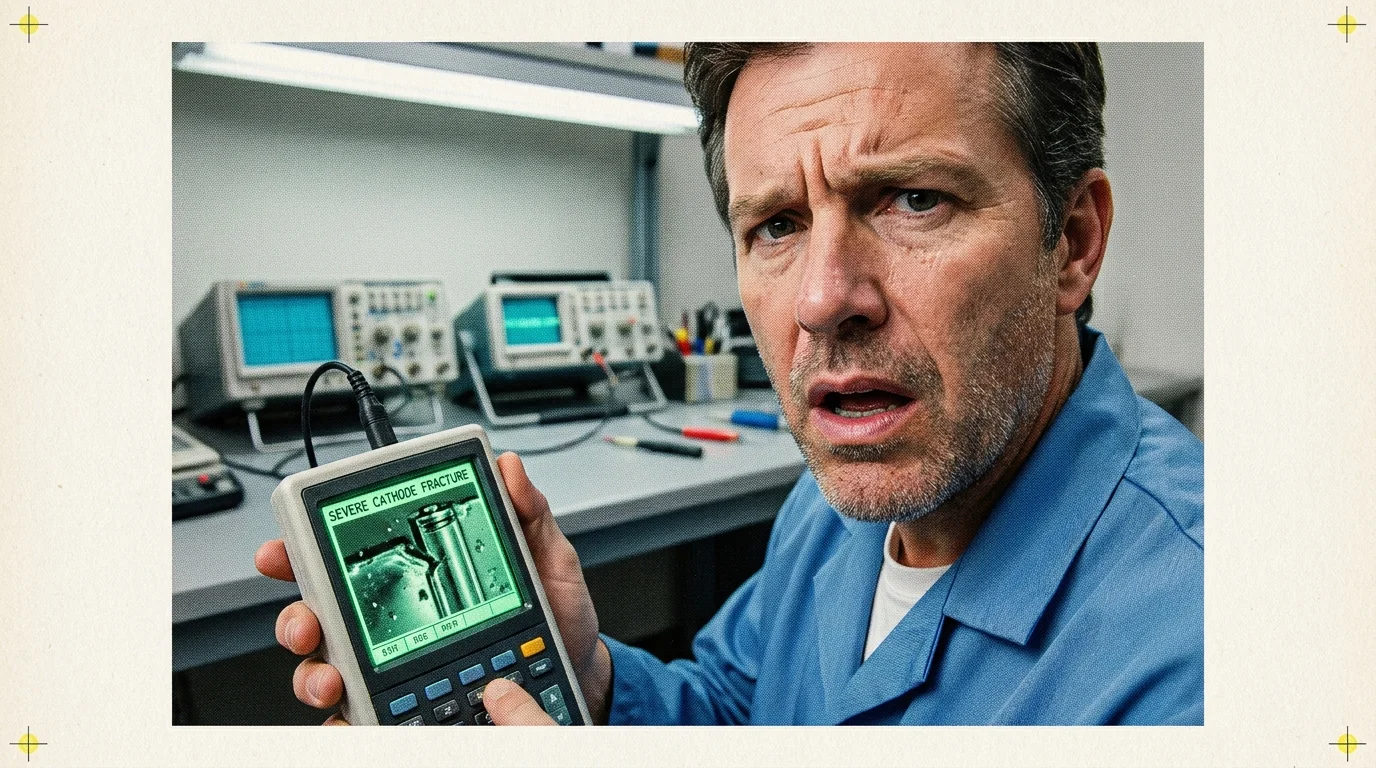
Every time you blast your battery with maximum wattage from zero percent, the layered crystal structure of the lithium nickel manganese cobalt oxide cathode experiences sudden lattice strain. Over dozens of cycles, this mechanical stress creates microscopic fissures—sub-micron cathode fracturing. Once a fracture forms, active lithium ions become permanently trapped in chemical dead zones, isolated from the electrical grid forever.
- Slack desktop cache bloat traps gigabytes of hidden crash logs across solid-state drives
- James Earl Jones AI voice deals secure permanent legacy rights across digital media
- Twitch Partner streamers confront sudden revenue cuts as platform slashes payout tiers
- Humane AI hardware pivots toward enterprise licensing after brutal wearable launch returns
- Daylight Computer tablets spark viral waitlists with glare-free paper display screens
Dr. Julian Vance, a 46-year-old battery electrochemist based in Boulder, Colorado, spent years analyzing teardown modules from returned warranty handsets. He often shows his graduate students microscopic cross-sections of degraded cobalt cathodes under an electron microscope, where pristine crystalline sheets end up looking like cracked mud under a desert sun. Julian keeps an old five-watt trickle charger beside his nightstand, entirely ignoring the ultra-fast power brick packaged in his phone box, noting that mechanical pacing always beats electronic brute force when you care about long-term material integrity.
Tailoring Your Daily Current: Three Profiles of Power
Your battery does not degrade on an even, predictable timeline; it reacts directly to your charging habits and ambient room temperature. Understanding how your specific routine interacts with thermal voltage stress lets you adjust your habits without turning battery care into a full-time obsession.
The Desk-Bound Worker
If you spend eight hours a day within arm’s reach of a standard wall outlet or computer USB port, fast charging serves no practical purpose. Subjecting your device to repeated 80-watt voltage spikes while checking emails simply inflicts needless cathode lattice strain. Running a standard, low-wattage legacy brick keeps the pack cool and preserves crystalline structures for years.
The Commuter and Road Warrior
Those who rely on short layovers, rideshares, and unpredictable field days genuinely benefit from the rapid turnaround of high-wattage charging. In these moments, fast charging serves as a utility bridge rather than an everyday crutch. The goal is not to eliminate fast charging entirely, but to reserve maximum wattage bursts strictly for emergencies when you have fifteen minutes before boarding a flight.
The Overnight Sleeper
Plugging an ultra-fast charger into your phone on the bedside table creates an unnecessary thermal penalty. Your phone hits one hundred percent while you are in your first cycle of deep sleep, leaving the electrolyte matrix sitting at peak cell voltage and elevated heat for six straight hours. Slow, unhurried overnight current eliminates this structural fatigue completely.
Mindful Current Management: The Low-Stress Protocol
Restoring balance to your charging routine does not require you to monitor battery graphs or download clunky diagnostic utilities. It comes down to a few tactile adjustments that respect the physical chemistry inside your pocket.
First, inspect your hardware drawer and locate a legacy 5-volt, 1-amp or 2-amp power brick—the familiar little cubes from an older generation of electronics. Pair this with a durable USB-A to USB-C cable for your regular nighttime charging station. Cool nighttime trickle charging protects fragile electrode layers from expanding during rapid thermal spikes.
- Disable proprietary rapid charging switches in your device battery settings unless you are running late.
- Remove thick silicone cases before high-wattage top-offs to allow radiant heat to escape the chassis.
- Avoid charging your phone in direct sunlight, warm cars, or buried under pillows.
- Unplug once your phone reaches eighty or eighty-five percent during daily maintenance charges.
Keep your SuperVOOC adapter inside your travel bag or glove box instead of your bedroom nightstand. That simple physical boundary prevents you from habitually hitting the battery with an electronic sledgehammer when a light tap would easily suffice.
• Ideal Cell Temperature Range: 60°F to 85°F (15°C to 29°C)
• Recommended Nighttime Power Delivery: 5W to 10W standard USB-A
• Emergency Burst Window: 15 to 20 minutes maximum under SuperVOOC
• Optimal Cycling Zone: Keep the battery resting between 20% and 80% charge
The Bigger Picture: Resisting the Velocity Trap
Our gadgets constantly push us toward higher speeds, convincing us that saving three minutes at a wall outlet represents unvarnished progress. We trade the long-term health of our hardware for fleeting convenience, throwing devices into premature recycling bins when their usable capacity falls off a cliff after eighteen months.
Slowing down your power delivery is a quiet rejection of that disposable mindset. When you allow your phone to absorb energy gently, you preserve the physical integrity of the raw materials mined from the earth to build it. Patience extends physical hardware far beyond the synthetic expiration dates engineered by consumer turnover cycles.
There is a quiet satisfaction in unplugging a phone that has charged quietly through the night without turning into a miniature hand warmer. You step out the door with a battery that retains its resilience not just today, but three hundred mornings from now.
The greatest enemy of battery longevity is not cycle count, but the sheer thermal violence of unnecessary speed.
| Key Point | Detail | Added Value for the Reader |
|---|---|---|
| Cathode Micro-Fracturing | High current forces rapid ion insertion, physically cracking lithium crystal structures. | Reveals why fast-charged phones drop off sharply in capacity after the first year. |
| Thermal Accumulation | SuperVOOC transfers substantial wattage that elevates core temperatures above 95°F. | Helps you spot environmental heat hazards before cell damage becomes irreversible. |
| Low-Wattage Overnight Charging | Using legacy 5W bricks keeps the chemical matrix calm and mechanically stable. | Eliminates morning battery degradation without changing your sleep schedule. |
Frequently Asked Questions
Does using a SuperVOOC charger occasionally ruin my phone?
Not at all. Modern lithium cells handle occasional fast charging easily. The structural damage occurs when rapid wattage spikes become your primary, everyday charging method.Why do manufacturers include high-wattage bricks in the box?
Fast charging speeds make for compelling marketing benchmarks and flashy retail demonstrations. Device brands prioritize immediate convenience over four-year hardware lifespans.Does stopping the charge at 80% genuinely help?
Yes, the highest structural and voltage tension on cathode layers happens between 80% and 100%. Limiting top-offs significantly slows down crystalline wear.Will a low-wattage charger harm my fast-charge capable phone?
Never. Modern smartphones automatically negotiate power delivery, safely drawing low current without causing electrical errors or hardware strain.Can software updates fix fractured cathode material?
No. Once the microscopic crystalline structure shears and traps lithium ions, that capacity is permanently lost at a chemical level.