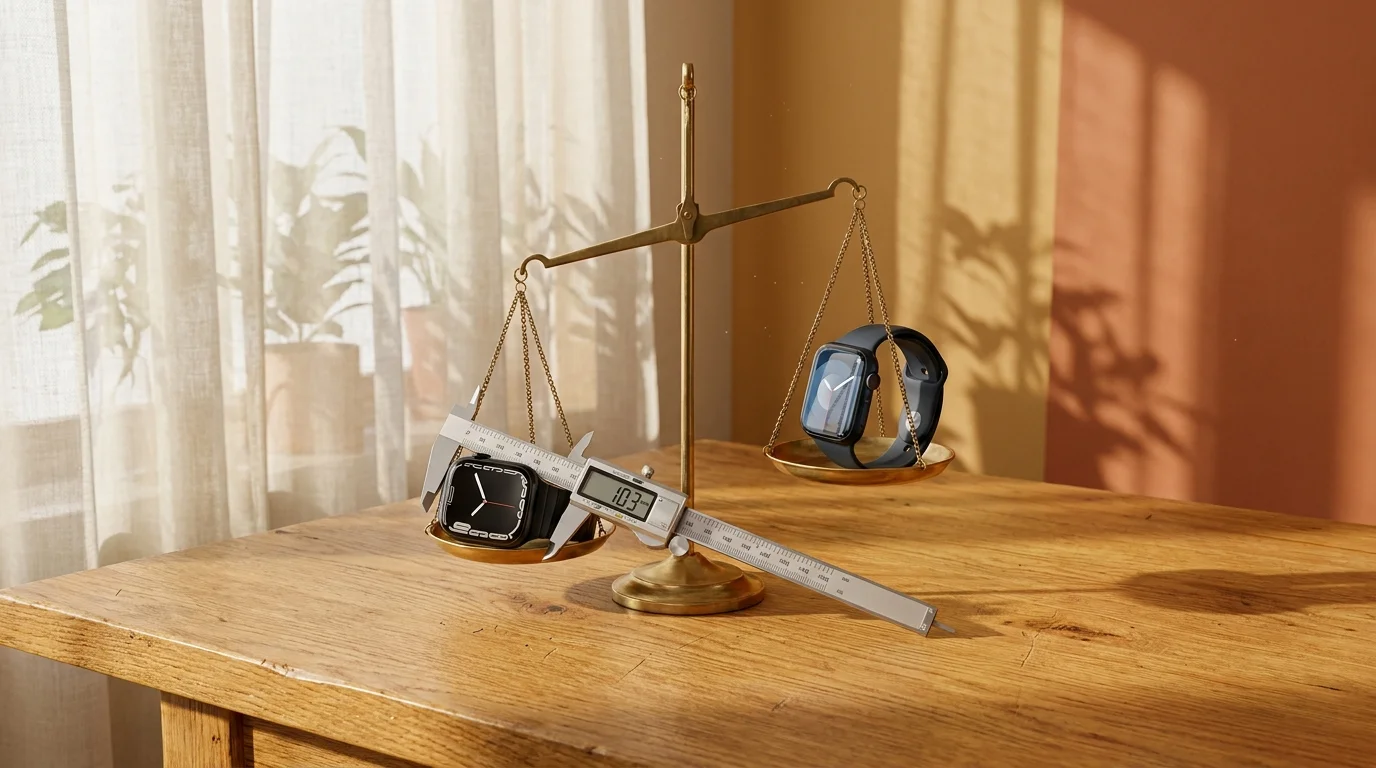
The magnetic charging puck snaps against the curved composite back with a familiar, muted clack. Dawn filters across your desk in pale gray ribbons, illuminating two square screens resting shoulder to shoulder on a wooden tray. To an untrained eye, they seem identical, resting like twin river stones carved from dark slate.
Slip the Apple Watch Series 10 onto your wrist, and the first sensation is purely tactile: it sits flatter against your skin, shaving away a single millimeter that makes long-sleeve cuffs slide past with slightly less friction. Yet as your fingers tap the glass to begin your morning run, the interface greets you with the exact rhythm, haptic click, and visual architecture you relied on throughout the previous year. That shaved millimeter carries a steep retail premium that demands careful scrutiny before you tap your wallet against the payment terminal.
Consumer product cycles thrive on creating subtle optical shifts that convince our instincts we have fallen behind the technological curve. When you look past the polished chamfers and the newly widened viewing angles, the actual data pipelines feeding your wrist reveal an entirely different story. The heartbeat keeping pace with your morning stride is measured through an engine that has reached a mature, quiet plateau.
The Illusion of Sculpted Metal
Upgrading consumer hardware today often resembles paying an extravagant sum to repaint a high-performance vehicle while leaving the powertrain untouched under the hood. The Series 10 makes a compelling visual argument by reducing case thickness and offering a screen that radiates brighter light when viewed from extreme off-axis tilts. In daily operation, however, your eyes rarely inspect workout splits or text notifications at a seventy-degree angle while your arms swing through a brisk jog.
The internal silicon—the S10 System in Package—shares the exact computational DNA and neural processing cores as the S9 chip before it. Benchmarking real-world app launch speeds, interface latency, and Siri voice parsing yields differences measured in fleeting milliseconds that vanish in ordinary life. Silicon development has hit an efficiency ceiling where routine tasks fail to stress modern wearable architecture, leaving the physical chassis to do the heavy marketing lift.
By treating chassis geometry as the primary justification for an upgrade cycle, technology manufacturers quietly admit that health sensor breakthroughs are moving at a clinical, deliberate pace rather than an annual consumer gallop. When you strap on a smartwatch, you are buying a biometric monitor, not merely an ornament. If the sensor hub fails to extract deeper truth from your bloodstream, the newer shell remains an aesthetic luxury rather than an actionable tool.
- PayPal security texts trick mobile users into surrendering private account passwords
- Samsung One UI settings silence aggressive background battery drain across phone displays
- Bose QuietComfort headphones trigger dull eardrum ache during long active noise cancellation sessions
- Netgear Nighthawk routers trigger stuttering video streams as crowded 6GHz bands drop packets
- Amazon Kindle e-readers wipe downloaded libraries leaving blank e-ink screens overnight
The Telemetry Bench Test in Boulder
Marcus Vance, a 38-year-old biomechanics research technician based in Boulder, Colorado, spent three weeks running dual-wrist telemetry logs across mountain trails and stationary ergometers. Fastening a Series 9 to his left wrist and a Series 10 to his right, Vance mirrored continuous heart-rate samples, blood oxygen absorption logs, and cadence patterns through third-party raw-telemetry extraction tools. The resulting comparative spreadsheets showed an operational variance of less than 0.8 percent across both devices under heavy anaerobic load.
His findings revealed that the heart-rate sensor module in the Series 10 relies on the same third-generation optical architecture deployed in the preceding model. While the acoustic speaker array received an overhaul to allow direct audio playback without earbuds, the core biological data streams remained functionally identical. Paying several hundred dollars extra yields identical cardiovascular telemetry, confirming that last year’s hardware provides parity for serious training.
Auditing the Wrist for Your Daily Reality
Every individual maintains a distinct physiological relationship with their wearable, and your daily environment dictates whether hardware changes matter at all. Rather than accepting sweeping generalizations, consider how your specific lifestyle interacts with the physical wrist unit throughout twenty-four hours.
For the Endurance Athlete: If you measure your days in trail miles and elevation gain, battery endurance forms the bedrock of your routine. The slimmer casing of the Series 10 forces a slightly smaller physical battery cell, which Apple counterbalances using a marginally more efficient wide-angle display panel. Real-world multi-hour GPS tracking drains both models at roughly identical rates, meaning the Series 10 offers zero extra margin during an extended backcountry hike.
For the Sleep and Recovery Tracker: Overnight wear reveals the lone practical advantage of the redesigned geometry. The thinner profile catches less against bedsheets, making it noticeably less obtrusive for light sleepers who want accurate sleep-stage charting. Yet the sleep apnea detection feature heavily promoted for the Series 10 was deployed via software to the Series 9 as well, granting the older watch identical overnight diagnostic utility.
For the Everyday Commuter: City navigation and office routines rely on wrist vibrations, quick calendar checks, and contactless transit payments. In these quiet moments, the widened viewing angle of the newer display allows you to glance at a meeting reminder without fully twisting your forearm. This tiny ergonomic convenience remains the primary daily benefit you will experience, making it difficult to justify spending retail prices when certified older inventory trades at deep discounts.
The Hardware Value Audit Protocol
Before committing your budget to the latest showroom hardware, run your purchase through a deliberate diagnostic checklist. This prevents marketing momentum from overriding real-world fiscal utility.
- Inspect the price gap: Certified refurbished or clearance Series 9 units routinely surface between $100 and $150 below the baseline Series 10 sticker price.
- Evaluate display visibility: If your current watch features an always-on display, you already possess ninety percent of the legibility benefits found in the newer panel.
- Examine sensor requirements: Both generations track depth down to six meters and include water-temperature sensors, matching recreational water sports utility.
- Audit charging routines: The Series 10 charges to eighty percent roughly fifteen minutes faster, which matters exclusively if you forget to charge your device during your evening shower.
The Tactical Hardware Toolkit: When comparing both devices side by side, specific metrics matter far more than keynote adjectives. The Series 9 provides 1,000 to 2,000 nits of peak brightness, a 64-bit dual-core processor, and an 18-hour continuous battery baseline. The Series 10 increases peak off-axis brightness by forty percent and trims case thickness by 1.1 millimeters, while leaving total computational throughput, internal storage (64GB), and optical diagnostic capabilities completely intact.
Freedom from the Annual Upgrade Carousel
There is quiet satisfaction in wearing technology that has settled into its mature form, freed from the frantic urge to chase every fractional revision. When a device sits on your wrist day after day, gathering the rhythm of your heart and the tally of your steps, its value springs from reliability rather than novelty. A discounted previous-generation model delivers the exact same operational awareness while leaving your personal capital intact.
By choosing hardware based on internal telemetry rather than casing contours, you step outside the modern consumer trap of paying premium rates for cosmetic adjustments. True digital efficiency means extracting the highest functional yield from tools that serve your health without inflating your monthly expenses. The Series 9 remains an exquisite piece of micro-engineering that matches its successor beat for beat, proving that true utility rarely needs a yearly redesign to prove its worth.
The smartest upgrade in personal technology is often the model released twelve months ago, which carries identical capability at a fraction of the cost.
| Key Point | Detail | Added Value for the Reader |
|---|---|---|
| Biometric Sensor Array | Third-generation optical heart sensors present on both models | Identical cardiovascular metrics without paying flagship pricing |
| Chassis Thickness | Series 10 is 9.7mm thick; Series 9 measures 10.7mm | Slightly less cuff friction, but minimal functional impact |
| Processing Silicon | S10 architecture matches S9 compute and neural speed | Zero discernible lag difference during daily application navigation |
| Battery & Charging | Both hit 18 hours; Series 10 charges ~15 minutes faster | Negligible routine difference for overnight or desk charging habits |
Frequently Asked Questions
Does the Series 10 track health metrics that the Series 9 cannot detect? No, both smartwatches share the same core biometric telemetry hardware, including heart rate tracking, ECG capture, cycle tracking, and sleep apnea notifications enabled via watchOS.
Is the wider display on the Series 10 worth the price difference? For most users, no. While the screen is brighter when viewed from sharp angles, the direct viewing experience matches the Series 9 in everyday clarity and functional resolution.
Will the Series 9 continue to receive software updates? Yes, Apple historically supports watch hardware with major watchOS revisions for four to five years, ensuring the Series 9 remains fully modern for years to come.
How noticeable is the thinner design during daily wear? The 1.1-millimeter reduction is noticeable when sliding tight jacket sleeves over your wrist, but it feels virtually identical during workouts and casual use.
Can the Series 9 play audio directly through its internal speaker like the Series 10? No, the Series 10 includes a redesigned acoustic driver that plays podcasts and music directly from the watch body, whereas the Series 9 requires Bluetooth headphones for media playback.