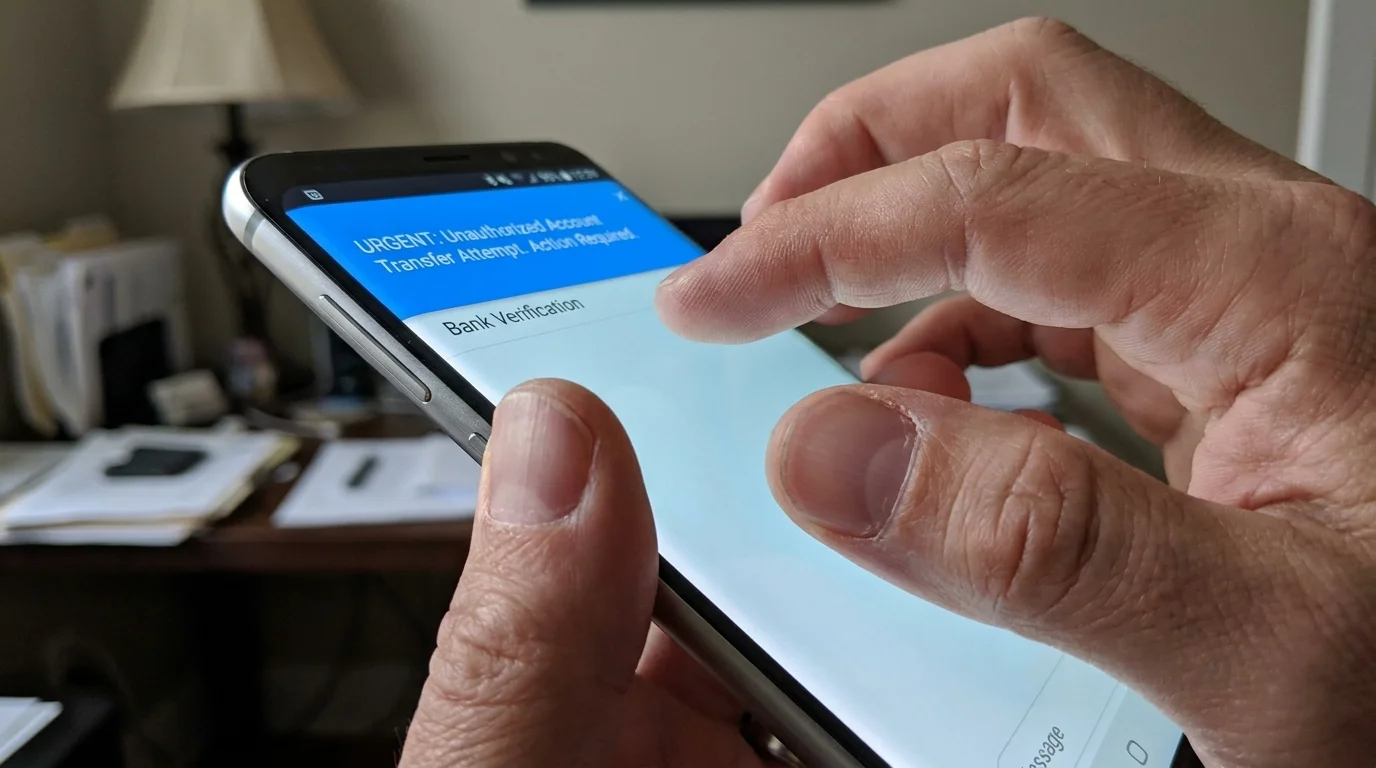
It is 8:14 on a damp Tuesday evening. The living room smells faintly of steeped peppermint tea and cool rain tapping against the window pane. Your phone buzzes against the coffee table—a sharp, twin-pulse vibration that carries the familiar rhythm of an automated bank notification. You pick up the cold glass slab, expecting a routine balance summary or a delivery alert.
Instead, your screen illuminates an active message thread you have relied on for years. The sender is listed simply as Citibank, and your prior, legitimate transaction receipts sit directly above the new arrival. The incoming alert warns of a $482.19 withdrawal flagged at an out-of-state electronics retailer. Before your pulse even settles, your ringtone interrupts the quiet room, displaying the exact customer service number stamped across the back of your debit card. Your trust feels completely justified in that split second, but every pixel on that screen has been commandeered.
Telecommunications routing relies on an aging transmission framework that never anticipated modern digital mimicry. What appears to be an urgent defensive intervention by your financial institution is actually an orchestrated two-step trap, designed to exploit the very communication hub you rely on for personal safety.
The mechanics behind this intrusion are neither mysterious nor untraceable once you inspect the piping beneath the screen. By dissecting the illusion of shortcode thread hijacking, you can turn an unnerving security breach into a clear, predictable playbook that holds zero power over your checking account.
Counterfeit Wax Seals: The Telecom Flaw Behind the Screen
For centuries, couriers trusted a stamp of hot crimson wax pressed with a signet ring to guarantee that a dispatch had not been tampered with along muddy trade routes. If the seal remained unbroken, the recipient accepted the message as gospel. Modern smartphones treat alphanumeric sender IDs and incoming caller IDs with that exact same naive reverence, assuming the origin stamped on the packet header matches the party holding the wire.
When a scammer registers an offshore SIP trunk through an unvetted VoIP aggregator, they can inject arbitrary text into the Calling Party Number parameter. Carriers blindly deliver the packet across legacy SS7 protocols without verifying cryptographic origin, dropping the fake alert directly into your genuine, historical SMS archive.
This means your phone does not create a new, suspicious thread for the fraudulent message. It reads the spoofed sender metadata, locates your historical history with Citibank, and places the predator’s trap right beneath your authentic 2023 password resets. The counterfeit note arrives bearing a flawless imitation of the king’s wax seal.
Understanding this architecture instantly strips away the panic. When an alert arrives urging immediate action to prevent financial loss, the urgency does not originate from your bank. It is an artificial fog engineered to force your fingers into tapping an unvetted link or surrendering a one-time passcode over a compromised call.
- CapCut video drafts hoard phantom gigabytes freezing cluttered phone storage bars
- Keychron mechanical keyboards mimic boutique luxury gear while delivering crisp tactile key clacks
- LG smart TVs broadcast private home viewing records fueling intrusive flickering screen ads
- Anker fast chargers scorch phone battery health under blistering charging block heat
- iPad Mini 7 tablets recycle sluggish scrolling stutter despite expensive retail markups
Marcus Vance, 42, an infrastructure security auditor based in Dallas, spent three weeks analyzing these spoofed transmission routes after his own spouse received an identical alert on a quiet Sunday afternoon. He observed that the attackers rent temporary virtual routes during high-volume consumer banking hours, betting that victims will bypass manual verification in favor of rapid compliance.
The Two Threat Layers: Urgent Freezes and Live Interceptions
Predatory bank alerts do not operate on brute force; they rely on behavioral choreography split across two distinct engagement models. Identifying which variation has landed in your message queue allows you to defuse it before a credential leaves your hand.
For the Passive Mobile Banker: The False Link Harvest
This variant relies purely on visual imitation within your SMS inbox. The message claims your online access has been restricted due to suspicious routing, providing a link with subtle typographic modifications designed to pass a hurried glance. The landing interface mirrors reality down to the exact hex codes of the Citibank brand banner, prompting you to provide your primary user ID, static password, and debit card PIN to resolve an imaginary account lock.
These cloned interfaces do not store your data for later use; they relay your inputs directly into an automated script running against the authentic banking portal in real time. If the system prompts for a secondary challenge, the fraudulent page mirrors that request back to your screen instantly.
For the Active Communicator: The Spoofed Voice Escort
In this second, far more aggressive pattern, the SMS alert serves merely as an overture. Within ninety seconds of the text arriving, your device rings with the spoofed 1-800 toll-free number of the bank’s actual fraud department.
The voice on the other end is calm, professional, and entirely devoid of urgency. They know your full name, your billing address, and the last four digits of your account—details harvested from recent commercial data breaches. They pose as your defender while quietly asking you to read back the multi-factor security code currently pinging your device. In reality, that incoming code is not a cancellation token; it is the final authorization required to drain your primary checking account via an instant external transfer.
The Strict Reverse-Lookup Rule: Mindful Defensive Protocols
Neutralizing this attack requires abandoning reactive finger taps in favor of deliberate, out-of-band communication. When the screen demands speed, you must introduce deliberate, mechanical friction.
When an urgent banking notification lands on your device, execute this defensive sequence without exception:
- Sever incoming engagement immediately. Disconnect the inbound call or exit the SMS thread without tapping hyperlinks, responding with confirmation letters, or acknowledging the prompt.
- Turn your physical debit or credit card over. Locate the small, embossed customer service telephone number printed directly onto the plastic substrate.
- Dial that specific number manually from your keypad. This guarantees you originate a fresh connection through verified carrier pathways rather than answering an open, spoofed bridge.
- Navigate directly to fraud resolution through the automated branch. If a legitimate restriction exists on your checking account, the internal customer service representative will see the flag on your profile without asking for your password or multi-factor token.
Adopting this sequence creates an unbridgeable moat between your liquid funds and the caller ID manipulation engine. Friction is your greatest asset whenever financial credentials are at stake.
Defensive Verification Parameters
- Inbound response policy: Zero tolerance. Never speak sensitive data to an incoming caller.
- Outbound verification target: Use only the physical card reverse or official account statements.
- Passcode handling rule: One-time SMS codes authenticate outgoing actions only, never inbound claims.
- System reporting avenue: Forward predatory SMS threads directly to 7726 (SPAM) to alert wireless infrastructure teams.
Reclaiming Calm in an Unverified World
Living alongside modern communication technology often feels like navigating a crowded marketplace where every stranger can whisper into your ear using the voice of an old friend. The realization that your message threads and caller IDs can be forged so seamlessly might initially feel like a loss of footing. Yet, that realization is where your real autonomy begins.
Once you strip away the assumption that incoming signals are inherently truthful, the anxiety surrounding surprise notifications evaporates. You control the authentication gateway, not the entity lighting up your screen on a quiet evening.
By instituting a single, unshakeable habit—never verifying yourself to someone who called you—you render an entire billion-dollar ecosystem of social engineering completely powerless. Your peace of mind returns, grounded not in blind faith in telecom infrastructure, but in the deliberate, steady habits of your own digital life.
The most secure line of defense on your smartphone is the two seconds of quiet breathing you take before deciding not to tap the glass.
| Verification Point | Spoofed Caller ID / SMS | Authentic Direct Inbound |
|---|---|---|
| Sender Authenticity | Easily forged via open VoIP routing tools | Tied to secured internal account logs |
| Credential Safety | Actively harvests multi-factor tokens and PINs | Never requires spoken security passcodes |
| Action Required | High-pressure demand for immediate response | Deliberate, logged review within secure app |
Frequently Asked Questions
How can a scam text appear inside my real Citibank message history?
Mobile operating systems automatically organize incoming text messages by the alphanumeric sender ID stamped on the transmission packet. Because carriers often do not cryptographically verify SMS origin metadata, an attacker who injects Citibank into the sender field will have their text delivered directly into your existing, legitimate conversation log.Why does the caller ID match the real number on my card?
VoIP software allows callers to display arbitrary telephone numbers on the receiver’s screen through caller ID spoofing. The number you see is simply an unverified text string transmitted alongside the call signal, which attackers match to the public customer service lines of major financial institutions.What should I do if I already clicked the link in the message?
Immediately open a separate, secure browser on your computer or launch your official banking application to change your account password. Once updated, call the bank directly using the phone number on the back of your card to request a temporary freeze on external transfers and debit transactions.Will Citibank ever call me to ask for a one-time verification code?
No. Legitimate bank representatives will never ask you to verbally provide a one-time security code sent via SMS. Those codes are strictly intended to authorize actions you personally initiate, such as logging in from a new computer or executing a wire transfer.Does blocking the number prevent future scam attempts?
Blocking the spoofed number offers little protection because scammers cycle through thousands of virtual caller IDs and VoIP routes. The only permanent safeguard is adopting the strict reverse-lookup rule: ignoring incoming prompts and always initiating contact yourself through verified physical sources.