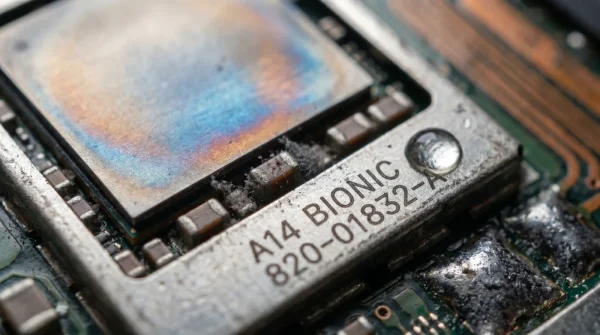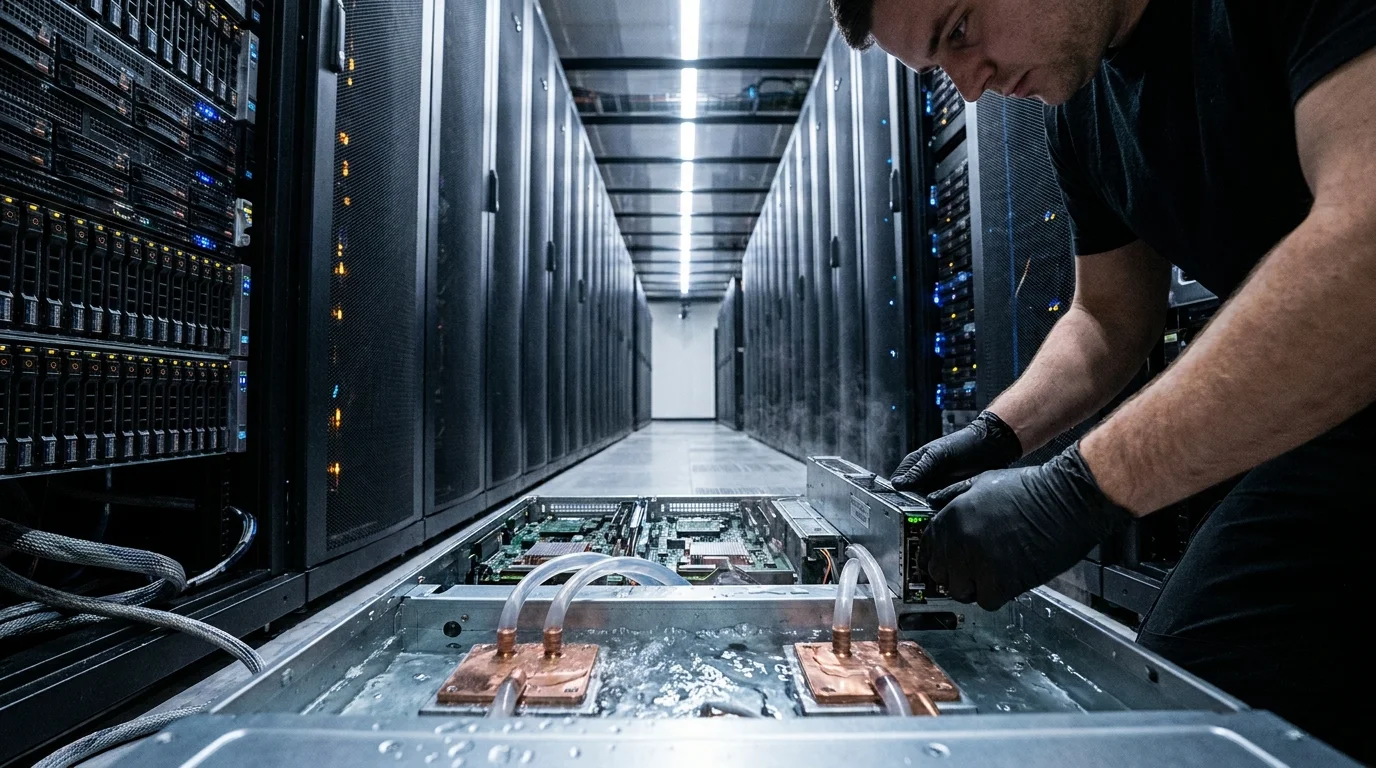
Step inside a newly retrofitted server hall in northern Virginia, and the expected hurricane roar of floor fans is eerily absent. Instead, you hear a low, rhythmic hum resembling a hospital ward. Transparent conduits snake across rack after rack, carrying engineered fluids over glowing circuitry. On the silicon face itself, steaming copper cold plates bathed in clear dielectric fluid pull massive heat spikes away before a single thermal throttle can trigger.
For over two decades, the tech industry relied on a simple premise: push cold air through perforated floor tiles and let evaporative rooftop towers blow off the excess heat as steam. But training modern neural networks has shattered that physical limit. Modern multi-die processor clusters draw upwards of 1,000 watts per socket, generating thermal densities comparable to the core of a small nuclear reactor vessel.
Air cooling simply cannot move fast enough to strip that thermal energy without sounding like a jet engine taking off inside the server chassis. Even worse, traditional evaporative cooling systems consume and vaporize millions of gallons of potable municipal water every single day. The industry has reached an unavoidable crossroads, prompting an aggressive overhaul across American compute corridors.
Facility operators are stripping out their massive open-air misting towers. In their place, engineers are installing sealed, closed-loop liquid architectures designed to capture, transfer, and reuse thermal energy without losing a single drop of coolant to the atmosphere.
The Myth of the Giant Air Conditioner
You have likely been told that server farms are just giant warehouses chilled by oversized air conditioners. In reality, blowing air across an ultra-dense compute blade is like breathing through a heavy winter pillow while trying to run a sprint. Air is a poor thermal conductor; it cannot grab heat molecules quickly enough when silicon transitions from idle to full synthetic load in microseconds.
When data centers pushed standard air systems past their design limits, they compensated with evaporative cooling towers. These open towers work through intentional boiling: hot water from the server loops is sprayed over baffles, where outside air evaporates a portion of it, cooling the remaining volume. While thermally effective, this design bleeds municipal water reservoirs dry and creates massive plumes of lost vapor over desert and suburban hubs alike.
- Xbox Game Pass cloud search surges force sudden server allocation for high-bandwidth streaming
- PlayStation Direct cart telemetry reveals sudden anti-scalper blocks on high-demand console bundles
- Framework Laptop 16 modular chassis sparks a revolt against glued shut aluminum slabs
- Logitech MX Master 3S scroll wheel skips require scraping stubborn gummy lint
- Sennheiser HD 560S headphones switch cheap plastic audio into crisp airy studio sound
The engineering pivot moves away from sweating into the open atmosphere toward a human circulatory model. By enclosing closed-loop liquid lines directly over the chip packaging, facilities isolate the heat immediately. The fluid carries thermal energy away in a tight, pressurized loop, transferring it through plate heat exchangers to outdoor dry coolers without allowing liquid to boil off or evaporate into the sky.
Marcus Vance, 44, an infrastructure architect who manages critical power and thermal deployments across Phoenix and Northern Virginia, witnessed this turning point firsthand during a sweltering July heatwave. ‘Our chillers were consuming over three hundred thousand gallons of treated reservoir water per building each day just to keep cluster temperatures below ninety degrees Celsius,’ Marcus explained while adjusting a closed-loop pressure valve. ‘We realized that treating municipal water like a disposable heat sponge was a dead end. We had to seal the circuit entirely.’
Three Blueprints Reshaping Compute Facilities
The transition away from evaporative fluid loss is not a one-size-fits-all swap. Data centers are deploying three primary architecture layers based on rack density and structural load bearing.
1. Direct-to-Chip (Cold Plate) Circuits
This approach bolts micro-channel copper plates directly onto the processor lid. A continuous stream of treated deionized water or specialized glycol flows across internal copper fins just millimeters thick. The fluid absorbs heat straight from the silicon lid, flows to an external liquid-to-liquid heat distribution unit, and cycles back. It eliminates server-level fans and operates as a 100% closed, zero-evaporation loop.
2. Single-Phase Immersion Baths
For extreme high-density racks, engineers skip copper tubes altogether and submerge the entire server chassis in non-conductive dielectric hydrocarbon fluid. The liquid circulates silently around memory modules, power delivery stages, and chip packages. Because the fluid never reaches its boiling threshold, it remains in a stable liquid state, circulating through outdoor radiator coils before returning to the tank.
3. Rear-Door Heat Exchanger Hybrids
Facilities transitioning existing legacy air-cooled rooms install passive or active chilled liquid coils directly into the rear exhaust door of the rack enclosure. The hot exhaust air generated by the chassis immediately hits a closed liquid radiator before it can warm the surrounding room, capturing up to 90% of the exhaust heat right at the server perimeter.
The Mechanics of Zero-Loss Thermal Control
Transforming a facility from open evaporative cooling to hermetically sealed fluid networks requires precise fluid dynamics and strict telemetry monitoring. When coolant cannot evaporate, you must manage pressure gradients, flow rates, and ambient dry-cooling temperatures with surgical accuracy.
- Operating Coolant Inlet Temperatures: Maintain fluid supply lines between 86°F and 113°F (30°C to 45°C), allowing warm-water cooling that eliminates the need for mechanical chillers.
- Dielectric Viscosity Management: Use low-viscosity synthetic fluids to minimize pump strain and prevent cavitation within tight chassis passages.
- Redundant Pumping Manifolds: Install dual-pump circulation loops with automatic failover to prevent thermal runaways if a primary impeller seizes.
- Dry-Cooler Heat Rejection: Route hot secondary loops through closed-fin air radiators outdoors, exchanging heat with outside ambient air without consuming water.
What Silicon Thirst Teaches Us About the Grid
The physical transformation of computing infrastructure proves that software never truly lives in the abstract cloud. Every neural weight calculated and every query processed produces friction, heat, and physical stress on our shared power and municipal resources.
By abandoning wasteful evaporative cooling towers in favor of sealed closed-loop systems, the infrastructure running our digital world becomes far more resilient. It protects local water tables, stabilizes utility grids, and allows dense hardware to operate at maximum efficiency without risking hardware degradation. Understanding the physical reality behind the screen helps us build a more balanced relationship with the infrastructure quietly powering our modern lives.
‘When you stop throwing water at a thermal problem and start engineering closed loops, you turn a facility from an environmental sponge into a self-contained thermal circuit.’
| Key Point | Detail | Added Value for the Reader |
|---|---|---|
| Evaporative Towers | Consumes massive municipal water via boiling steam loss | Explains why older facilities face local environmental resistance |
| Direct-to-Chip | Sealed liquid channels mounted straight to copper heat spreaders | Maintains maximum compute speed without thermal throttling |
| Dielectric Immersion | Submerges full components in non-conductive, non-boiling fluid | Eliminates internal server fans and cuts total facility power waste |
Frequently Asked Questions
Why did older data centers rely on evaporative water cooling for so long?
Evaporative towers were cheap to construct and highly effective at shedding massive heat through simple phase change, but they wasted millions of gallons of potable water.Does direct-to-chip cooling risk water leaks on expensive processors?
Modern cold-plate loops use negative pressure systems and non-conductive fluid blends, meaning a minor puncture pulls air in rather than spraying liquid out onto sensitive silicon.What is dielectric fluid, and is it toxic?
Dielectric fluids are specially engineered synthetic oils or fluorochemical liquids that do not conduct electricity, remain non-toxic, and are safe for direct hardware submersion.How does this shift affect the overall power grid?
Closed-loop liquid systems slash the power needed to run thousands of noisy chassis fans and mechanical chillers, allowing more grid capacity to go directly toward useful compute work.Can these liquid loops reuse waste heat elsewhere?
Yes, because closed-loop liquid captures heat at higher temperatures, facilities can pipe the warm fluid directly into district heating networks or commercial greenhouses.