Global semiconductor and memory stocks fell sharply this week after Chinese chipmaker ChangXin Memory Technologies (CXMT) announced progress on a denser dynamic random-access memory (DRAM) architecture. Speaking at an industry conference in Shanghai over the weekend of October 11–12, CXMT President Cao Kanyu stated that the Hefei-based company plans to introduce a server-memory product built on a new 4F² DRAM cell structure by the end of 2026, according to CNBC. The news accelerated a broad pullback across U.S., South Korean, Japanese, and European chipmakers as investors weighed the prospect of rising Chinese competition against existing concerns over artificial intelligence infrastructure spending and future supply gluts.
By Thursday, the five-day losses among leading memory manufacturers were substantial. Shares of South Korean memory giants SK Hynix and Samsung Electronics dropped 26% and 22%, respectively, over the five-day stretch, while U.S. memory maker Micron Technology declined roughly 11%, CNBC reported. While market commentary initially framed CXMT’s announcement as a direct threat to high-end AI memory dominance, semiconductor analysts point out a wide gap between an unverified server DRAM design target and commercial readiness in high-bandwidth memory (HBM).
What CXMT Actually Claimed: 4F² DRAM vs. HBM
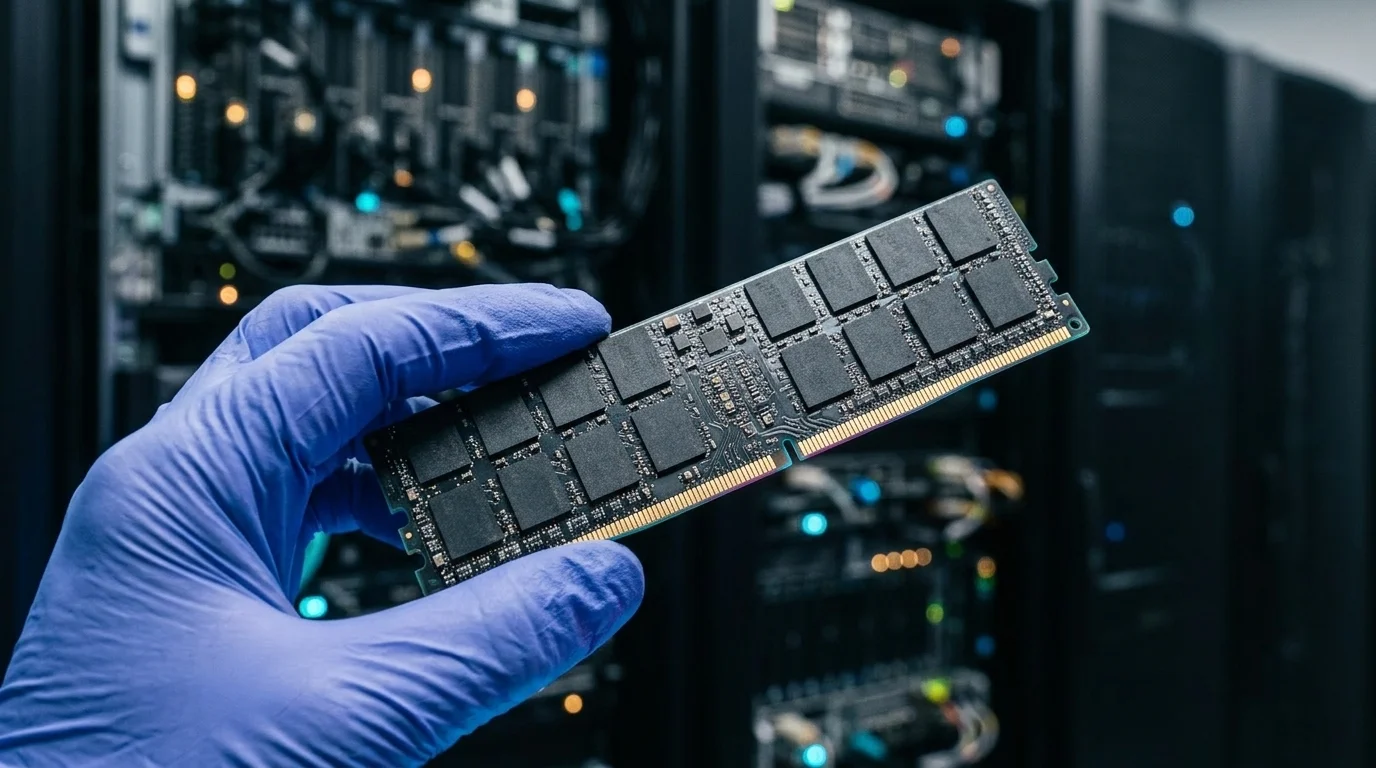
The core of CXMT’s announcement centers on a 4F² DRAM cell architecture designed to pack more data into a smaller physical footprint. According to Yahoo Finance, CXMT claims the architecture could increase memory density by 30% to 50%. Such density improvements are pursued across the industry; SK Hynix, for example, presented its own roadmap for developing 4F² technology in 2025.
However, industry coverage and analyst assessments highlight a crucial technical distinction: CXMT’s planned rollout by year-end 2026 targets conventional server memory, such as prospective DDR5 registered DIMM modules, rather than the stacked high-bandwidth memory integrated alongside AI accelerators from companies like Nvidia. Furthermore, CXMT has not published detailed technical specifications, sample performance metrics, or independent verification of mass production.
Founded in 2016, CXMT remained relatively unknown outside of China until its initial public offering this past summer. While the company benefits from substantial domestic demand, it operates under strict U.S. export controls that block access to advanced semiconductor manufacturing equipment, specifically extreme ultraviolet (EUV) lithography systems manufactured by Dutch supplier ASML.
- Google Launches Gemini 4 Argon AI Model for Developers, Enterprises, and Subscribers
- US and South Korean Chip Stocks Tumble Amid CXMT Progress and Broadcom Warnings
- Apple Unveils $299 Apple TV 4K and $149 HomePod Mini 2 With Siri AI Upgrades
- Anthropic Reports $16.8 Billion Q3 Revenue Ahead of Planned IPO
- Columbia Law School Launches AI @ CLS Initiative Backed by Paul, Weiss
Those equipment constraints make high-volume manufacturing of denser memory architectures difficult. Ben Barringer, global head of technology research at Quilter Cheviot, noted on CNBC that architectural changes inevitably raise questions about manufacturing yields, pointing out that a 50% yield effectively means discarding half of the produced chips. Kevin Cassidy, a senior research analyst at Rosenblatt Securities, told the network that CXMT’s developments are unlikely to alter the global supply-demand equation.
Broader Market Contagion and Analyst Disagreements
The equity selloff extended well beyond primary DRAM manufacturers, hitting storage providers, chip equipment makers, and major AI investors across multiple sessions. On Tuesday alone, SK Hynix closed down 10% and Samsung fell 7.4% in Seoul, while Micron dropped 3.62% in New York, according to CNBC. Over a two-day span early in the week, U.S. storage and memory stocks Micron, Sandisk, Seagate Technology, and Western Digital fell 4.4%, 6.2%, 4.5%, and 4.1%, respectively. Even CXMT’s own shares closed 2.8% lower in Shanghai on Tuesday.
Selling pressure spilled into adjacent technology sectors globally. In Japan, SoftBank Group sank 8.5%, chipmaking equipment supplier Tokyo Electron dropped 7.2%, Lasertec fell over 5%, Renesas Electronics shed 5.9%, Disco lost 4.7%, and Advantest declined 2.9%. In Europe, lithography leader ASML slipped 3.3%, STMicroelectronics and Infineon each fell 5%, and Dutch firms BE Semiconductor and ASM International dropped roughly 4%. Sentiment was further rattled on Monday when Tesla and SpaceX CEO Elon Musk posted that once China determines how to manufacture a product, its ability to scale production often exceeds the rest of the world combined.
By Thursday, macroeconomic headwinds compounded the sector’s losses. A hotter-than-expected U.S. wholesale inflation report driven by energy costs dragged the Nasdaq composite down 1.2% and the S&P 500 down 0.5% in early trading, while Nvidia fell 3.2%, Advanced Micro Devices lost 5.4%, and South Korea’s Kospi index sank 7.6%, according to 2 News Nevada.
Market observers remain divided over whether the rout reflects genuine competitive disruption or short-term profit-taking. According to Morningstar analyst Jing Jie Yu, if CXMT successfully commercializes its design ahead of global peers, it would signal growing Chinese competitiveness in DRAM and elevate long-term oversupply risks as domestic capacity expands. Conversely, Rayliant strategist Phillip Wool and UBP senior equity advisor Vey-Sern Ling told CNBC that CXMT has not demonstrated large-scale production capabilities and poses no immediate threat in advanced HBM, characterizing the selloff as an excuse for jittery investors to take profits on outperforming AI equities.
Memory Supply Cycles and Incumbent Fundamentals
The debate over CXMT intersects with broader investor anxiety regarding the traditional boom-and-bust cycle of the memory industry. Historically, surging demand triggers capacity expansions that eventually lead to oversupply and collapsing margins. Some market speculation has centered on a potential RAM oversupply by 2029, though industry analysts note that building and bringing a new semiconductor fabrication plant online takes three to five years.
Because of those long lead times, many analysts expect current memory shortages to persist until 2028. Counterpoint Research projects that while DRAM prices may decline roughly 23% in 2028 compared to 2027 levels, pricing would still remain approximately 230% higher than in 2025. Jeongku Choi, a senior research analyst at Counterpoint Research, noted that the market has entered a different era characterized by three- to five-year long-term agreements between suppliers and buyers.
Meanwhile, established U.S. and South Korean memory makers continue to post strong financial results backed by locked-in data center commitments. According to Yahoo Finance, Micron recently closed its fiscal 2026 with record revenue and projected fiscal first-quarter 2027 revenue of $61.5 billion (plus or minus $1.5 billion) alongside adjusted earnings of $38.15 per share (plus or minus $1)—representing roughly 351% year-over-year revenue growth and 698% earnings growth. Micron has already contracted the majority of its 2027 HBM supply at higher prices, is ramping up HBM4 production, is collaborating with Nvidia on a custom HBM4E solution, and saw its fiscal fourth-quarter data center solid-state drive (SSD) revenue approach $10 billion, more than ten times the prior year’s level.
Key Questions for Tech Investors
Has CXMT matched Samsung, SK Hynix, and Micron in AI high-bandwidth memory?
No. CXMT’s announcement describes a 4F² cell architecture targeted for a server DRAM product by the end of 2026. Conventional server DRAM and stacked high-bandwidth memory (HBM) are distinct product categories, and analysts note that CXMT continues to trail global incumbents in advanced HBM manufacturing.
What hurdles must CXMT clear to impact the global memory market?
To shift global supply dynamics, CXMT must publish verifiable technical specifications, ship commercial samples by its year-end 2026 target, pass customer qualification for production servers, and achieve high manufacturing yields at scale—all without access to restricted EUV lithography equipment.
Could Chinese DRAM expansion affect memory prices even without an HBM breakthrough?
Yes, over the long term. If CXMT successfully commercializes denser server DRAM and scales domestic production capacity, it could increase supply and pressure pricing in the commodity and standard server memory segments, even while high-end HBM remains dominated by SK Hynix, Samsung, and Micron.
Sources
- CNBC – Why this little known Chinese chipmaker has caused a global stock rout
- CNBC – Memory stocks are getting hammered. China and a 2029 oversupply are the big worries
- CNBC – Micron sinks, other memory-linked names dip for a second day
- Yahoo Finance – AI Memory Chip Selloff Looks Overblown: 2 Stocks to Buy on the Dip
- 2 News Nevada – Drops in AI stocks hit Wall Street after dragging other markets lower – KTVN
- Morningstar – Samsung and SK Hynix Lead Chip Selloff as China Competition Fears Grow