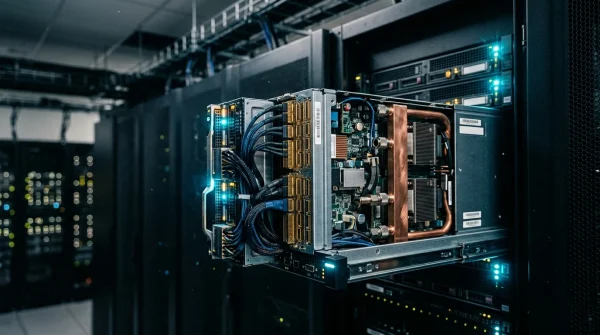
Shares and corporate bonds of artificial intelligence cloud provider CoreWeave tumbled further on Thursday, October 15, 2026, as Wall Street scrutinized the massive debt loads financing the AI data center boom. Following a drop of more than 15% on Wednesday, CoreWeave’s stock fell between 4.5% and 6% in Thursday premarket trading before sliding 8.5% during the session, according to differing snapshots from Yahoo Finance and Reuters. The sell-off has pushed the company’s bond yields into distressed territory and triggered broader losses across semiconductor and technology stocks, including major chip supplier and shareholder Nvidia.
Bond Yields and Balance Sheet Pressures
The core of the market anxiety lies in how CoreWeave funds its rapid infrastructure expansion. CoreWeave, which went public in March 2025, leads a category of specialized providers known as “neoclouds” that purchase graphics processing units (GPUs) to rent computing power to tech companies, including Microsoft, Meta Platforms, and OpenAI. Building these facilities requires immense upfront capital before customer contracts generate cash flow.
Assessments of the company’s total obligations vary depending on how liabilities are categorized. While Reuters summarized CoreWeave’s burden at around $50 billion in debt, detailed balance-sheet estimates from TradingKey and Yahoo Finance put June 30 debt at approximately $35.6 billion alongside $16.3 billion in operating-lease obligations, for a combined total of roughly $51.9 billion. Meanwhile, analysts expect CoreWeave to generate nearly $13 billion in revenue in 2026 against a projected net loss of $2.13 billion. In August, the company raised its 2026 capital expenditure guidance by $4 billion to a range of $35 billion to $39 billion, with $11.5 billion to $13.5 billion slated for the third quarter alone.
Fixed-income investors have reacted sharply to this cash-flow mismatch. CNBC reported that yields reached about 14.8% on CoreWeave’s 9.625% bonds due 2032 and 14.9% on its 9.75% bonds due 2031, after investor Chamath Palihapitiya highlighted a chart on Tuesday showing the 2032 yield touching 15%—a post that drew a “yikes” response from Elon Musk on social media. By Thursday, yields on the April-issued 2031 bonds surged past 16%, a threshold that typically signals financial distress. While rising secondary-market yields do not alter the fixed coupon payments on existing bonds, they dramatically increase the cost of future borrowing or refinancing.
At the same time, the cost of insuring CoreWeave’s debt against default via five-year credit default swaps climbed to roughly 1,000 basis points. Market pricing implies a nearly 63% probability of default within five years, more than doubling from around 30% a year earlier.
- China’s CXMT Claims DRAM Architecture Advance, Triggering Global Memory Stock Selloff
- Google Launches Gemini 4 Argon AI Model for Developers, Enterprises, and Subscribers
- US and South Korean Chip Stocks Tumble Amid CXMT Progress and Broadcom Warnings
- Apple Unveils $299 Apple TV 4K and $149 HomePod Mini 2 With Siri AI Upgrades
- Anthropic Reports $16.8 Billion Q3 Revenue Ahead of Planned IPO
CoreWeave CEO Mike Intrator pushed back against the panic in an internal employee memo. “When you are building a new type of technology company there will be periods of time when the market misunderstands and acts irrationally,” Intrator wrote, adding that management remains confident in its deal backlog, which he said more than supports all debt obligations. Following its second-quarter results, CoreWeave’s revenue backlog stood at roughly $104 billion, according to Yahoo Finance, with more than $25 billion in additional customer commitments logged early in the third quarter.
Why CoreWeave’s Troubles Matter to Nvidia
Wall Street is closely monitoring the fallout for Nvidia, whose business is deeply intertwined with CoreWeave’s expansion. According to Yahoo Finance, Nvidia expanded its partnership with the cloud provider in January 2026, investing $2 billion in CoreWeave stock. Nvidia holds 47.2 million shares, representing an ownership stake of around 10%, and CoreWeave committed to deploying Nvidia hardware to build more than 5 gigawatts of AI data center capacity by 2030.
To support its partner, Nvidia previously agreed to purchase any unsold CoreWeave computing capacity through April 13, 2032. However, bond traders have largely looked past this arrangement during the current rout. While the agreement serves as a demand backstop for computing capacity, it does not function as a direct guarantee of CoreWeave’s corporate debt or insulate the company from construction delays, power constraints, and financing squeezes.
If higher borrowing costs force CoreWeave and similar neoclouds to slow data center construction, a key channel of demand for Nvidia’s costly processors could weaken. Furthermore, hardware depreciation poses an ongoing risk: as newer generations of chips launch, older GPUs lose value, pressuring operators to borrow and spend again to upgrade their fleets. Amid Thursday’s broader tech sell-off, Nvidia shares dropped 1.3% in premarket trading and extended losses to 3.3% during the morning session, while competitors AMD and Micron Technology fell 6.4% and 5%, respectively.
Broader Implications for the AI Sector
The turbulence surrounding CoreWeave reflects a wider reassessment of credit-fueled AI spending across the technology industry. According to Gartner analyst Will Sommer, providers are projected to spend nearly $1 trillion on AI infrastructure in 2026 and an additional $6 trillion between 2027 and 2030. A separate Gartner forecast warned that cost pressures and a lack of differentiated business models will force more than 80% of neocloud providers to cease independent operations by 2030. Reflecting those structural concerns, Bernstein analyst Madison Rezaei maintained an “Underperform” rating on CoreWeave on Thursday, noting that its long-term business model remains economically challenged.
Even major tech conglomerates are leaning heavily on debt markets. Through October 13, hyperscalers Alphabet, Amazon, Meta Platforms, and Oracle had issued more than $228 billion in bonds in 2026—more than double their combined issuance for all of 2025, per LSEG data. JPMorgan estimates hyperscaler capital spending will reach $800 billion in 2026 and exceed $1 trillion annually by 2027.
Combined with hotter-than-expected U.S. inflation data and cautious 2027 macroeconomic commentary from chipmaker TSMC, the credit jitters have weighed heavily on equities. The Philadelphia Semiconductor Index erased more than $1.6 trillion in market value over a multi-day 11.6% slide, with the broader chip sector on track to shed $2 trillion over seven sessions.
Frequently Asked Questions
Why doesn’t CoreWeave’s $104 billion backlog prevent debt concerns?
A revenue backlog represents contracted future commitments, not cash currently on hand. To convert that $104 billion backlog into actual revenue, CoreWeave must first finance, build, power, and equip its data centers. Investors are concerned that rising borrowing costs make bridging the gap between immediate capital outlays and future customer payments much more expensive.
Does Nvidia guarantee CoreWeave’s $50 billion in debt and lease obligations?
No. While Nvidia owns roughly 10% of CoreWeave and agreed to buy any unsold computing capacity through April 13, 2032, that contract only backstops capacity utilization once facilities are operational. It is not a blanket guarantee of CoreWeave’s bonds or lease liabilities.
How do rising bond yields affect CoreWeave’s daily operations?
When yields on existing bonds climb past 15% or 16% on the secondary market, it does not change the fixed interest rate CoreWeave currently pays on those specific notes. However, it signals that lenders demand much higher risk compensation, which makes raising new debt or refinancing maturing obligations significantly more costly for a company planning to spend up to $39 billion on capital expenditures in 2026.
Sources
- Yahoo Finance / Reuters – CoreWeave’s slump puts spotlight on debt behind AI boom
- CNBC – CoreWeave shares tumble as bond yields near 15% on concern about AI borrowing binge
- Yahoo Finance – Why CoreWeave stock panic matters to Nvidia, explained in under 30 seconds
- Yahoo Finance / Reuters – Nasdaq slides to near one-month low as AI rout deepens
- Reuters – CoreWeave shares and bonds slide further as AI debt fears mount
- TradingKey – CoreWeave Stock Forecast, AI Debt and Backlog Analysis
- Yahoo Finance – CoreWeave shares sink as Musk reacts to bond yields
- Yahoo Finance – CoreWeave falls as bond yield climbs