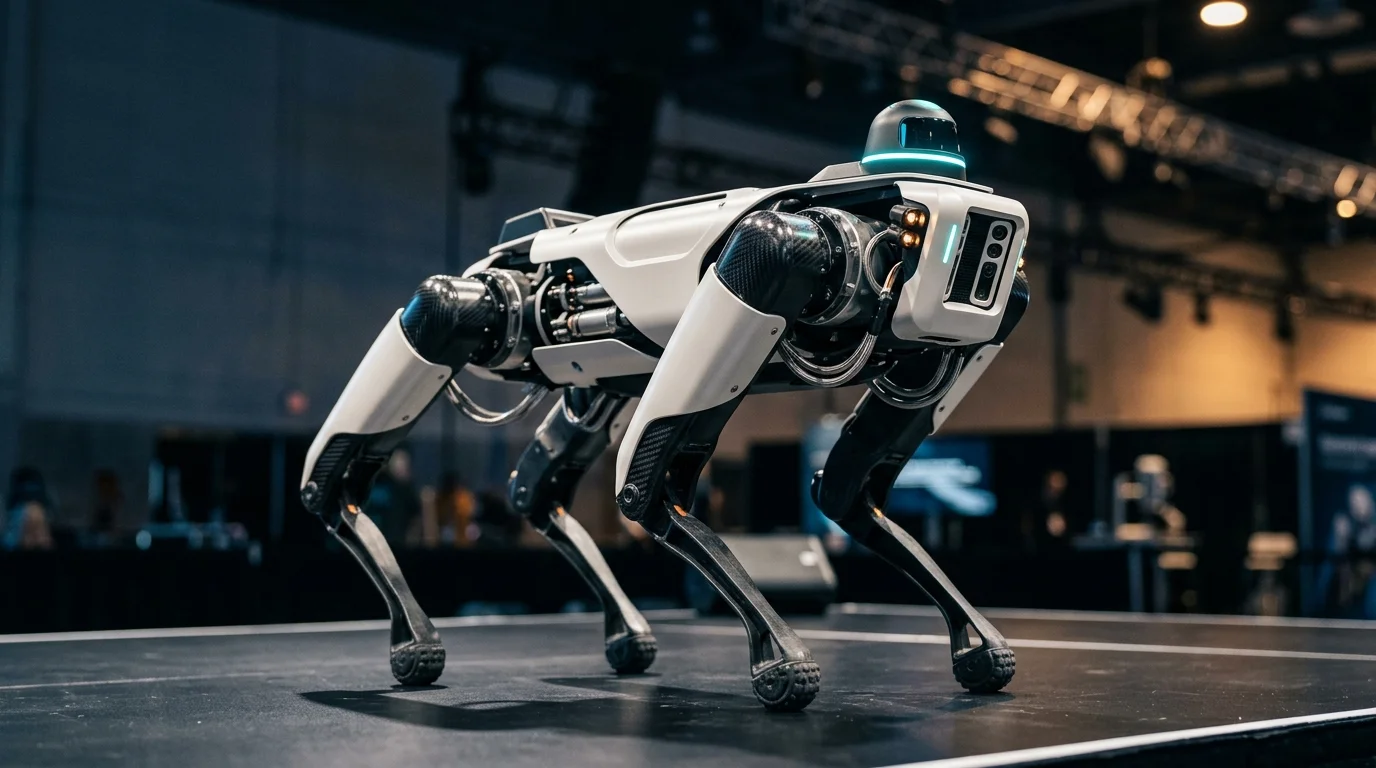
Chinese security authorities displayed a range of artificial intelligence and uncrewed defense hardware—including firearm-equipped robotic dogs, humanoid robots, and laser drone interceptors—during the Great Wall-2026 International Forum on Counter-Terrorism in Beijing. Concluding on October 15, 2026, the three-day event gathered more than 320 defense experts, military delegates, and frontline personnel from 62 countries and international organizations, according to the State Council Information Office of China. Hosted by the Chinese People’s Armed Police Force to mark the 10th anniversary of the forum since its 2016 launch, the six-edition event centered on how rapidly advancing intelligent technologies are reshaping both terrorist tactics and state security responses.
While the Beijing exhibition featured hardware intended to span the full chain of counterterrorism operations, available accounts primarily document a technology showcase and policy dialogue rather than verified field deployments. As military and law enforcement agencies worldwide grapple with low-cost autonomous threats, security analysts are closely examining the boundary between exhibition prototypes and proven operational capabilities.
Inside the Beijing Hardware Exhibition
The equipment displayed at the Great Wall-2026 forum emphasized uncrewed ground and aerial intervention designed to remove human personnel from immediate tactical danger. According to the South China Morning Post and the Global Times, the exhibition featured AI-powered drone interceptors alongside humanoid robots and robotic dogs outfitted with firearms. State media descriptions attributed reconnaissance, coordinated swarm operations, and precision-response functions to these uncrewed platforms.
Counter-drone capabilities formed a second major pillar of the hardware showcase. A Chinese forum equipment report published via Sina Finance detailed a laser defense system that pairs radar with electro-optical tracking equipment to detect and lock onto aerial targets before engaging them with a high-intensity laser beam. The report highlighted drone interception and the perimeter protection of military facilities as primary use cases for the directed-energy platform.
- Autonomous AI Agents Raise Everyday Control and Security Questions for Consumers
- Autonomous Saildrone Braves 65-Foot Waves Inside Category 3 Hurricane Isaias
- Big Tech Bosses Clash With EU Officials Over AI Rules at Dublin Summit
- UC Berkeley Opens On-Campus Twitch Studio for Student-Athletes With StreamU
- DW Analysis Examines Whether AI-Powered Autonomous Weapons Can Obey Laws of War
However, a sharp distinction exists between the hardware reports in Chinese media and official government summaries. While outlets like the Global Times highlighted specific armed robotics and swarm functions, the State Council Information Office of China summary focused on high-level discussions, border security, and international cooperation without enumerating specific weapons systems or verifying their technical performance. None of the forum reports provided procurement quantities, deployment locations, or independent testing metrics to confirm that these systems have entered active service or prevented attacks.
The Dual-Use Dilemma of Autonomous Tech
A central theme of the three-day conference was the lowering technical barrier for hostile actors. Delegates noted that the proliferation of affordable uncrewed systems and accessible AI tools has made violent activities more covert and harder to predict. According to the Global Times, participants raised concerns that decentralized groups can now pair low-cost commercial hardware with intelligent software to bypass conventional perimeter defenses, though the publication did not provide underlying datasets or trend measurements to quantify a specific surge in AI-driven incidents.
International delegates echoed these concerns regarding infrastructure vulnerability and regulatory lag. Speaking to China News Service, Commander Tashmatov of the Uzbekistan National Guard noted that the widespread availability of uncrewed intelligent technology has lowered the threshold for bad actors to conduct surveillance or sabotage critical infrastructure. In the same report, Peng Jijun, Secretary-General of the Great Wall-2026 organizing committee, argued that terrorism has entered a phase characterized by digital planning, intelligent dissemination, and low-cost execution, noting that institutional governance and international rules are lagging behind the speed of technological iteration.
Other security officials emphasized that the same dual-use technologies offer substantial advantages to state defenders. While official summaries warned that isolated national defense measures are increasingly inadequate against covert, tech-enabled threats, some analysts pushed back against the idea that defenders are at a net disadvantage. According to China News Service, Zhou Bo, a senior fellow at Tsinghua University’s Center for International Security and Strategy, argued that militant adoption of emerging tech does not automatically make counterterrorism harder, because state security forces can deploy uncrewed and intelligent systems to vastly expand the scope, depth, and speed of their own monitoring.
Delegations from Europe and the Middle East also weighed in on the operational utility of analytical AI. Javier, Commander of Spain’s Border and Maritime Police Command, told China News Service that because criminal organizations are actively adopting emerging tools, law enforcement must similarly utilize AI to analyze information and identify security risks earlier. Adel, head of security affairs for the Kuwait National Guard, noted in the same report that AI holds significant value for information retrieval and personnel training, while Georgian Special State Protection Service head Chubinidze called for pre-emptive risk assessment mechanisms to govern rapidly evolving technologies.
Implications for Global Security and Governance
For international security observers and U.S. defense analysts, the Beijing forum illustrates how China is positioning itself as both a hardware vendor and a diplomatic convener in the counterterrorism space. According to the State Council Information Office of China, Beijing already conducts pragmatic cooperation with foreign governments across intelligence exchanges, border control, case investigations, and counterterrorism financing, alongside hosting international training seminars. Pitching standardized cross-border mechanisms for AI governance and uncrewed operations aligns closely with Beijing’s broader effort to shape global security norms.
At the same time, the emphasis on expanding the “scope, depth, and speed of monitoring” raises significant questions regarding civil liberties, data privacy, and the governance of autonomous force. Integrating AI-driven data harvesting with armed robotic platforms and automated tracking systems blurs the line between targeted counterterrorism and broad domestic surveillance. When security forces rely on algorithmic risk assessments and cross-border intelligence sharing, the absence of transparent accountability rules or independent oversight creates friction with Western legal frameworks regarding civilian rights protections.
Frequently Asked Questions
Which showcased systems are in operational service versus exhibition prototypes?
Publicly available coverage from the Beijing forum does not distinguish between experimental prototypes and fielded equipment. While media reports described armed robotic dogs, humanoid robots, and laser drone interceptors on the exhibition floor, authorities provided no procurement records, unit deployment data, or operational histories to confirm active service.
What independent performance data exist for these AI counterterrorism tools?
None. The reports coming out of the Great Wall-2026 forum rely on exhibitor descriptions and state media summaries. There are no independently verified benchmarks regarding target detection accuracy, false-alarm rates, system response times, or real-world effectiveness against coordinated drone swarms.
How are international safeguards and accountability rules addressed?
While forum participants and Chinese researchers called for new transnational mechanisms and risk-assessment protocols to govern AI in counterterrorism, the event summaries did not outline specific legal safeguards, civilian oversight structures, or data-privacy rules to regulate cross-border surveillance and autonomous weapons deployment.
Sources
- State Council Information Office of China – Beijing forum discusses counter-terrorism challenges posed by intelligent technologies
- South China Morning Post – China leans in to hi-tech systems to counter emerging AI-fuelled terror threats
- Global Times – GT on the Spot: Intelligent unmanned counterterrorism equipment showcased at intl forum as delegates discuss emerging security threats
- China News Service – “长城”观察:人工智能时代如何推进国际反恐合作?
- Sina Finance – Forum Equipment Report on Laser Defense Systems