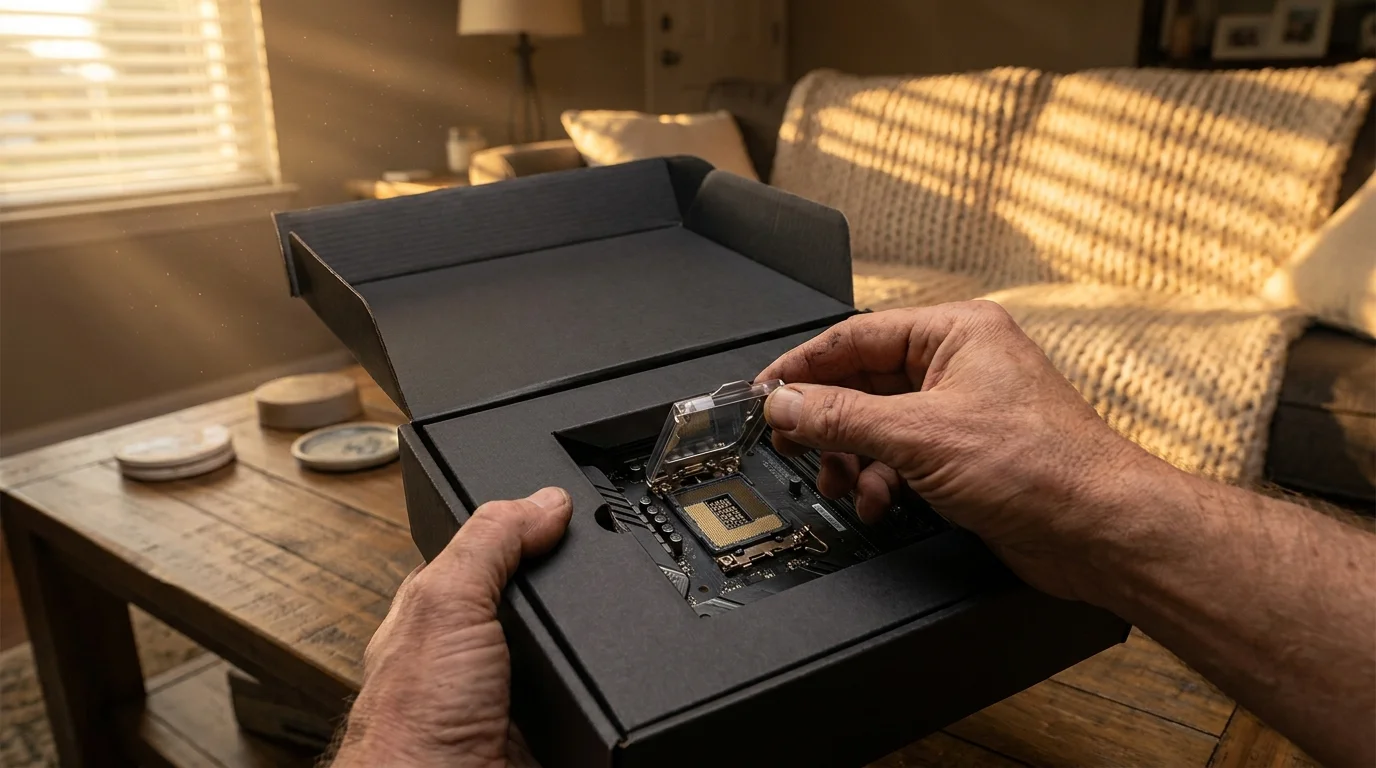
A sharp snap echoes through your workspace as you release the steel retention arm on a pristine motherboard. Under the workshop lamp, the dense gold pin grid array on a fresh LGA1851 socket catches the light like miniature wheat shafts in an autumn field. It feels familiar, tactile, and heavy with the promise of raw silicon speed.
You lean in close, perhaps balancing an unboxed desktop processor between two fingers, hoping that this year might be the year the industry spares your wallet. For three generations, the LGA1700 platform served as your dependable anchor, quietly enduring microcode updates, cooler swaps, and incremental silicon refreshes.
Yet as the chip hovers above that shimmering contact field, the alignment notches reveal an undeniable physical reality. The gold contact pads beneath the heat spreader do not align, and no amount of optimistic firmware updates or forum workarounds can bridge the physical divide. Intel Arrow Lake processors demand a clean break, abruptly ending an era of motherboard longevity.
The Illusion of the Perpetual Socket
For years, desktop builders treated motherboard longevity like a lease agreement they could continually renegotiate. You bought a high-end Z690 or Z790 board, weathered the early quirks of high-frequency memory, and told yourself that next season’s upgrade would simply drop into place without tearing apart your cable management.
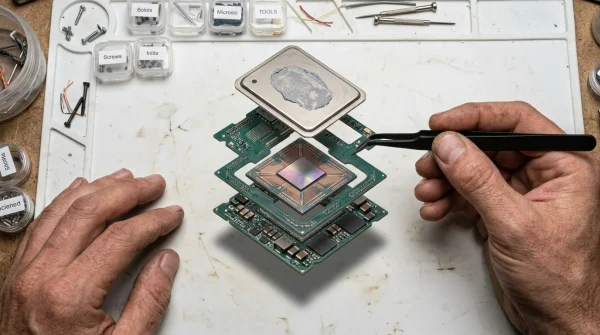
Think of CPU sockets like municipal plumbing mains. When an engineer redesigns the water volume flowing through an entire district, keeping the old iron pipes isn’t just inefficient; it introduces friction and instability. Arrow Lake brings radical structural reconfiguration, shifting from monolithic silicon dies to a disaggregated tile architecture that distributes heat, power delivery, and PCIe bandwidth in ways LGA1700 simply cannot channel.
The move to LGA1851 adds 151 additional gold contacts inside the exact same physical perimeter of 45 by 37.5 millimeters. That staggering jump in density is not an arbitrary design choice intended to frustrate builders. It reflects a total rerouting of direct-to-die PCIe lanes and the total abandonment of legacy memory traces.
- Microsoft Exchange Online routing shifts derail corporate email delivery across major regional networks
- ATF database server leaks expose sensitive personal registry records through unpatched system holes
- Sony digital game purchases enforce multi-million refund payouts following massive consumer settlement claims
- Apple Watch watchOS 11 updates switch off background location drains to preserve active batteries
- Decluttr tech trade-ins demand spotless glass screens to avoid aggressive cash deduction traps
Marcus Vance, a 38-year-old firmware integration technician in Beaverton, Oregon, spent months bench-testing early pre-production boards. He observed that pushing multi-gigahertz signals through shared legacy traces turned clean square waves into ragged ripples, making the architectural divorce completely inevitable if power efficiency was ever going to balance raw compute performance.
Architectural Segmentation: The Cost of Clean Power
Arrow Lake forces an honest appraisal of what your computing rig actually accomplishes every day. The physical shift affects different tiers of builders in profoundly disparate ways.
For the Dedicated Production Engineer
If your machine spends its days rendering high-bitrate video, compiling massive software builds, or handling complex local machine learning models, the new pin mapping provides tangible relief. Arrow Lake routes dedicated PCIe 5.0 lanes directly to primary M.2 storage without cannibalizing bandwidth from your discrete graphics card. On previous platforms, running a Gen 5 solid-state drive often chopped your primary x16 slot down to x8 mode. The LGA1851 layout isolates high-speed storage paths cleanly, giving data-heavy workflows breathing room to sprint without hitting lane saturation.
For the Balanced Daily Builder
If your machine exists primarily for evening gaming sessions and standard office tasks, this mandatory platform shift stings. DDR4 support is officially extinct on this platform. Arrow Lake commits exclusively to native DDR5, ditching dual-mode memory controllers entirely. That means you cannot salvage your ultra-low-latency DDR4 memory kit to soften the blow. Upgrading requires buying a new processor, a 800-series motherboard, and a modern DDR5 memory kit in a single, unyielding checkout transaction.
Mindful Platform Migration
Approaching a full-platform build requires methodical patience rather than impulsive frustration. Because the physical socket dimensions remain identical to LGA1700, the cooler mounting mechanism survives, but board dynamics and pin layouts do not. Treat the transition as an opportunity to build a cooler, quieter foundation.
To navigate this architectural shift cleanly, follow this practical checklist:
- Audit your current cooler bracket mounting pressure; while holes align, slight changes in the integrated heat spreader height require checking for updated standoff kits from your cooler manufacturer.
- Verify power supply compatibility; Arrow Lake changes how transient spikes travel through the motherboard VRM, making high-quality ATX 3.0 power supplies with dedicated 12V-2×6 connectors far more practical.
- Ditch hybrid DDR4/DDR5 expectations and source memory kits verified for native JEDEC DDR5-6400 speeds to avoid memory controller instability.
- Inspect socket seating with a bare eye before lowering the retention arm, as the higher pin density makes LGA1851 pins significantly more vulnerable to lateral shear damage.
Taking ten deliberate minutes to align the gold registration triangles saves hundreds of dollars in bent-pin heartaches. Slow hands prevent ruined sockets, especially when dealing with pins spaced down to fractions of a millimeter.
The Value of a Clean Slate
It is easy to view mandatory hardware shifts with cynicism, especially when components demand significant financial investments. Yet clinging to aging platform constraints eventually strangles real progress. Architectural progress requires letting go of backward compatibility when older electrical frameworks choke modern computational efficiency.
When you step back from the glowing screen and the tangle of zip ties, there is a quiet satisfaction in assembling a system built without compromises. Arrow Lake resets the baseline, clearing away a decade of legacy baggage to give high-speed lanes and tile-based silicon room to breathe. When you finally press the power switch, you are not wrestling with legacy workarounds; you are running on an architecture built strictly for tomorrow.
The true cost of silicon longevity is stagnation; sometimes you must break the socket to liberate the architecture.
| Key Point | Detail | Added Value for the Reader |
|---|---|---|
| Socket Architecture | LGA1851 replaces LGA1700 with 151 added pins in the same surface area. | Explains why physical pin alignment prevents using Arrow Lake chips in older motherboards. |
| Memory Standards | Pure DDR5 support with native 6400 MT/s baselines; zero DDR4 legacy traces. | Prevents accidental purchases of legacy memory kits and sets clear upgrade budget targets. |
| Storage Expansion | Dedicated PCIe 5.0 lanes routed straight to M.2 without GPU lane bisecting. | Guarantees peak graphics card throughput alongside cutting-edge Gen 5 storage speeds. |
Frequently Asked Questions
Can I use my existing LGA1700 CPU cooler on an LGA1851 motherboard?
Yes, the physical dimensions and mounting hole spacing remain identical, though you should confirm with your cooler manufacturer whether a slightly adjusted standoff screw is recommended to maintain optimal mounting pressure.Will any BIOS update allow Arrow Lake processors to run on Z790 or Z690 boards?
No, the physical pin count and arrangement are completely incompatible, making backward compatibility physically impossible regardless of software or firmware updates.Does Arrow Lake support DDR4 RAM on budget motherboards?
No, Intel has entirely stripped DDR4 memory controllers from the Arrow Lake silicon architecture, requiring native DDR5 RAM across all 800-series motherboards.Why did Intel add 151 pins without making the socket physically larger?
Retaining the 45 by 37.5 millimeter outer footprint maintains broad chassis and cooler bracket compatibility while increasing trace density for dedicated PCIe 5.0 storage lines and power delivery.Will the new LGA1851 socket last for multiple processor generations?
While Intel has not published a multi-year socket guarantee, history suggests the LGA1851 platform will anchor at least two primary desktop architecture cycles before another physical transition occurs.