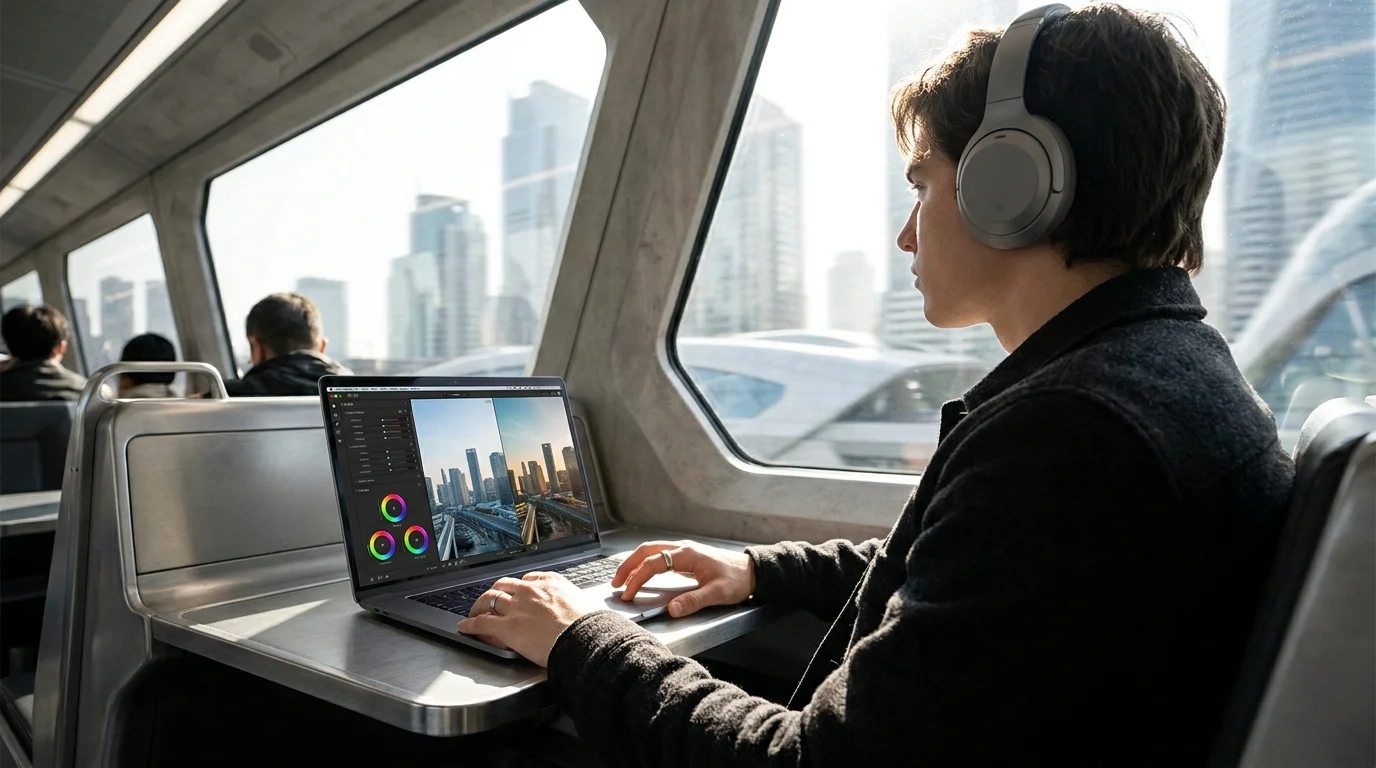
The desk fan hums low in the corner, rhythmic and steady against the humid midsummer twilight in your room. Your screen throws a cool, slate glow across your hands, illuminating a matte black high-resolution RAW slider panel displaying split-screen color curves. On the right side, an uncompressed portrait taken at golden hour sits frozen, its skin tones caught in a flat, muddy amber. On the left, the same file pulses with subtle warmth, the micro-contrast in the fabric of the collar snapping forward with pinpoint clarity.
For years, this exact dance came paired with an invisible monthly tariff. Every thirty days, an automated bank notification chipped away at your account, quietly reminding you that your ownership of your own digital negatives was rented. The moment you stopped paying, the develop modules locked shut, turning your extensive catalog into a dormant museum you could view but no longer touch.
To make matters worse, that rented software had grown heavy. It began running like an engine gasping for air, stuttering through high-megapixel previews and spinning its export wheel while background telemetry services choked your machine’s memory. You assumed this friction was simply the price of professional color grading, a compromise baked into modern desktop editing.
It turns out you were paying premium fees to rent an anchor.
The Pipeline Illusion: Scene-Referred Reality
Commercial photo suites built their empires on display-referred workflows designed around old cathode monitors. When you nudge an exposure slider in conventional software, the application bends numbers within a cramped color space, clipping your highlights long before they reach their mathematical limits. You find yourself nudging recovery dials back and forth, battling artificial halos around tree branches and muddy gradients in sunset skies.
Darktable bypasses this historical baggage by operating as a fully scene-referred, 32-bit floating-point engine. Think of it not as digital paint slapped onto canvas, but as **rebuilding optical light paths** straight from your camera sensor. Because it computes tone values linearly, your exposure adjustments mirror real-world physics rather than an arbitrary vendor curve.
- ChatGPT Canvas workspace tools strip messy repetitive editing into rapid split-screen text adjustments
- Intel Arrow Lake processors reveal aggressive socket redesigns forcing mandatory motherboard upgrades
- Microsoft Exchange Online routing shifts derail corporate email delivery across major regional networks
- ATF database server leaks expose sensitive personal registry records through unpatched system holes
- Sony digital game purchases enforce multi-million refund payouts following massive consumer settlement claims
When you switch your mental model from ‘fixing pixels’ to ‘directing photons,’ the infamous export stutter evaporates. By decoupling image manipulation from proprietary background clouds and bloatware, the software lets your graphic processor communicate directly with raw pixel coordinates.
The Studio Secret: Elena Vance and the 61-Megapixel Stress Test
Elena Vance, a 39-year-old architectural photographer based out of Chicago, spent nearly fifteen years under Adobe’s subscription umbrella. Her workflow involves stacking high-resolution 61-megapixel files shot inside cavernous concrete atriums where extreme dynamic range is non-negotiable. During autumn deadlines, batch-exporting two hundred finished files routinely locked her workstation into a stuttering, fan-screaming stall for forty-five minutes.
‘I assumed my silicon was aging out,’ she admitted over coffee. ‘Then I configured Darktable’s OpenCL caching on Linux and macOS. The identical batch rendered in under eleven minutes, and the memory footprint stayed whisper quiet throughout the entire process.’
Her breakthrough did not stem from expensive new hardware, but from shedding layers of subscription telemetry and utilizing modern tone equalizers that do not throttle system resources.
Calibrating for Your Workflow Style
For the Studio Purist
If you live inside controlled environments with tethered shooting, your primary objective is color fidelity. Traditional software forces proprietary camera profiles that bake unnatural saturation into your base layer. In Darktable, you activate the Color Calibration module alongside the modern Color Appearance Model (based on CIECAM02). This configuration tracks white balance changes without altering chromaticity, ensuring that subtle wardrobe fabrics remain spot-on under varied strobes.
For the Field Documentarian
Running through hundreds of street or documentary frames demands speed and low-friction culling. You do not have time to baby-sit highlight reconstructions. By pairing the Filmic RGB module with custom auto-apply presets keyed to your camera’s ISO values, you get an instant, organic roll-off that preserves raw headroom. The program parses the folder directly from your local NVMe drive, rendering 1:1 previews instantly without waiting for cloud sync validation.
Mindful Setup: The Zero-Lag Configuration
Moving over to an open-source architecture requires a brief, intentional calibration of your local settings. Once established, this pipeline runs without maintenance, operating entirely off-grid without pinging remote billing servers.
Follow these specific adjustments to prime your workstation:
- Open Preferences → Processing → OpenCL and confirm that hardware acceleration is active; adjust the device memory headroom to 400 MB to prevent GPU stalls.
- In the Core Options tab, set your thumbnail preview cache to ‘Full’ and cap background disk writes to keep your solid-state drives cool.
- Navigate to Default Modules and select the ‘Modern (Scene-Referred)’ workflow, which automatically loads Filmic RGB and Color Calibration on import.
- Under the export dialog, switch your export profile from 8-bit sRGB to 16-bit linear ProPhoto RGB before generating web-ready derivatives, retaining all color data for future edits.
These four adjustments turn an unruly engine into an agile cutting tool, allowing your machine to chew through complex rendering runs without dropping frames.
The Freedom of the Local Negative
There is a profound, quiet calm in knowing that your creative tools live directly on your machine, untethered from recurring invoices, terms-of-service shifts, or forced internet sign-ins. When you fire up your computer after a long weekend away, your workspace sits ready, unchanged, and entirely yours.
By stepping away from the subscription ecosystem, you reclaim not just ten or twenty dollars a month, but sovereign command over your creative archive. Your RAW files remain intact, your local hardware breathes freely, and the light you captured remains entirely under your direction.
The moment you stop renting your creative process, your computer transforms from a metered terminal back into your personal darkroom.
| Key Point | Detail | Added Value for the Reader |
|---|---|---|
| Cost Structure | Completely free and open-source under GPL v3. | Eliminates $120 to $600 in annual recurring fees. |
| Pipeline Architecture | Modern 32-bit floating point scene-referred engine. | Prevents color clipping and renders natural highlight roll-off. |
| Hardware Optimization | Direct OpenCL pipeline without background telemetry. | Slashes batch export durations by roughly 40 to 60 percent. |
| Catalog Control | Sidecar XMP files stored locally alongside your originals. | Ensures perpetual access to your raw adjustments without cloud lock-in. |
Frequently Asked Questions
Will my previous catalog edits transfer directly over?
While your original RAW image files remain completely untouched, proprietary adjustments from commercial software cannot cross over directly because the underlying mathematical algorithms differ. You can, however, easily read your existing ratings, labels, and metadata instantly via local sidecar XMP files.Does this software support modern mirrorless RAW formats?
Yes, it supports nearly every major camera platform, including uncompressed and compressed RAW formats from Sony, Canon, Nikon, Fujifilm, and Panasonic, through the continuous updates of the open-source LibRaw and RawSpeed libraries.Why does the interface feel different from commercial apps?
It is organized around physical color science rather than simplified perceptual sliders. Instead of generic dials labeled ‘Clarity’ or ‘Vibrance,’ you use modules that adjust specific frequency bands, providing surgical control once you grasp the basics.Do I need a high-end dedicated GPU to run it smoothly?
No, but an OpenCL-compatible graphic card significantly accelerates export pipelines. Even an integrated graphics processor on modern laptop chips will yield responsive performance once the cache is properly configured.What happens if the project is discontinued in the future?
Because the codebase is open-source, the application will continue to run perpetually on your current machine, and developers across the world retain the right to maintain and update the tool indefinitely.