The late afternoon sun cuts across your desk at a sharp angle, catching the pale dust settled along the plastic rim of your computer screen. You barely notice it because of the dull, grinding heat radiating between your shoulder blades. Your chin has drifted forward, millimeter by millimeter, hanging suspended over the keyboard while your neck muscles fire continuously just to keep your skull from tumbling downward into your lap.
You shake your shoulders, roll your head back until you hear that familiar dry click at the base of your skull, and tell yourself you need a thousand-dollar mesh task chair. The marketing engines of corporate ergonomics have spent years convincing you that comfort lives inside pneumatic gas cylinders, patented lumbar pillows, and mechanized standing desks that whine softly whenever you press an electronic memory preset.
Yet when you sit back down, the ache settles back into your upper trapezius within six minutes. The real villain is quietly resting right before your eyes. Your neck follows your sightline like an obedient hound, and when your display sits even two inches below your natural optical horizon, your body compensates by folding inward like a closing book.
Fixing this structural failure does not require high-end showroom catalogs or an overhauled workspace budget. It asks for a deliberate recalibration of geometric angles and the quiet, physical support of a simple mechanical lift.
The Bowling Ball Lever: Why Good Posture Fails at Low Altitudes
Consider the adult human head as an eleven-pound bowling ball balanced atop a flexible, segmented broomstick. When that bowling ball rests squarely over your center of gravity, your deep spinal stabilizers do almost no heavy lifting. They hum along in quiet equilibrium, allowing blood and oxygen to move freely through your cervical spine.
The moment you tilt that bowling ball forward by just fifteen degrees to look at a monitor sitting flat on your desktop, physical leverage turns that eleven-pound weight into roughly twenty-seven pounds of dynamic drag. Push that angle to thirty degrees—the common posture when squinting at lower browser windows—and your neck bears forty pounds of unrelenting mechanical tension.
Most people react to this strain by treating the symptom. You buy an orthopedic cushion or consciously yank your shoulder blades backward, trying to force an unnatural military posture while your eyes remain anchored to a low screen. This turns your workday into an exhausting tug-of-war against gravity. The display dictates your skull position; your skull dictates your spinal curvature; your spine dictates your daily pain threshold.
When you understand the system as an optical line of sight rather than an exercise in muscular willpower, everything softens. The monitor must come to your gaze, never the other way around.
- Refurbished iPad screens expose dead touch zones during five-minute blank note tests
- Garmin Forerunner watches eliminate erratic pulse spikes after wiping oily sensor glass clean
- OnePlus SuperVOOC bricks generate scorching surface warmth during rapid overnight battery top-ups
- YubiKey security keys block predatory SIM swap scams replacing vulnerable SMS login codes
- Apple AirPods Max stop choppy audio dropouts after resetting congested network caches
The Lesson from the Precision Printshop
Sarah Lin, a 42-year-old architectural draftsperson in Portland, spent fifteen years leaning over low digital drafting displays before chronic cervicogenic headaches nearly ended her studio practice. Her physical therapist suggested expensive traction collars, but the breakthrough arrived during an afternoon spent inspecting antique letterpress type at an industrial bindery.
Sarah noticed that the master typographer never tilted his chin down toward the sorting trays. Instead, his sorting slates were propped on angled cedar blocks, tilting the tiny lead letters perpendicular to his eyes while his spine remained as vertical as a plumb line. Back at her studio, Sarah refused the urge to order an extravagant motorized workstation. Instead, she elevated her dual screens using basic, notched aluminum platforms and measured her optical center using a simple carpenter's pencil held between her teeth.
Within forty-eight hours of floating her displays to meet her horizontal gaze, the throbbing pain along her occipital ridge evaporated. Her body had not been breaking down; it had simply been fighting an unfair lever arm for eight hours every single day.
Calibrating Your Line of Sight Across Daily Workflows
No two workdays look identical, and your setup should flex according to the depth of your daily visual focus. Rather than treating your desk as a static monument, organize your display height according to how your eyes actually traverse information.
For the Spreadsheets and Dense Data Wrangler
When your daily reality involves dense data matrices, financial models, or legal briefs, your gaze tends to comb through information line by line. If your screen is too low, you fall into a predatory hunch, leaning toward the glass to track tiny numbers.
For this workflow, set your adjustable riser so that the top one-third of the display panel aligns directly with your resting pupil height. When your eyes look straight ahead without tilting your chin, you should naturally gaze at the search bar or top menu ribbon. This allows your eyeballs to rotate downward across the spreadsheet rows while your cervical spine remains upright and completely neutral.
For the Dual-Screen Multitasker
Using two monitors introduces a horizontal shear across your neck muscles. If one screen sits on a riser while your secondary screen rests flat on the desk, your head constantly bobs up and down like a mechanical toy, stressing the delicate facet joints between your vertebrae.
Level the playing field. Match the physical bezel tops of both monitors down to the quarter inch. Angle them inward toward your nose in a gentle crescent, creating an optical cockpit. Your head should pivot smoothly like an owl turning on a single axis, never dipping downward as you slide files from one desktop space to the other.
For the Hybrid Laptop Minimalist
The single most dangerous posture trap in modern computing is typing directly on a laptop resting flat on an office desk. Your hands and your eyes are forced to share the same two-dimensional surface, an arrangement that guarantees a forward neck stoop.
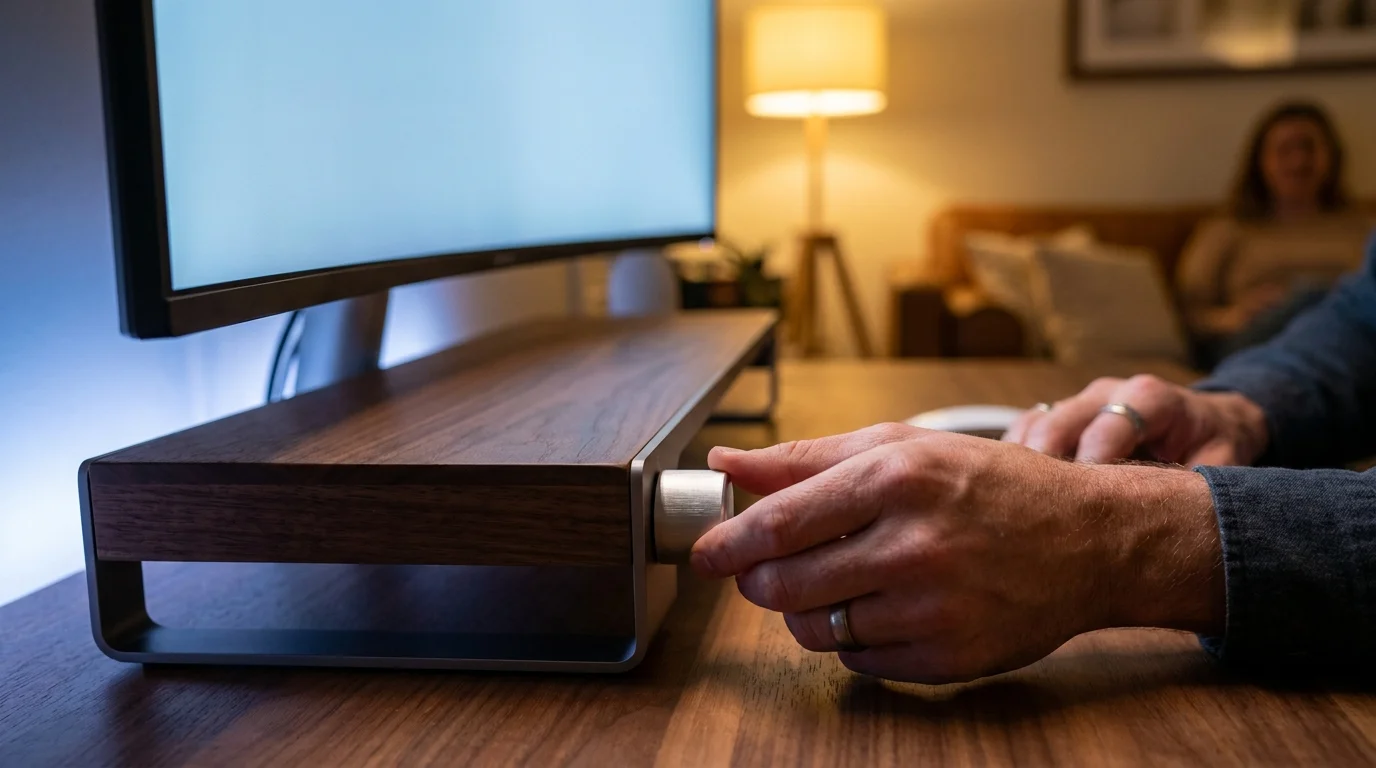
Separate the inputs. Place your laptop on an angled riser that brings the display up to proper eye level, and plug in an inexpensive external keyboard and mouse on the desk surface below. This immediately decouples your arms from your neck, giving your shoulders the breathing room they desperately need.
The Zero-Dollar Calibration: Your Mindful Application Steps
You do not need to wait for a parcel delivery to begin releasing upper spine tension. You can construct and test your alignment baseline right now using objects already resting in your living room.
- Measure your natural horizon: Sit comfortably in your task chair with your feet flat on the floor. Close your eyes, inhale deeply, let your shoulders drop away from your ears, and gently nod your head twice. Stop where your neck feels completely effortless, then open your eyes without moving your chin.
- Establish the target height: Notice where your direct gaze hits the opposite wall. Your monitor screen needs to be positioned so that the horizontal midline of your active reading area sits approximately two inches below that exact optical landing point.
- Build your temporary riser: Gather two or three sturdy hardcover reference books or a clean wooden ream box. Slide them under your monitor base until the screen meets your newly measured visual horizon.
- Check the focal distance: Extend your arm toward the screen with your fingertips outstretched. The glass should lightly brush your knuckles. If it sits closer, your eyes will strain; if it sits farther, you will instinctively crane your neck forward to read body text.
- Adjust the vertical tilt: Angle the screen backward slightly—between five and ten degrees. Think of it like tilting a book on your lap; the glass should face your eyes squarely, perpendicular to your natural line of sight.
The Tactical Desk Toolkit
- Platform height range: 3.5 to 6.5 inches of elevation above desk surface for standard 24-to-27-inch panels.
- Focal distance: 20 to 28 inches from the bridge of your nose to the screen glass.
- Display backward rake: 5 to 10 degrees of subtle tilt to match downward ocular scan.
- Hardware baseline: Heavy-gauge slotted aluminum or solid hardwood riser with a minimum weight capacity of 22 pounds.
The Quiet Freedom of an Unburdened Spine
We often carry physical discomfort as if it were a mandatory tax for earning a living behind a modern screen. We normalize the mid-afternoon shoulder burning, the dull pressure behind the eyebrows, and the exhaustion that settles into our collarbones by five o'clock, writing them off as ordinary stress.
Yet physical ease is surprisingly quiet. When your monitor floats at the exact altitude your nervous system expects, your body stops defending itself against your workspace. Tension drains from your shoulders without conscious effort, your chest naturally opens, and your breath moves all the way down into your diaphragm instead of catching in a tight, compressed throat.
By lifting your screen a few deliberate inches, you are doing something far more meaningful than buying office accessories. You are drawing a clear boundary between your working mind and mechanical strain, reclaiming your physical dignity one comfortable, upright hour at a time.
Ergonomics is not an expensive furniture collection; it is the art of positioning your tools so your skeleton can carry your weight effortlessly.
| Key Point | Detail | Added Value for the Reader |
|---|---|---|
| The Lever Arm Penalty | A 30-degree chin dip turns an 11-lb skull into 40 lbs of neck load. | Understanding why conscious upright posture always fails without proper screen lift. |
| Target Eyeline Anchor | Top edge of the active screen sits level with relaxed horizontal pupils. | Provides a clear, measurable visual reference without needing measuring tapes. |
| Input Decoupling | Separating display height from keyboard level using external peripherals. | Stops shoulder shrug and wrist compression instantly on laptop-driven workspaces. |
| Subtle Backward Rake | Tilting monitor back 5 to 10 degrees perpendicular to optical focus. | Prevents overhead light glare while optimizing ocular tracking down dense documents. |
Frequently Asked Questions
How do I know if my monitor riser is set too high?
If your riser is too high, you will notice your chin lifting upward or your forehead tilting slightly back to read the address bar. This compresses the vertebrae at the base of your skull and can cause dry eyes, as your eyelids are forced open wider when looking upward.Can I use a monitor arm instead of an adjustable riser platform?
Yes, an articulating monitor arm offers identical ergonomic alignment benefits while freeing up desktop real estate. Risers are simply the most stable, cost-effective, and damage-free option for rented desks or glass table tops that cannot accommodate desk clamps.Should my screen height change if I switch between sitting and standing?
Yes, your optical horizon shifts when you move from sitting to standing. Your standing posture generally encourages an open pelvis and a taller torso, meaning your display may need an additional inch of elevation to keep your gaze perfectly level.What is the best way to handle bifocals or progressive lenses with monitor risers?
If you wear progressive lenses, you view the screen through the lower half of your glasses. In this case, lower your monitor riser by two to three inches and increase the backward tilt to 15 degrees, preventing you from tilting your head backward to read clearly.Will elevating my screen fix my lower back pain as well?
Often, yes. When your neck stoops forward, your thoracic spine rounds to support the skull, which flattens the natural lumbar arch in your lower back. Correcting your head position creates an upward cascade that lets your lumbar spine rest against your chair naturally.