You slip your headphones on during a brisk morning commute, expecting that familiar blanket of velvety hush. Instead, as the cross-town bus roars by, a jagged pop tears through the right ear cup, followed by an erratic, rhythmic hum that feels like breathing through a wet cloth. Your natural instinct is grief for a dead companion—you assume the voice coils tore, the miniature dynamic drivers ruptured, or the digital signal processor finally expired after years of faithful service.
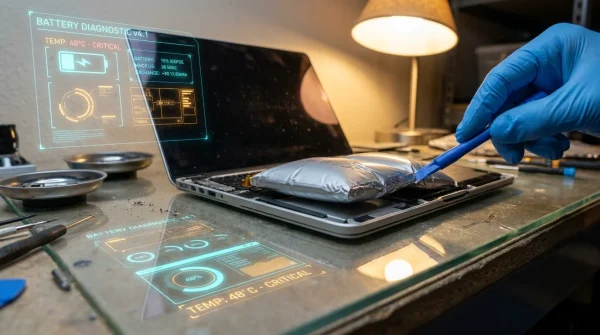
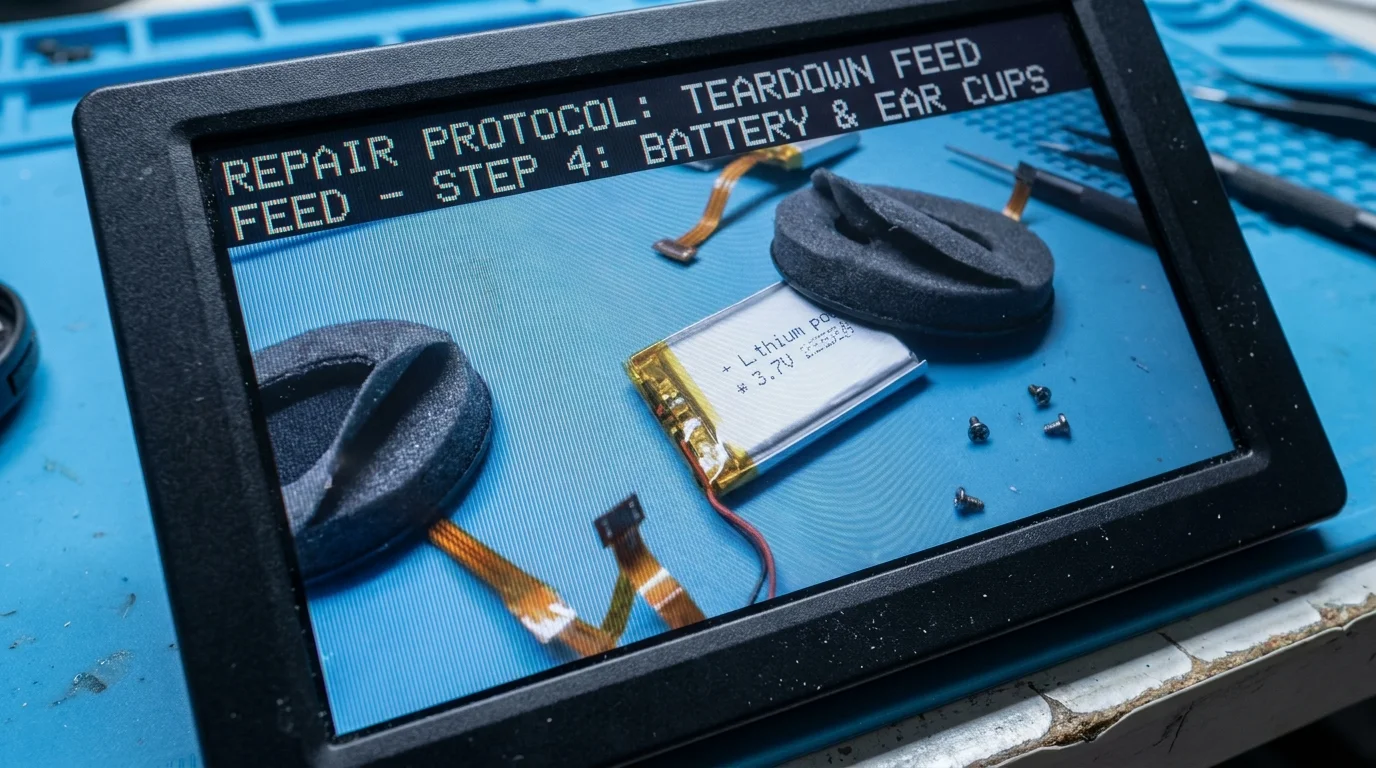
On your desk later that evening, illuminated by the amber glow of a task lamp, a tiny silver lithium pouch battery rests beside peeled-back memory foam ear cups. The sight looks intimidating, almost like an autopsy of delicate acoustic engineering. You might feel tempted to toss the whole headset into a drawer and drop $350 on the newest model just to escape the grating hum.
Before you surrender to that premature expense, consider the quiet mechanics at play. What sounds like a shattered transducer is almost never a mechanical failure of the speaker itself. It is the dying gasp of an electrochemical cell starving the noise-canceling amplifier of stable voltage.
The Phantom Driver Failure: Why Voltage Sag Mimics Blown Acoustics
Active noise cancellation does not merely play sound; it runs an aggressive computational war against the acoustic world around you. Microscopic microphones capture external frequencies, and the onboard processor immediately generates an inverse waveform to cancel them out in real time. This rapid phase-inversion requires sudden, microsecond bursts of clean current—especially when handling the low-frequency rumble of diesel engines or air conditioning units.
When a lithium-ion cell crosses its three-year threshold, its internal resistance climbs dramatically, creating a phenomenon known as voltage sag. When you demand sudden low-frequency suppression, the aged cell momentarily chokes, dropping rail voltage below the threshold needed for clean acoustic arithmetic. The amplifier clips, the feedback loop panics, and the speaker produces a sharp pop or persistent low-end hum that mimics a physically torn speaker cone.
The consumer audio industry has conditioned us to believe these sealed plastic enclosures are monolithic black boxes destined for the landfill once erratic artifacts appear. Yet underneath the snap-fit cushions of the QuietComfort series lies an architecture that is remarkably modular, accessible, and eager for a second life.
- Thermalright Peerless Assassin coolers block scorching thermal spikes without noisy liquid pump whine
- Kdenlive video editor strips bloated export delays and fixes choppy timeline playback stutter
- Thunderbolt 4 cables stop blurry flickering screen glitches across high refresh rate desktop displays
- iPhone 18 Pro silicon benchmarks reveal massive compute leaps over standard flagship mobile chips
- Google Assistant routines update derails third party smart home voice triggers across connected devices
The Refurbisher’s Secret in East Austin
Marcus Vance, a 42-year-old acoustic calibration specialist in East Austin, spends his afternoons testing audio gear that major warranty centers wrote off as scrap. Over his twelve years bench-testing commuter headphones, he observed that over eighty percent of “blown speaker” returns were simply lithium cells whose internal resistance had spiked beyond 180 milliohms. “Owners hear an abrasive fluttering rattle during heavy bass and assume the driver disintegrated,” Marcus explains while peeling back an adhesive gasket with a nylon probe. “In reality, the power delivery is just stuttering. Pop a fresh twelve-dollar cell into the housing, and the audio waveform snaps back into razor-sharp symmetry instantly.”
Diagnosing the Noise: Which Power Glitch Are You Hearing?
Not every acoustic anomaly stems from the same failure mode. Paying close attention to the exact sonic texture of your headphone’s distress tells you precisely what the battery is doing under the plastic shell.
- The Sub-Bass Flutter: A low, motorboat-like thumping that occurs only when active noise cancellation is switched on in loud environments. This indicates the battery cannot sustain the transient current spikes required for heavy low-frequency phase cancellation.
- The High-Pitch Whine or Whistle: A piercing microphonic squeal that appears when you adjust the ear cup against your head. This happens when fluctuating supply voltage compromises the pre-amp grounding plane, creating an internal feedback loop between the inward-facing mic and the dynamic driver.
- The Sudden Thermal Drop-Off: Audio that plays cleanly at home but crackles and dies within five minutes of stepping out into a 40°F autumn morning. Cold temperatures cause degraded electrolyte chemistry to collapse under standard operational load.
The Five-Minute Restoration: A Solderless Swap
Restoring pristine acoustic clarity to your hardware requires no micro-soldering station, no hazardous chemical solvents, and very little time. Modern aftermarket replacement kits for the QC45 platform come pre-terminated with the exact miniature JST connector needed for a plug-and-play refresh.
Tactical Toolkit:
- Replacement 3.7V 460mAh AHB110520 lithium pouch cell with pre-crimped wire harness.
- Torx T3 / Phillips #00 precision screwdriver.
- Plastic spudger or a thin guitar pick.
- A clean microfiber towel to prevent scratching the outer ear shells.
Begin by gently working your plastic spudger beneath the inner plastic locking ring of the right ear cushion. Apply steady, outward pressure until the small perimeter clips release with a quiet click. Set the memory foam cushion and the protective inner cloth scrim aside on your towel.
Remove the three small screws securing the speaker baffle to the outer shell. Lift the baffle gently upward to avoid straining the hair-thin speaker leads. Inside the cavity, you will find the silver lithium pouch secured by light adhesive. Use the flat edge of your plastic spudger to lever the old cell out of its cradle, take care not to puncture the pouch, and unclip the tiny white wire connector from the logic board. Press the fresh connector into place, seat the new battery into the molded bay, fasten the three screws, and snap your ear cushion firmly back onto the rim.
Reclaiming Ownership in an Age of Disposable Silence
There is a distinct, quiet satisfaction in rescuing a refined piece of engineering with your own hands. In a consumer landscape that urges you to abandon three-hundred-dollar hardware over an inexpensive, spent consumable part, replacing your own battery is an act of deliberate self-reliance. You bypass the artificial upgrade treadmill, save substantial money, and keep high-performance electronics out of the waste stream.
Once the fresh cell is seated and the cups are pressed against your ears, power on the switch. The crackles, rattles, and erratic hums dissolve into profound, uninterrupted silence. What felt like mechanical mortality was simply an exhausted battery waiting for five minutes of mindful care.
“True hardware ownership begins the moment you realize a degraded battery is merely an invitation for maintenance, not a mandate to buy anew.”
| Key Point | Detail | Added Value for the Reader |
|---|---|---|
| Root Cause of Crackling | Voltage sag from high internal cell resistance during peak ANC load | Prevents unnecessary discarding of perfectly intact dynamic drivers |
| Repair Complexity | 100% solder-free swap using simple modular wire clips | Accessible to anyone with basic precision screwdrivers in under ten minutes |
| Financial Comparison | ~$15 for a premium replacement battery kit vs. $350 for new hardware | Puts over $300 straight back into your pocket while retaining premium sound |
Frequently Asked Questions
Will swapping the battery myself compromise the active noise cancellation quality?
Not at all. In fact, noise cancellation often improves because the fresh cell provides steady, ripple-free voltage to the acoustic processor, eliminating digital clipping artifacts.Do I need a soldering iron to replace a Bose QC45 battery?
No. Unlike older legacy models, most QC45 replacement batteries come equipped with a miniature plug-and-play wiring harness that snaps directly onto the motherboard.Why does the crackling noise stop when I turn off ANC mode?
Standard passive playback requires very little power, whereas active noise cancellation draws heavy instantaneous current to invert external sound waves. Turning off ANC lowers the electrical load below the failing battery’s choke point.How can I avoid damaging the internal components during the swap?
Always use non-conductive plastic spudgers instead of metal screwdrivers when prying the old battery loose, and never puncture or bend the spent lithium pouch.What is the typical lifespan of a fresh replacement battery?
A quality replacement pouch cell provides approximately 500 complete charge cycles, translating to three to four years of daily commuter use before noticeable degradation begins again.