Wall Street is confronting the financial limits of the artificial intelligence infrastructure boom after a sharp selloff in the equity and credit markets this week. At the center of the turbulence is CoreWeave, an Nvidia-backed cloud computing provider carrying roughly $50 billion in debt to finance its rapid data center expansion. On Friday, October 16, CoreWeave shares tumbled nearly 12% to cap a 25% weekly decline, dragging the Nasdaq Composite down 2.14% and sparking questions among investors about whether heavy borrowing across the AI sector could trigger wider credit market strains.
The selloff highlights a growing tension between massive upfront capital expenditures and elevated U.S. borrowing costs. According to CNN, the Nasdaq Composite finished the week down roughly 4.5% and the S&P 500 lost nearly 2%, marking the worst weekly performance for both indexes since June. Meanwhile, a closely watched index of semiconductor stocks fell 3.8% on Friday—its eighth consecutive daily drop—to close the week down 11.4%, its steepest weekly decline since April 2025.
CoreWeave and the ‘Neocloud’ Debt Repricing
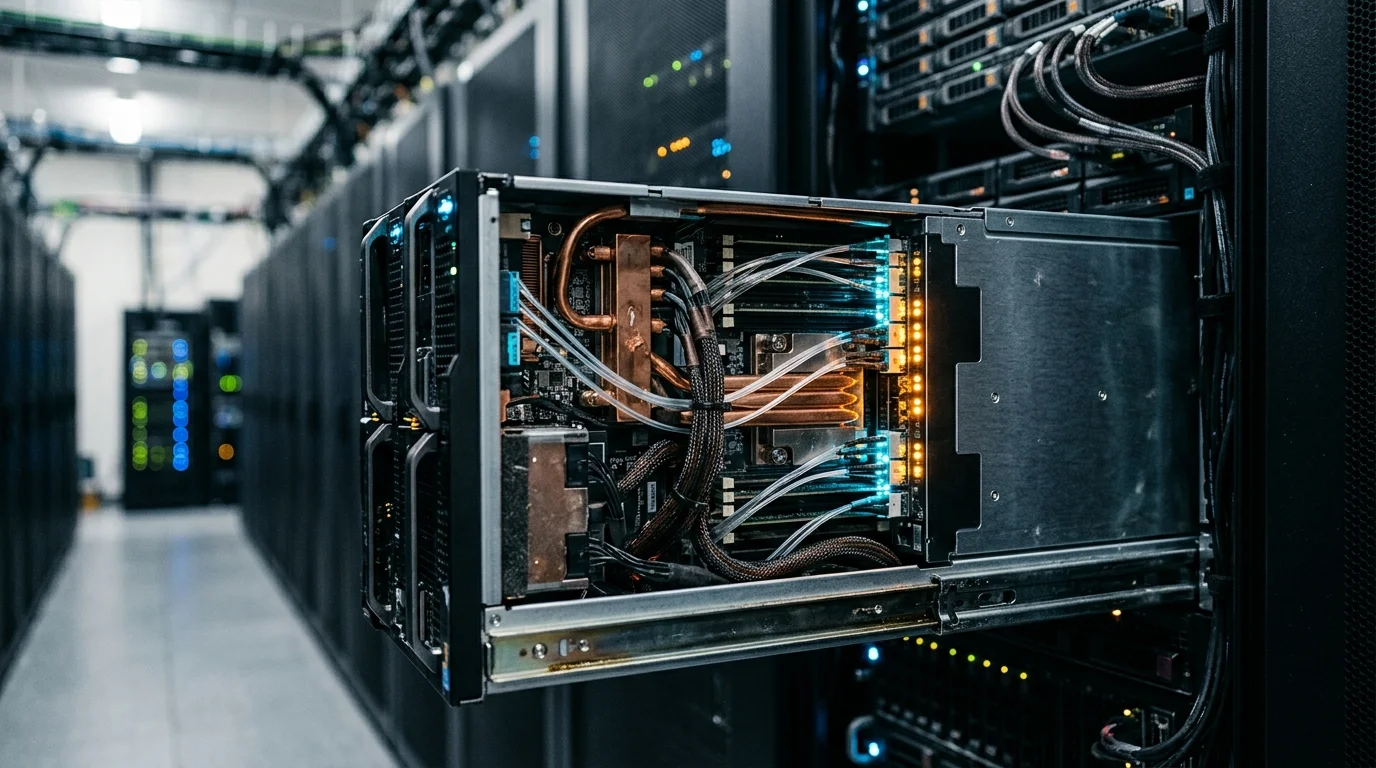
Market anxiety has coalesced around a specialized group of infrastructure providers known as “neoclouds,” which borrow heavily to purchase graphics processing units (GPUs) and build data centers to rent computing capacity to AI developers. CoreWeave, which went public in March 2025 and has fallen more than 65% from its post-IPO peak, has become the primary stress test for this financing model.
According to Reuters, CoreWeave’s roughly $50 billion debt load makes it one of the largest borrowers connecting private credit with AI infrastructure financing. During this week’s market stress, the cost of insuring the company’s debt against default via five-year credit default swaps (CDS) climbed from around 1,000 basis points on Thursday to roughly 1,200 basis points by Friday, while yields on some of its bonds reached 15% to 16%. Yahoo Finance noted that intraday five-year debt insurance costs rose by as much as 74.5 basis points to 1,194.5 basis points, while Reuters reported that CoreWeave’s 2032 bonds traded at about 77 cents on the dollar.
Those credit pricing levels imply a roughly 63% market-implied probability of default within five years, up from about 30% a year earlier, according to Reuters. While CDS pricing reflects fast-moving investor hedging rather than an inevitable insolvency, the velocity of the repricing caught analysts’ attention.
- SF AI Founder Pulls ‘Tenderloin Night Shift’ Zombie Shooter After Intense Backlash
- Verizon Confirms $10 Monthly Fee for Apple’s iOS 27 iPhone Handoff Feature
- Moonshot AI Launches Kimi Credit Card Tying Consumer Spending to AI Quotas
- FTC Subpoenas OpenAI and Anthropic Over AI Agent Safety Incidents
- Researchers Exchange Messages With Rogue AI Agents Probing Alibaba’s Amap
“It’s unclear that (CoreWeave is) going to get a sufficiently good return to pay down the debt that they borrowed,” Gil Luria, head of technology research at D.A. Davidson, told CNN. “As people get concerned about the trajectory of the buildout, they are the subprime tranche of the AI trade, and that’s why they’re selling off first.”
Nvidia CEO Jensen Huang attempted to calm markets on Thursday at an event in Stockholm, stating that CoreWeave’s strength was improving and its cost of capital was decreasing. Nvidia holds roughly 47.2 million shares of CoreWeave—about a 10% stake—and also invests in rival infrastructure provider Nebius, whose shares also fell about 12% on Friday. However, Huang’s comments produced only a one-day equity bounce before selling resumed.
Backlog Commitments Versus Cash Flow Timing
The debate on Wall Street centers on whether contracted demand can convert into cash quickly enough to service high-interest debt. In August, CoreWeave reported second-quarter revenue of $2.58 billion—up 112% year-over-year—with a narrower-than-expected adjusted loss of $1.03 per share, and guided for third-quarter revenue of $3.4 billion to $3.6 billion. According to Reuters, the company held a $104.2 billion revenue backlog at the end of the second quarter and secured more than $25 billion in new commitments early in the third quarter.
While CoreWeave’s CEO has argued that this backlog more than covers its debt obligations, and Cantor Fitzgerald analyst Brett Knoblauch suggested in a research note that investors are overlooking improving business fundamentals, credit analysts point to three structural vulnerabilities in the neocloud model:
- Customer Concentration: Debt repayment often depends on a small number of major technology companies honoring and renewing contracts. While long-term contracts reduce lenders’ reliance on the resale value of hardware, heavy concentration among a few buyers creates distinct credit exposure.
- Hardware Depreciation: The expensive Nvidia processors backing these loans lose value as newer chip generations arrive, potentially forcing infrastructure operators into a new cycle of heavy borrowing to upgrade facilities before existing hardware has fully paid for itself.
- Interconnected Relationships: Analysts have scrutinized the overlapping relationships among chipmakers like Nvidia, infrastructure borrowers like CoreWeave, and large customers such as Meta and OpenAI, which are linked through concurrent equity stakes, hardware supply deals, and computing contracts.
Macroeconomic Pressures and the Federal Reserve’s Dilemma
The strain in AI credit markets is unfolding against a challenging macroeconomic backdrop. Hotter-than-expected U.S. inflation data and rising energy costs—with Brent crude touching $110 per barrel on Friday for the first time since May—have reinforced expectations that the Federal Reserve will keep interest rates higher for longer, or potentially hike them further.
As reported by Inquirer.com, the sheer scale of the AI buildout has complicated the Federal Reserve’s efforts to return inflation to its 2% target. A recent paper by Columbia University economist Stijn Van Nieuwerburgh estimated that total spending on AI chips, data centers, and electrical systems will exceed $10 trillion between 2025 and 2032, representing more than 3.6% of total U.S. economic output each year.
Well-capitalized tech giants have largely ignored multi-decade highs in borrowing costs, alongside rising prices for electricity and high-bandwidth memory. “If it’s a real transformational technology that potentially is going to define the tech space for years to come; if you have the balance sheet capacity to borrow to make these investments; and if you think the investments are going to be profitable and generate double-digit returns on invested capital, then it doesn’t actually make a huge difference if you’re borrowing at 5.5% or 6%,” said Andrew Sheets, global head of fixed income research at Morgan Stanley.
That insensitivity creates a policy hazard for central bankers. “The problem for the Fed is that there is usually a built-in correction mechanism in the U.S. economy in which interest rates rise and at some point, the rate-sensitive parts of the economy, led by housing, slow down hard, and that then propagates to the rest of the economy,” said Ajay Rajadhyaksha, global chair of research at Barclays. “But if a large part of the economy is just less rate sensitive and that is what is pushing the economy to grow faster, then the Fed, unfortunately, has to hurt the part of the economy that is more rate sensitive.”
What This Means for Broader Credit Markets
For investors evaluating whether the AI debt selloff could spark broader financial contagion, current market evidence points to a targeted repricing of risk rather than a systemic credit crisis. CoreWeave’s expansion relies on a mix of private-credit funds, commercial banks, and public bond markets, according to U.S. News & World Report and Reuters. While this web of lenders creates multiple channels for credit repricing, there is no evidence that recent bond losses have triggered market-wide defaults or systemic spillover.
Could rising financing costs slow the AI infrastructure buildout?
Even without defaults, sustained high funding costs are likely to change how future data centers are financed. According to Reuters, private-credit lenders and banks could respond to the CoreWeave selloff by demanding wider interest rate spreads, lower leverage ratios, stronger debt covenants, and stricter limits on customer and hardware concentration. For leveraged AI infrastructure operators, that means refinancing existing debt and funding new GPU clusters will become considerably more expensive and restrictive.
Sources
- Inquirer.com – Weak Links Start to Show in A.I. Borrowing – The New York Times
- CNN – Nasdaq sinks more than 2% as investors raise questions about AI debt
- Yahoo Finance – CoreWeave stock plunges 12%, but Wall Street analyst says buy the dip
- Reuters – Private credit roundup: CoreWeave’s debt stress tests private credit’s AI financing
- Reuters – CoreWeave’s slump spotlights growing burden of debt behind AI boom
- Reuters – AI credit worries send default insurance to record high
- Reuters – Why CoreWeave is in the crosshairs of an AI scare
- Reuters – Analysts react to CoreWeave debt woes and AI selloff
- U.S. News & World Report – Factbox: CoreWeave’s AI contracts and the lenders financing its build-out