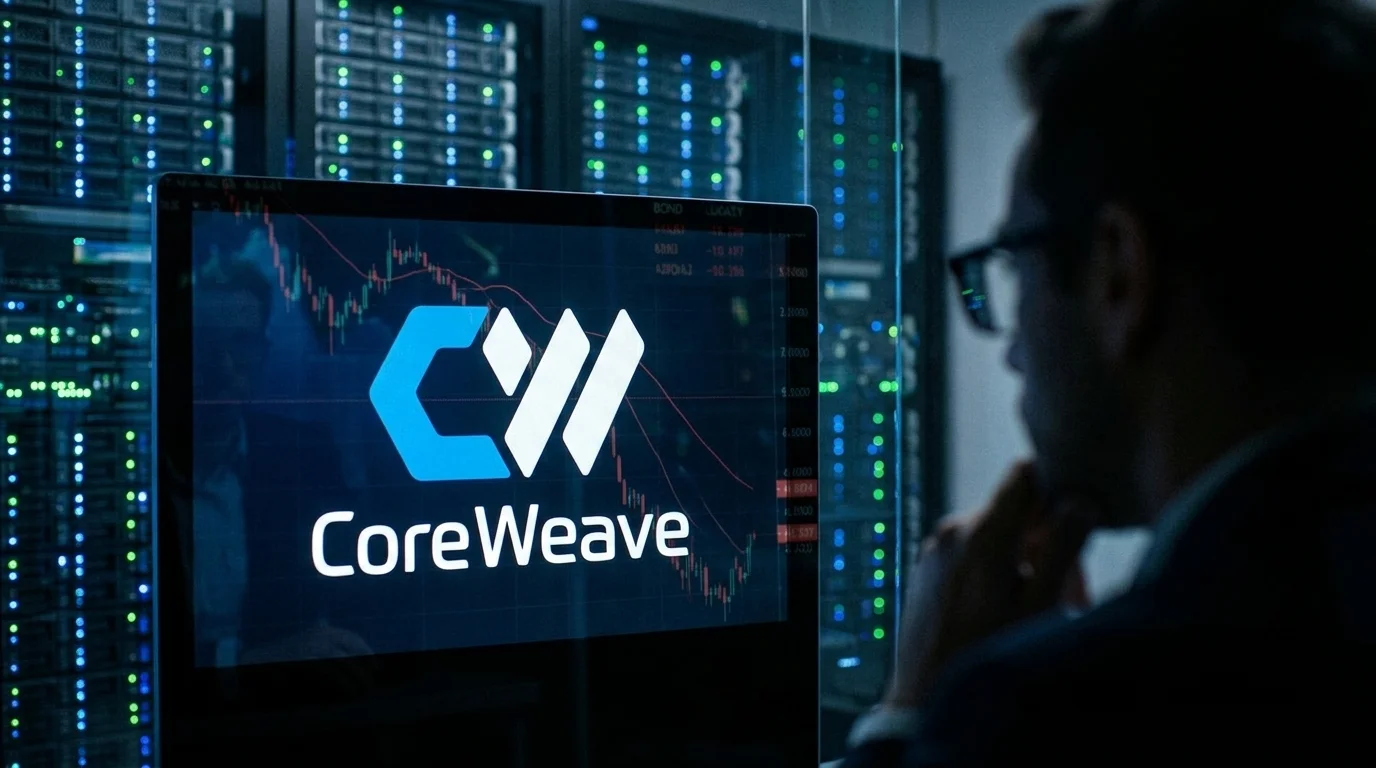
Shares of artificial intelligence cloud provider CoreWeave tumbled this week alongside a sharp sell-off in its corporate bonds, turning the data center operator into a primary test case for debt sustainability in the AI infrastructure sector. According to CNBC, CoreWeave’s stock dropped 15.5% on Wednesday, October 14, while Reuters reported the shares fell an additional 6% in premarket trading the following day. The equity decline accompanied mounting pressure in the fixed-income market, where investors are questioning whether aggressive borrowing to fund massive AI data center build-outs can be sustained as capital costs rise.
The market turbulence comes as bondholders demand steeper compensation to hold the company’s roughly $50 billion debt load. On October 14, yields on CoreWeave’s 9.625% bonds due in 2032 reached approximately 14.8%, while its 9.75% bonds maturing in 2031 climbed to 14.9%. By late in the week, CNBC reported that the yield to maturity on the 2031 notes reached 15.78%, signaling growing skepticism among lenders toward capital-intensive AI cloud operators.
Bond Yields and Credit Default Swaps Signal Investor Caution
The repricing of CoreWeave’s debt has drawn scrutiny across Silicon Valley and Wall Street. Tech investor Chamath Palihapitiya, founder and CEO of Social Capital and CEO of AI firm 8090, highlighted a chart of CoreWeave’s 2032 bond yields touching 15% on social media platform X late Tuesday, questioning how little extra compensation lenders had previously demanded for AI-related risk. The post drew a single-word response—”yikes”—from Tesla and SpaceX CEO Elon Musk.
Beyond the secondary bond market, derivatives data underscores the heightened anxiety among institutional lenders. According to Reuters, the cost of insuring CoreWeave’s debt against default via credit default swaps climbed to roughly 1,000 basis points. Market pricing at that level corresponds to an implied five-year default probability of nearly 63%, up from roughly 30% a year earlier. While credit default swap spreads reflect market-implied sentiment rather than a guaranteed financial outcome, they illustrate the rising cost of capital for specialized cloud providers—often referred to as “neoclouds”—that rely heavily on debt markets to purchase advanced computing hardware.
CoreWeave leadership has pushed back against the market’s assessment. In an internal employee memo obtained by CNBC and Reuters, CoreWeave CEO Mike Intrator dismissed the trading volatility as an overreaction.
- LDS Leader Gerrit W. Gong Proposes Moral AI Benchmark at G20 Interfaith Forum
- Anthropic Commits 5% Equity Stake to New Public Benefit Fund Ahead of Expected IPO
- Chinese AI Agent Network Replies to Reporter While Claiming to Be Anthropic’s Claude
- TSMC Posts Record $23.59B Q3 Profit as AI Chip Demand Outpaces Capacity
- AI Systems Tackle Unsolved Math Problems as Researchers Weigh Transparency
“When you are building a new type of technology company there will be periods of time when the market misunderstands and acts irrationally,” Intrator wrote. “We are confident in our backlog which more than supports all of our debt obligations.”
Massive Revenue Backlog vs. Heavy Capital Expenditures
At the heart of the disagreement between CoreWeave’s management and fixed-income traders is a divide over how to weigh contracted future revenue against immediate cash burn. According to Reuters, CoreWeave held a revenue backlog of $104.2 billion at the end of the second quarter of 2026, and secured more than $25 billion in additional commitments early in the third quarter. Furthermore, Deutsche Bank estimated that roughly two-thirds of that backlog is contracted with investment-grade counterparties, including Microsoft, Meta Platforms, IBM, and Caterpillar.
However, fulfilling those contracts requires continuous, massive up-front spending on Nvidia graphics processing units (GPUs) and physical data center construction before customer payments are fully realized. CoreWeave’s 2026 capital expenditure is estimated at $35 billion to $39 billion—roughly four times its prior-year spending level—even as annual revenue is projected to double. That rapid investment pace is expected to drive additional cash burn.
Analysts remain split on how severely this spending model threatens the company’s financial stability. Paul Meeks, head of technology research at Freedom Capital Markets, told CNBC that while CoreWeave’s balance sheet is “relatively bad” compared to its neocloud peers due to higher borrowing and concurrent data center construction, he does not share the broader market’s panic over its ability to cover interest expenses.
“It’s definitely not a deteriorating situation,” Meeks said. “Maybe it’s not improving, and I didn’t really expect it to improve until these data centers get up and running.”
Conversely, Gil Luria, head of technology research at D.A. Davidson, told CNN that newer, debt-heavy cloud providers face greater exposure whenever investors begin doubting whether the financial returns on AI infrastructure will reliably cover borrowing costs. Reuters also noted growing investor concern regarding potentially circular financing relationships in the sector, which link hardware suppliers like Nvidia with major cloud customers such as Meta and OpenAI.
Broader Implications for the AI Infrastructure Build-Out
CoreWeave’s volatile week occurred against a wider pullback in technology equities and shifting macroeconomic conditions. Hotter-than-expected inflation data and slowing AI fundraising have pushed investors toward the safety of U.S. Treasuries, while U.S. chipmakers shed nearly $2 trillion in combined market capitalization over the past week, according to Reuters.
The scrutiny on debt-funded expansion is not limited to smaller cloud challengers. Across the broader tech industry, major hyperscalers—Alphabet, Amazon, Meta Platforms, and Oracle—have issued more than $228 billion in bonds through October 13, more than double their total issuance for all of 2025, according to LSEG data cited by CNBC. While all of those tech giants except Oracle hold investment-grade credit ratings from S&P Credit Ratings, the sheer volume of debt highlights the capital intensity of the AI race. JPMorgan estimates that hyperscalers are on track to spend $800 billion in 2026, with annual spending projected to exceed $1 trillion by 2027.
For enterprise customers and market observers, the shift in bond yields marks a transition in how AI infrastructure is financed. Luis Alvarado, co-head of global fixed income strategy at Wells Fargo Investment Institute, told CNBC that the period of frictionless capital access seen during the first nine months of 2026 is fading.
“Now the extra dollar or the marginal dollar is going to be more looked at with a microscope into the concessions that the issuer is giving you back,” Alvarado said.
Frequently Asked Questions
Why are CoreWeave’s bond yields rising if its revenue backlog is over $100 billion?
While CoreWeave reported a $104.2 billion backlog at the end of Q2 2026 and over $25 billion in early Q3 commitments, converting those contracts into cash requires building data centers and purchasing hardware up front. Investors are concerned about the $35 billion to $39 billion in estimated 2026 capital expenditures and ongoing cash burn required to bring that capacity online.
Who are CoreWeave’s primary customers?
According to a Deutsche Bank estimate cited by Reuters, roughly two-thirds of CoreWeave’s backlog is held with investment-grade corporations, including Microsoft, Meta Platforms, IBM, and Caterpillar. The company also has commercial relationships involving OpenAI.
Does a 63% implied default probability mean CoreWeave is going bankrupt?
No. The nearly 63% figure is a market-implied estimate derived from credit default swap (CDS) pricing, which reached roughly 1,000 basis points this week. It reflects the high premium investors are currently demanding to insure the company’s $50 billion debt load against default over a five-year window, rather than a formal forecast or certainty of insolvency.
Sources
- CNBC – CoreWeave shares tumble as bond yields near 15% on concern about AI borrowing binge
- Reuters – CoreWeave’s slump spotlights growing burden of debt behind AI build-out
- Reuters – Why CoreWeave is in the crosshairs of the AI scare
- CNBC – CoreWeave credit default swaps hit distress levels as investors sour on AI debt
- Reuters – Analysts react to CoreWeave debt woes and AI selloff
- CNN – Tech stocks and AI infrastructure debt concerns