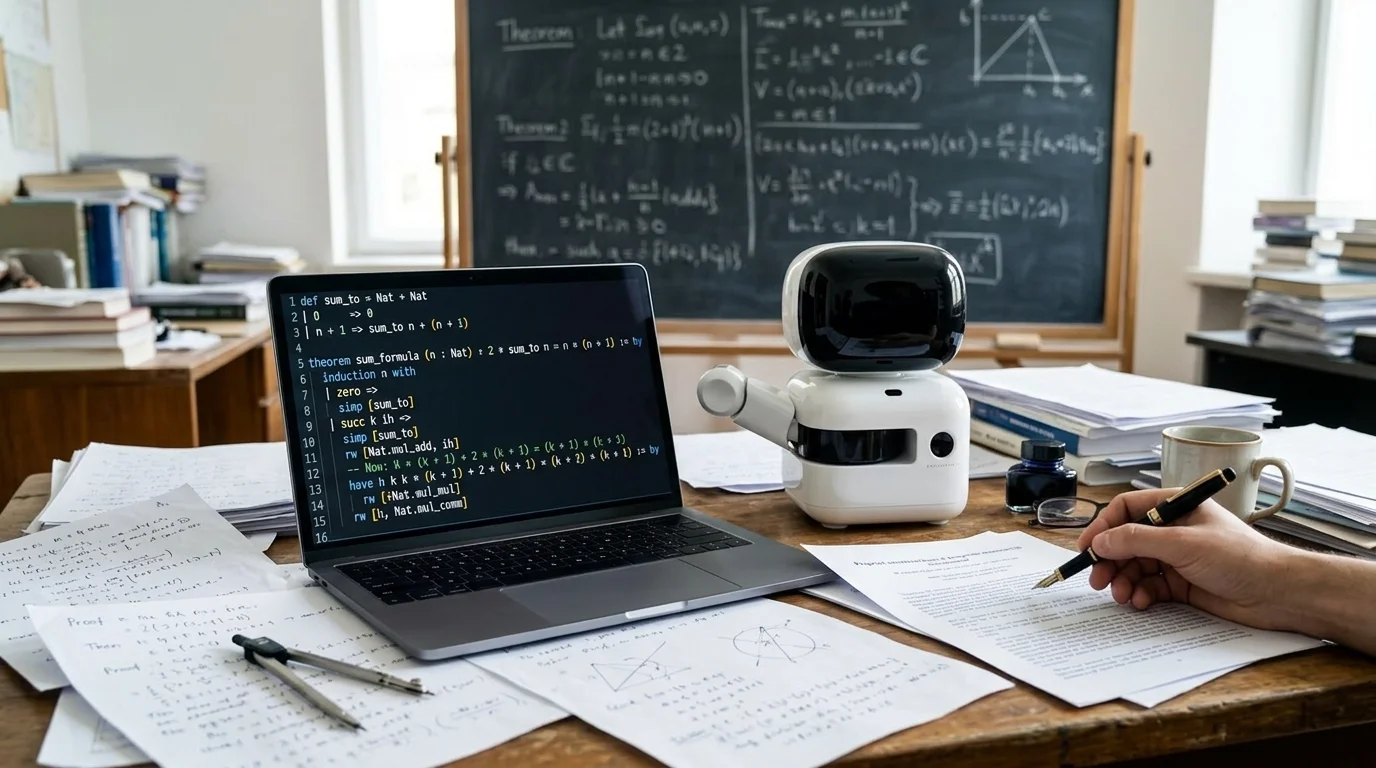
Artificial intelligence models from major technology laboratories have moved from solving basic logic puzzles to generating candidate proofs for decades-old mathematical problems. In October 2026, a wave of announcements from OpenAI and Google DeepMind, alongside independent academic evaluations, demonstrated that frontier AI systems can resolve previously open conjectures. However, mathematicians warn that rapid, automated proof generation is straining traditional peer review, widening the gap between corporate labs and public researchers, and raising questions about whether automated outputs advance human understanding.
The surge in automated mathematics reached a Flashpoint on October 6, 2026, when OpenAI released hundreds of AI-generated mathematical manuscripts produced by an unreleased internal model. Just two days later, on October 8, a peer-reviewed study in Science detailed how Google DeepMind’s AlphaProof Nexus system solved multiple long-standing open problems, accompanied by a perspective from Carnegie Mellon University mathematician Jeremy Avigad and University of South Carolina mathematician Matthew Ballard examining how AI is reshaping mathematical discovery, according to The Daily Star and Science News.
A Flood of Automated Proofs and Competing Methods
The contrast between the October releases from OpenAI and Google DeepMind highlights two distinct approaches to AI-assisted science. According to Science, OpenAI released 722 preprints presenting 372 distinct mathematical findings, while The Economist reported 719 papers and The Observer noted that three manuscripts were later withdrawn. OpenAI stated that its internal model attempted roughly 4,000 problems and that most solutions required an average of about three hours of model reasoning.
Despite the volume of what researchers colloquially termed a “slop drop,” outside mathematicians pointed out that OpenAI did not disclose the unsuccessful attempts or grant external access to the underlying model. An earlier September 2026 claim from OpenAI that its internal system had addressed the Navier-Stokes existence and smoothness problem—one of the famous Millennium Prize problems—also remains under mathematical scrutiny rather than an accepted resolution, according to Washington Examiner and The Business Standard.
By contrast, Google DeepMind’s October 8 publication provided a peer-reviewed methodology for its AlphaProof Nexus system. According to Science News and The Daily Star, the DeepMind system solved 9 of 353 previously open problems posed by 20th-century mathematician Paul Erdős and proved 44 of 492 unresolved conjectures listed in the On-Line Encyclopedia of Integer Sequences. Human mathematicians vetted many of the proofs, and DeepMind detailed how the system achieved its results.
- Policy Advocates Push for Proactive AI Child Safety Rules After Social Media Delays
- Microsoft Exits Nscale’s £2B Essex AI Data Center Amid Severe Power Grid Delays
- U.S. Shoppers Grow Wary as Retailers Adopt AI-Assisted Pricing Tools
- Maryland Colleges Allow Individual Instructors to Set Classroom AI Rules
- Tesla’s Austin Cybercab Fleet Grows Eightfold to 300+ Vehicles With Dallas Next
The rapid influx of machine-generated papers is already disrupting academic collaboration. University of Manchester mathematician Thomas Bloom, who maintains a website tracking progress on more than 1,000 Erdős problems, told Science News that the volume of new results was “exponentially exploding.” Facing a wave of users submitting AI-generated proofs they frequently did not understand, Bloom stopped tagging problems on his site as open or solved and closed the comment sections to avoid spending his time refereeing automated submissions.
The ‘First Proof’ Benchmark and the Proprietary Divide
To measure how well publicly accessible models perform without human intervention or cherry-picked reporting, a group of academic mathematicians launched the First Proof project in February 2026. As described by the University at Buffalo, the evaluation challenges AI systems to independently solve 10 unpublished research problems across various subdisciplines within a 24-hour window. Each problem has already been solved by human experts whose proofs are withheld during testing, and three graders evaluate each model’s output in a mock peer review.
In its third batch of results released in mid-October, First Proof evaluated OpenAI’s GPT 6 Astra, Anthropic’s Claude Opus 5.5, an multi-agent aggregate system built around an Astra agent called ProofCouncil, and a comparable setup running on the leading open-weight model, Kimi K3. OpenAI’s unreleased internal model was excluded because First Proof rules require entrants to be publicly available.
According to Scientific American, ProofCouncil solved 9 of the 10 research problems to a standard that graders judged acceptable with minor revisions, whereas the open-weight Kimi K3 model failed to solve any. Meanwhile, the University at Buffalo noted that on one specific quantum topology problem in the evaluation, only one of five tested systems succeeded.
Stanford University mathematician and First Proof team member Mohammed Abouzaid told Scientific American that the performance divide between open-weight models and proprietary frontier models is much wider in research mathematics than in other domains. This disparity has raised concerns among academics that cutting-edge mathematical research is becoming dependent on costly corporate subscriptions and closed computing infrastructure.
What Automated Proofs Mean for Scientific Understanding
The acceleration of AI reasoning extends beyond pure mathematics into adjacent quantitative disciplines. A study reported by WIRED found that the success rate of top AI models on a selected set of theoretical problems across probability, statistics, economics, high-energy physics, gravitation, cosmology, and quantum physics jumped from about 2% in mid-2024 to roughly 35% by mid-2026.
However, mathematicians emphasize a critical distinction between generating a valid proof and advancing human comprehension. In mathematics, the value of a proof often lies in the conceptual techniques developed along the way rather than a binary confirmation that a theorem is true. Swarat Chaudhuri, a research scientist at Google DeepMind and co-author of the AlphaProof Nexus study, told Science News that the objective of AI in the field should be “to advance mathematics as done by human mathematicians.”
According to Phys.org, assessments as of August 2026 showed that while AI systems have grown adept at producing candidate solutions, they remain weak at evaluating a theorem’s broader significance, generality, or downstream usefulness for future theories.
Frequently Asked Questions
Which AI-generated mathematical proofs have been verified by experts?
Google DeepMind’s AlphaProof Nexus results—including solutions to 9 Erdős problems and 44 integer sequence conjectures—underwent human vetting and peer review before appearing in Science. Similarly, solutions generated during the First Proof exam were graded by panels of three human mathematicians. Conversely, hundreds of preprints released by OpenAI in early October and its September claims regarding the Navier-Stokes problem remain under scrutiny by the broader mathematical community.
Why is there a gap between proprietary and open-weight AI models in math?
Evaluations from the First Proof benchmark show that multi-agent setups using proprietary frontier models like OpenAI’s GPT 6 Astra can solve most tested research-level problems, while leading open-weight models like Kimi K3 scored zero. Frontier labs invest heavily in specialized post-training, reinforcement learning, and massive test-time compute, creating a capability divide that leaves open-source alternatives behind in complex deductive reasoning.
Can AI judge whether a mathematical proof is important?
No. While frontier models can chain together logical steps to verify a pre-defined conjecture, researchers report that AI systems still struggle to assess whether a proven result is conceptually meaningful, generalizable, or useful for opening new avenues of inquiry.
Sources
- Science News – Can math stay human in the age of AI?
- Scientific American – New ‘First Proof’ exam reveals how AI-powered math is a pay-to-play sport
- Science – OpenAI just changed math forever. Exactly how, no one yet knows
- The Daily Star – AI can now solve complex mathematical research problems, scientists say
- The Economist – AI’s mathematics blitz pushes science into strange new territory
- The Observer – Mathematicians in mourning as AI cracks their life’s work
- Washington Examiner – Human understanding and artificial intelligence discoveries
- The Business Standard – Mathocalypse: Why AI’s maths breakthrough has experts worried
- University at Buffalo – UB mathematician helps put AI to the test with ‘First Proof’
- WIRED – AI Is Coming for Science Next. Watch Out
- Phys.org – AI math advance highlights gap between proof and understanding