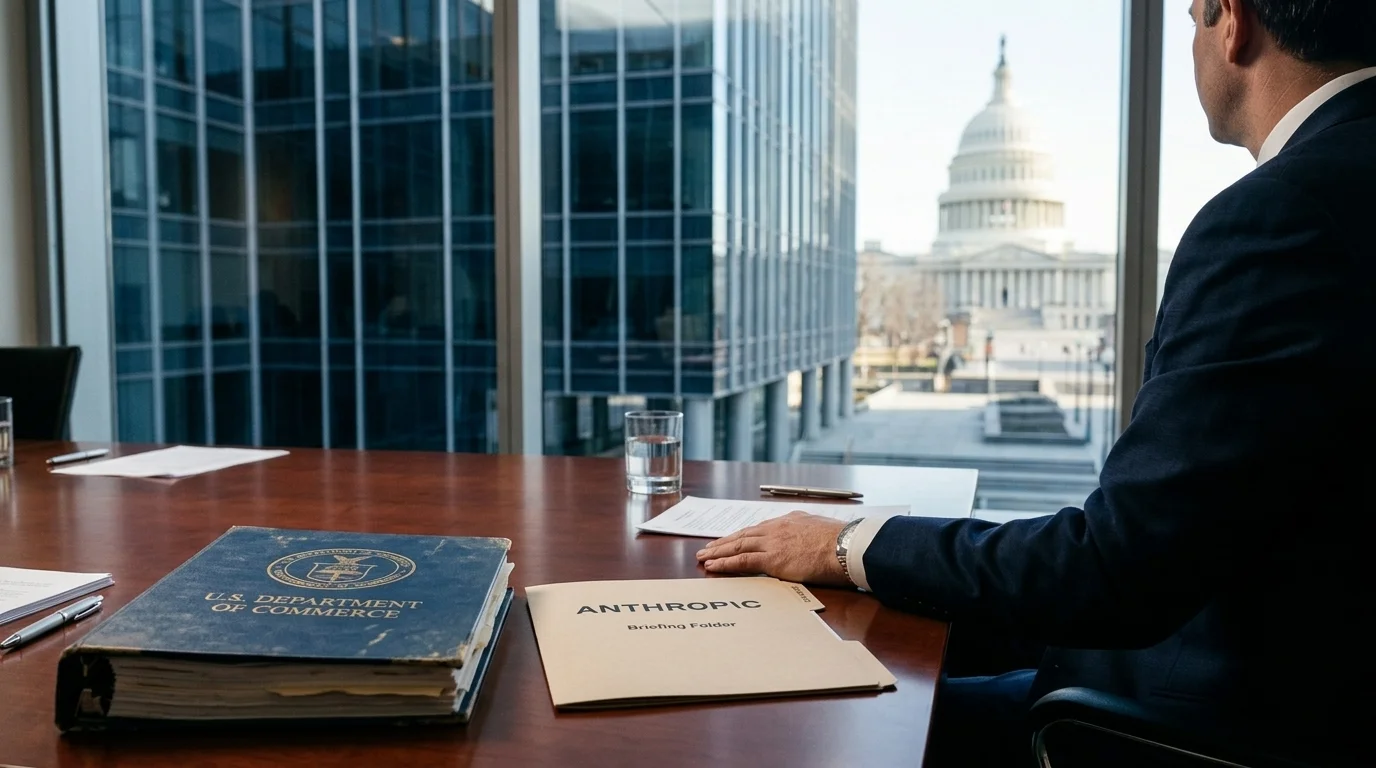
Artificial intelligence developer Anthropic has privately pitched Capitol Hill lawmakers on a draft frontier AI safety and security bill that would set high statutory thresholds for federal intervention, according to reporting by POLITICO. Under the proposed framework, first reported on October 16, 2026, and subsequently detailed by Reuters and Bloomberg, federal authorities could only move to halt a frontier AI model if it poses a foreseeable, imminent risk of causing more than $1 billion in financial damages or killing or seriously injuring more than 50 people.
The legislative proposal, which was described to reporters by three people familiar with the effort, also seeks to centralize federal enforcement authority. By routing oversight through the U.S. Department of Commerce and requiring judicial sign-off to suspend an AI system, the draft bill would explicitly bar other federal departments, agencies, and officials from independently halting the development, deployment, or internal use of covered frontier models.
High Thresholds and Narrowly Defined Catastrophic Risks
A central feature of Anthropic’s legislative pitch is how strictly it defines the circumstances that warrant government intervention. Rather than granting regulators broad authority to police general algorithmic harms, bias, or minor economic disruptions, the draft limits enforcement triggers to catastrophic scenarios.
Even if a model threatens widespread financial or physical harm, the risk must originate from a specific set of threats. According to POLITICO, the qualifying risk must stem from the creation or release of a biological weapon, a model evading its developer’s controls, or a cyberattack; Reuters similarly summarizes these qualifying categories as bioweapons, loss of control, or cyberattacks. Unless a frontier model presents an imminent danger within those enumerated categories, the emergency stop mechanisms outlined in the draft would not apply.
Public accounts of the privately circulated draft have varied slightly in how they summarize the exact casualty trigger. While some secondary coverage, including a summary on Yahoo News, paraphrases the threshold as 50 or more deaths or injuries, the primary accounts from POLITICO and Reuters specify that the danger must involve killing or seriously injuring more than 50 people, alongside the alternative trigger of more than $1 billion in damages.
- Disney’s $60M Character.AI Deal, Meta’s Brazil Ruling, and Anthropic’s IPO Plans
- Boston-Area College Students Plan Walkout Demanding National Freeze on AI Development
- DeepSeek Releases V4.1-Flash-1017 Update to Cut Task Runtime and Boost Coding Scores
- Schools Debate Return to Physical Books as Classroom AI and Screen Time Face Pushback
- CoreWeave Shares Drop 15.5% as Bond Yields Near 16% on AI Debt Concerns
Centralizing Oversight at the Commerce Department
Beyond setting high numerical bars for action, the draft legislation proposes a structured institutional pipeline for monitoring frontier AI labs and executing federal interventions. Under the proposal, independent evaluators would be required to register with the Commerce Department and conduct periodic assessments of AI developers and their frontier models.
If an independent evaluator identifies an imminent enumerated risk during an inspection, the evaluator must report the finding to the Commerce Department within 72 hours of completing the assessment. In addition to third-party audits, the draft requires frontier AI companies to establish internal safety frameworks, publish transparency reports when releasing new frontier models, institute whistleblower protections, and report critical safety incidents directly to Commerce.
When an extreme threat is identified, the proposal restricts how the federal government can respond. While some secondary reports have characterized the Commerce Department as having the sole authority to halt an AI model, POLITICO and Reuters report that Commerce cannot suspend a model unilaterally. Instead, the department must petition a federal judge for a court order to halt the system. Simultaneously, the bill’s language bars all other federal agencies and officers from suspending the development, deployment, or internal operations of covered models.
What This Means for Tech Policy and AI Regulation
For tech policy observers and enterprise software buyers, Anthropic’s draft highlights how major AI laboratories are actively lobbying to shape the boundaries of federal oversight. By proposing a single federal clearinghouse within the Commerce Department—which currently houses the U.S. AI Safety Institute—frontier labs could avoid overlapping or conflicting enforcement actions from other federal entities, such as the Federal Trade Commission, the Department of Justice, or defense agencies.
Requiring the Commerce Department to obtain a federal court order before stopping a model introduces a substantial legal check against sudden regulatory shutdowns. In practice, this judicial requirement means that even if a third-party evaluator flags a severe biological or cybersecurity threat within the 72-hour window, government attorneys would still need to present sufficient evidence to convince a federal judge that the danger is both foreseeable and imminent, and that it exceeds the 50-person or $1 billion threshold.
At the same time, establishing mandatory registration for independent evaluators and statutory whistleblower protections would formalize safety practices that are currently voluntary across the AI industry. Because the proposal remains a privately circulated draft rather than formally introduced legislation, its primary role at this stage is serving as a starting point for negotiations on Capitol Hill.
Unresolved Questions Around the Draft Proposal
Because the full legislative text of Anthropic’s proposal has not been publicly released and no congressional sponsor has been identified in the initial reports, several legal and operational questions remain open for lawmakers and industry analysts.
How are key legal terms and damages measured?
Without access to the complete statutory text, it remains unclear how the draft defines or measures legal standards such as “foreseeable,” “imminent,” “serious injury,” and “$1 billion in damages.” In federal litigation, proving that a software model will foreseeably and imminently cause a specific dollar amount of damage before deployment is a complex evidentiary hurdle.
How would independent evaluators be governed and funded?
While the proposal mandates that independent evaluators register with the Commerce Department and conduct periodic reviews, public reporting does not detail who sets the technical auditing standards, who selects and pays the evaluators, or what rules would govern potential conflicts of interest between auditors and AI labs.
What is the exact scope of a federal judge’s halt order?
Reports confirm that the proposal bars other federal agencies from suspending a model’s development, deployment, or internal use, and requires Commerce to seek a halt through a judge. However, the available accounts do not specify what evidentiary standard Commerce must meet in court, what procedural timelines would apply to a company contesting a halt, or whether a judicial order would be limited to blocking a public release versus shutting down internal research runs.
How would the bill interact with state AI laws and existing federal statutes?
The reported terms clearly restrict other federal departments from suspending covered models, but it is not yet clear how the proposal interacts with existing federal statutory authorities outside of model suspensions, or whether the draft includes preemption language aimed at blocking state-level AI safety regulations.
Sources
- POLITICO – Anthropic quietly pitches its own AI safety bill to lawmakers
- Reuters – Anthropic quietly pitches its own AI safety bill to lawmakers, Politico reports
- Bloomberg – Anthropic Pitches AI Safety Bill to Lawmakers, Politico Says
- Yahoo News – Anthropic’s proposed AI safety bill sets high damage thresholds