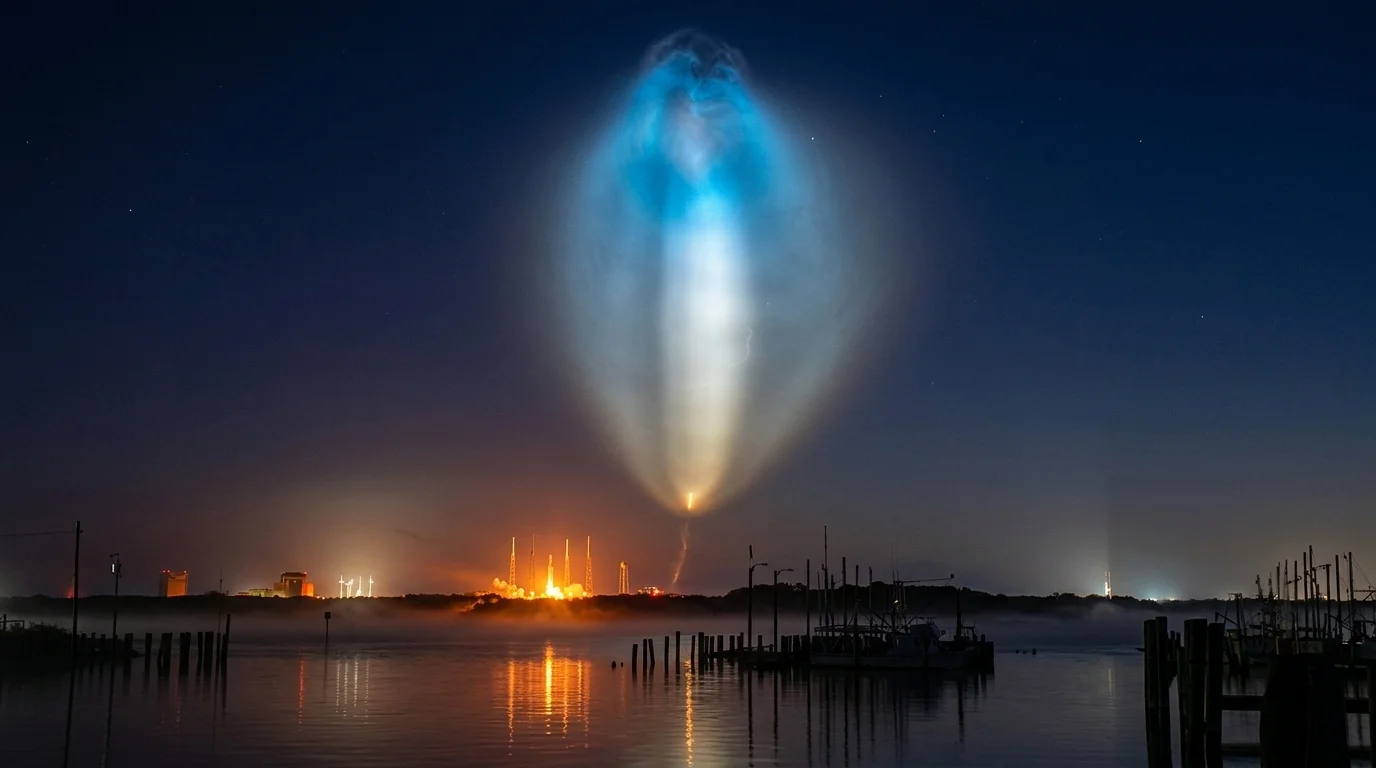
SpaceX is scheduled to launch its Bandwagon-5 rideshare mission aboard a Falcon 9 rocket on Monday, October 19, 2026, from Space Launch Complex 40 at Cape Canaveral Space Force Station in Florida. The one-hour launch window opens at 6:30 a.m. EDT (5:30 a.m. CDT / 10:30 UTC), just under an hour before the 7:25 a.m. local sunrise, according to The Seattle Times and Spaceflight Now. The mission will carry a batch of commercial and institutional spacecraft into low Earth orbit along a southeasterly trajectory, with pre-dawn atmospheric conditions offering the potential for a sunlit “space jellyfish” exhaust plume across parts of the southeastern United States and the northern Gulf Coast.
Whether the rocket lifts off on Monday depends heavily on local meteorological conditions. The U.S. Space Force’s 45th Weather Squadron forecasts a 55 percent chance of acceptable weather during the Monday window, noting that a stalled cold front over southern Florida brings gusty liftoff winds approaching launch constraints alongside a secondary concern regarding cumulus clouds. Forecasters also noted a moderate-to-high risk of unfavorable recovery weather downrange in the Atlantic Ocean. If SpaceX scrubs the Monday attempt, a backup one-hour window opens at 6:30 a.m. EDT on Tuesday, when launch site weather odds improve to 85 percent favorable, though moderate concerns for booster recovery conditions downrange remain.
Starfall Reentry Capsule and the Customer Manifest
Bandwagon-5 marks the fifth dedicated mid-inclination mission under SpaceX’s SmallSat Rideshare program, with a third-party mission listing reproduced by SpaceX.com.pl noting a target orbital inclination of 45.4 degrees. Reporting varies slightly on how the total payload manifest is tallied. According to Spaceflight Now and Florida Today, the Falcon 9 is carrying 32 payloads in total: 31 customer spacecraft plus SpaceX’s proprietary, uncrewed Starfall reentry capsule. Meanwhile, a mission description reproduced by SpaceX.com.pl refers to the manifest simply as 31 small satellites without clarifying whether Starfall is included in that count.
SpaceX first flew the Starfall capsule on a mission in June, revealing few operational details prior to liftoff and sharing only a rendering during the June 23 launch broadcast without disclosing its deployment time. During that June broadcast, SpaceX avionics supply chain engineer Zachary Luppen described Starfall as a microgravity laboratory designed for researchers and entrepreneurs to develop products in orbit.
- Anthropic Pitches Federal AI Safety Bill With $1B and 50-Person Harm Thresholds
- Disney’s $60M Character.AI Deal, Meta’s Brazil Ruling, and Anthropic’s IPO Plans
- Boston-Area College Students Plan Walkout Demanding National Freeze on AI Development
- DeepSeek Releases V4.1-Flash-1017 Update to Cut Task Runtime and Boost Coding Scores
- Schools Debate Return to Physical Books as Classroom AI and Screen Time Face Pushback
A majority of the commercial payloads on Bandwagon-5 were integrated by the multinational mission management provider Exolaunch, though news outlets differ on the exact tally. According to Spaceflight Now, Exolaunch manifested 20 of the 31 customer payloads, while an October 16 report from Florida Today states that Exolaunch will deploy 23 customer satellites. Among the confirmed Exolaunch-managed spacecraft are four radio-frequency-monitoring satellites built by Virginia-based HawkEye 360, four communications microsatellites for Finland-based Iceye, and six navigation satellites operated by California-based Xona Space Systems.
Booster B1085 and Space Coast Launch Cadence
The first-stage booster assigned to Monday’s flight carries the tail number B1085 and is making its 19th trip to space. Its prior flight history includes NASA’s Crew-9 mission, the Fram2 mission, Firefly Aerospace’s Blue Ghost Mission 1 lunar lander, RRT-1, SXM-10, SXM-11, MTG-S1, EchoStar 25, and 10 Starlink missions. Nearly nine minutes after leaving Space Launch Complex 40, B1085 will attempt a touchdown on the autonomous drone ship A Shortfall of Gravitas stationed in the Atlantic Ocean. A successful recovery will mark the 167th booster landing on that specific vessel and the 672nd Falcon booster landing overall.
In a broader industry context, Bandwagon-5 represents the 60th orbital launch across all providers from Florida’s Space Coast in 2026, with SpaceX accounting for all but seven of those missions. However, the launch cadence in Florida has slowed noticeably compared to 2025, which saw a record 109 Space Coast launches across all providers—roughly one liftoff every three days. According to The Seattle Times, SpaceX has flown only four other times from Florida since August 30 as the company directs resources toward constructing its Starship and Super Heavy launch tower at Kennedy Space Center’s Launch Complex 39A. Other launch providers have also experienced extended gaps: United Launch Alliance has not launched since July 2 as it addresses issues from an earlier Vulcan rocket flight, though an Atlas V rocket could fly Boeing’s uncrewed Starliner capsule to the International Space Station as early as December, while Blue Origin has flown its New Glenn rocket once in 2026.
Viewing Conditions and the ‘Space Jellyfish’ Phenomenon
Because the launch window opens during twilight hours ahead of sunrise, the mission has the potential to produce a visual phenomenon known as a “space jellyfish.” This optical effect happens when a rocket ascends out of Earth’s shadow into high-altitude sunlight while observers on the ground remain in pre-dawn darkness. As exhaust gases and water vapor from the Falcon 9’s Merlin engines expand rapidly in the thin upper atmosphere, sunlight illuminates the plume, creating a glowing, bulbous shape with trailing tendrils.
Less than a week ago, on Tuesday, October 13, a separate SpaceX Falcon 9 launch generated a prominent space jellyfish that was photographed across Florida, up the East Coast to Washington, D.C., and along the northern Gulf Coast in Grand Isle and Venice Marina, Louisiana. However, viewers hoping for an identical display on Monday should note trajectory differences. According to WRAL, Bandwagon-5’s southeasterly flight path differs from prior launches that produced visible plumes over the Carolinas and the Mid-Atlantic, meaning visibility is not guaranteed even if the exhaust is sunlit. An earlier liftoff within the 60-minute window increases the likelihood of optimal contrast between the sunlit plume and dark skies.
Along the northern Gulf Coast, a high-pressure system is bringing dry, clear skies to coastal Mississippi and southeastern Louisiana, according to WDSU. If the rocket launches on time at 5:30 a.m. CDT, the illuminated plume could become visible roughly five to 15 minutes after liftoff. Local meteorologists recommend finding a dark area away from urban light pollution—such as Grand Isle, Port Sulphur, Boothville, or lower Plaquemines Parish—with an unobstructed view toward the eastern or east-southeastern horizon. According to WAFB, citing photographer John Kraus’s Space Jellyfish Predictor tool, southeast Louisiana and southwest Mississippi sit near the western boundary of the favorable viewing zone, where the plume may rise only about 7 degrees above the horizon in the Baton Rouge area, making an unobstructed view free of trees and buildings necessary.
Frequently Asked Questions
How can I watch the Bandwagon-5 launch online?
SpaceX plans to broadcast the launch live on its website and social media channels starting approximately 15 minutes prior to liftoff, according to Florida Today. In addition, Spaceflight Now will provide live commentary and coverage beginning about one hour before the launch window opens.
Why do payload counts for Bandwagon-5 vary between 31 and 32?
The difference stems from how SpaceX’s internal spacecraft is categorized alongside commercial rideshare customers. Spaceflight Now and Florida Today count 31 third-party customer payloads plus SpaceX’s uncrewed Starfall reentry capsule for a combined total of 32 spacecraft, whereas a general mission summary reproduced by SpaceX.com.pl lists 31 small satellites without specifying whether Starfall is counted separately.
What happens if weather delays Monday’s launch attempt?
If liftoff winds at Cape Canaveral or sea states in the Atlantic recovery zone prevent a launch during Monday’s one-hour window, SpaceX holds a backup launch opportunity on Tuesday, October 20. The Tuesday window also runs for one hour starting at 6:30 a.m. EDT (5:30 a.m. CDT), preserving the pre-sunrise timing required for a potential sunlit exhaust plume.
Sources
- SpaceX – Bandwagon-5 Mission
- Spaceflight Now – Live coverage: SpaceX to launch Starfall reentry capsule, 31 customer payloads on Bandwagon-5 rideshare mission
- The Seattle Times – Monday morning SpaceX launch could serve up space jellyfish encore
- WDSU – SpaceX ‘Space Jellyfish’ cloud could be visible from Louisiana Monday morning
- WAFB – Another ‘space jellyfish’ possible over southeast Louisiana Monday morning
- Florida Today – SpaceX rocket launch tracker: Falcon 9 to liftoff on Bandwagon-5
- Florida Today – SpaceX rocket to launch Bandwagon-5 satellite payloads at Cape Canaveral Space Force Station
- Florida Today – Another SpaceX rocket jellyfish likely in sky, but will weather cooperate on Florida Space Coast
- WRAL – Space jellyfish explained
- SpaceX.com.pl – Bandwagon-5 Mission Listing