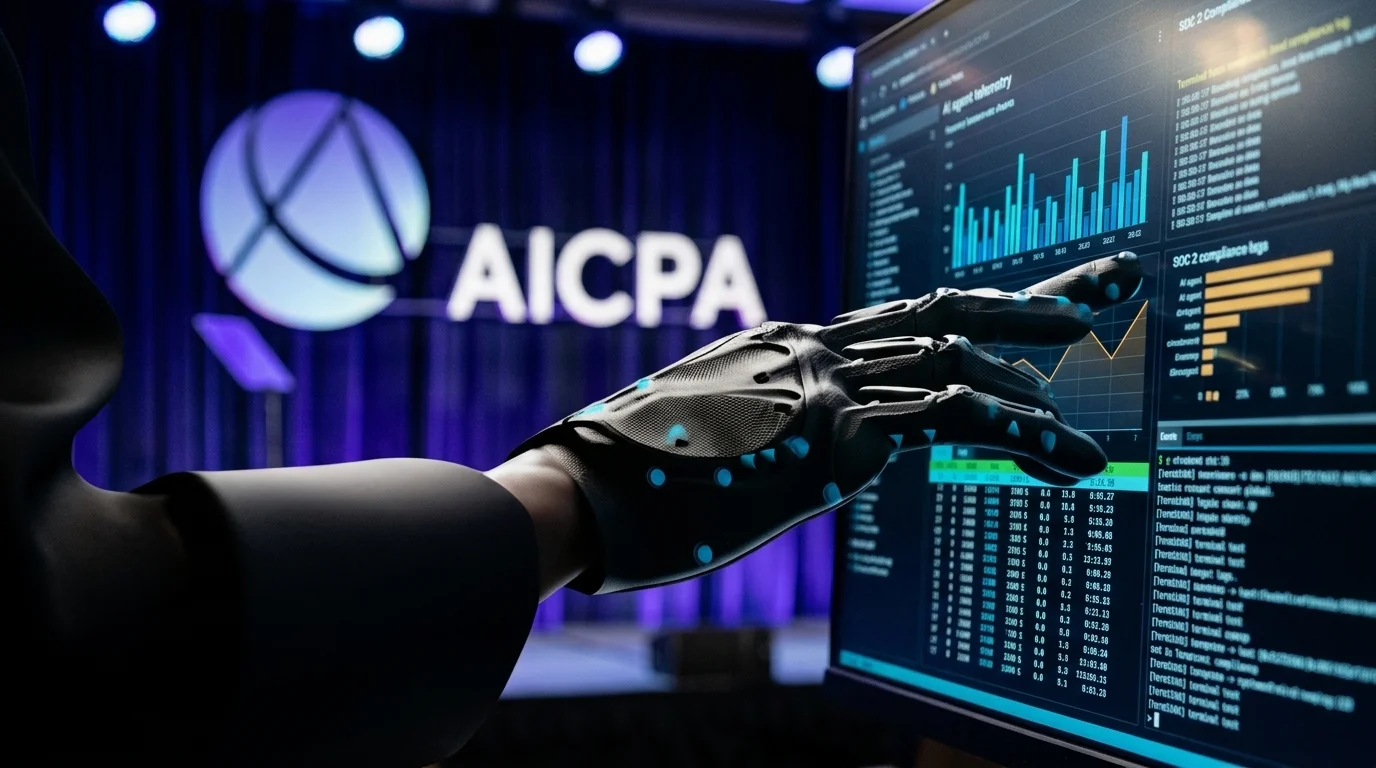
The American Institute of CPAs (AICPA) and the Artificial Intelligence Underwriting Company (AIUC) announced a joint assurance offering on October 19, 2026, designed to evaluate the security, governance, and operational reliability of enterprise AI systems and autonomous agents. Delivered through a single CPA-led engagement, the product pairs a standard System and Organization Controls (SOC 2) examination with an AIUC-1 technical certification to verify both organizational safeguards and live AI agent behavior.
The initiative comes as enterprises increasingly grant autonomous software agents direct access to internal infrastructure. According to the AICPA, modern AI agents hold system credentials, call application programming interfaces (APIs), and execute actions inside core business environments—meaning an algorithmic failure can quickly become an operational security breach. While multiple CPA firms are already conducting initial engagements with clients, a broad rollout of the combined report is scheduled for early 2027.
How the Dual Assurance Engagement Works
Historically, enterprise software buyers and vendors have vetted AI deployments through custom security questionnaires and ad hoc technical reviews. The AICPA and AIUC stated that this fragmented approach slows down software procurement and often fails to verify how autonomous systems behave under real-world pressure. The joint offering consolidates this vetting into a unified audit report.
The first half of the engagement relies on the established SOC 2 framework, an independent examination conducted by a licensed CPA under AICPA Attestation Standards. A SOC 2 report evaluates the design and operating effectiveness of an organization’s internal controls across five criteria: security, availability, processing integrity, confidentiality, and privacy.
The second component incorporates AIUC-1, a technical standard tailored specifically for autonomous agents and AI models. According to the Journal of Accountancy, the partners noted that more than 40,000 organizations obtained either a SOC 2 attestation or an AIUC-1 certification over the past year. Combining them allows auditors to inspect traditional IT governance alongside model-specific vulnerabilities.
- NBA Expands AI Integration Across Officiating, Broadcasts, and Fan App Features
- U.S. Banks Block Third-Party AI Agents From Moving Customer Money
- Massachusetts Students Examine How AI Reshapes Work and Careers at WPI Studio
- Autonomous AI Agents Require Extensive Personal Data, Raising Consumer Privacy Risks
- Amazon Shares Climb as Morgan Stanley Lifts Price Target to $350 on Five AI Catalysts
“Companies have made substantial investments in AI and investors, clients, and other stakeholders deserve a fuller, objective picture of whether the technology is safe, reliable, and properly governed,” AICPA President and CEO Mark Koziel stated in the CPA Practice Advisor report. Koziel added that placing CPAs at the head of the engagement brings established financial and systems auditing rigor to emerging enterprise technologies.
Inside the AIUC-1 Technical Testing Protocol
While traditional IT audits focus heavily on written policies, access logs, and architectural guardrails, the AIUC-1 standard emphasizes active behavioral testing. According to the AICPA announcement, the AIUC-1 framework was developed by a consortium of more than 250 chief information security officers (CISOs) and security leaders. Its controls are organized around six core principles: data and privacy, security, safety, reliability, accountability, and society.
To bridges the gap between policy and execution, the certification requires live technical testing of deployed AI agents. Rajiv Dattani, cofounder of AIUC, explained in the release that agents are evaluated across hundreds of risk and attack combinations. These adversarial tests check for model hallucinations, unauthorized data leakage, susceptibility to manipulative user requests, and vulnerability to adversarial prompt injection.
Because AI models and agentic workflows change much faster than legacy enterprise software, the assurance cadence is split. Both the SOC 2 examination and the base AIUC-1 certification require annual renewal. However, maintaining the AIUC-1 certification also requires quarterly technical retesting to account for model drift, updated system prompts, and emerging attack vectors.
The AICPA noted that AIUC-1 controls map directly to several international governance and threat frameworks, including MITRE ATLAS, ISO 42001, and the European Union AI Act. However, this control mapping functions as an operational alignment tool; the joint assurance product is a voluntary commercial certification rather than a government-mandated audit, an official ISO certification, or a formal legal determination of compliance under EU regulations.
Industry Rollout and Broader Accounting Context
While the formal announcement centered on the partnership between the AICPA and AIUC, major accounting and compliance firms have already integrated themselves into the rollout. In a separate statement published the same day, audit and cybersecurity firm Schellman characterized the initiative as a direct collaboration among the AICPA, AIUC, and Schellman. The firm identified itself as the first accredited AIUC-1 assessor and reported having already completed more than 100 AI assurance engagements.
Similarly, PwC stated on October 19 that it served as a founding member of the AICPA working group behind the initiative and was an early participant in the AIUC-1 consortium. According to Bloomberg Tax, the broader accounting industry is moving quickly to establish structured risk assessments as corporate anxieties over autonomous software grow.
This commercial certification also follows separate regulatory and professional guidance within the accounting sector. On October 13, 2026, the AICPA published a distinct practice aid for financial statement auditors, as reported by CFO Dive and Accounting Today. That earlier guidance focuses on how auditors should evaluate AI tools used in corporate financial reporting and within audit firms themselves—emphasizing risk assessment, evidence verification, human supervision, and professional judgment. Together, the two October initiatives show the accounting profession simultaneously tightening rules for internal financial audits while commercializing new technical assurance services for enterprise software vendors.
What It Means for Enterprise Buyers and Vendors
For software vendors building autonomous agents and enterprise CIOs looking to buy them, the SOC 2 plus AIUC-1 report aims to standardize third-party risk management. If widely adopted, a single CPA-signed package could replace repetitive vendor security reviews. However, several operational questions remain unanswered ahead of the planned early 2027 full launch.
Are the technical test thresholds publicly standardized?
While the partners state that AI agents are tested against hundreds of attack combinations, the public announcements do not disclose the exact testing protocols, pass/fail scoring thresholds, or coverage criteria. Enterprise buyers will need to scrutinize the actual reports to see whether residual risks, specific failure rates, and testing boundaries are detailed transparently enough to compare different AI vendors objectively.
How are SOC 2 opinions separated from AIUC-1 results?
A SOC 2 examination results in a formal CPA attestation opinion on internal control design and operating effectiveness. The announcements have not yet detailed how the combined report structurally separates traditional CPA attestation opinions from the technical benchmarking results generated during quarterly AIUC-1 agent testing, or what happens if an organization passes its SOC 2 controls check but fails a quarterly prompt-injection retest.
What are the costs, timelines, and boundary rules?
Neither the AICPA nor AIUC disclosed the pricing structure or expected duration for the combined engagement. Technical teams will also need clarity on how the audit handles rapid software updates between quarterly tests, and where liability and assessment boundaries are drawn when a company’s AI agent relies on foundation models, APIs, or data sources operated by outside third parties.
Sources
- AICPA & CIMA – Auditors Meet Urgent Demand for AI Assurance with New Offering from AICPA and AIUC
- Journal of Accountancy – AICPA partners on new offering that assures AI systems and agents
- CPA Practice Advisor – New AICPA Joint Offering Provides Full Review of Business Risk Related to AI Systems and Agents
- Bloomberg Tax – CPA Industry Offers AI Assurance Framework as Tech Fears Grow
- Schellman – What Trust Looks Like in the AI Era
- PwC – Building Trust in AI
- CFO Dive – AICPA issues guidance on AI-assisted auditing
- Accounting Today – AICPA releases practice guide for auditors dealing with AI