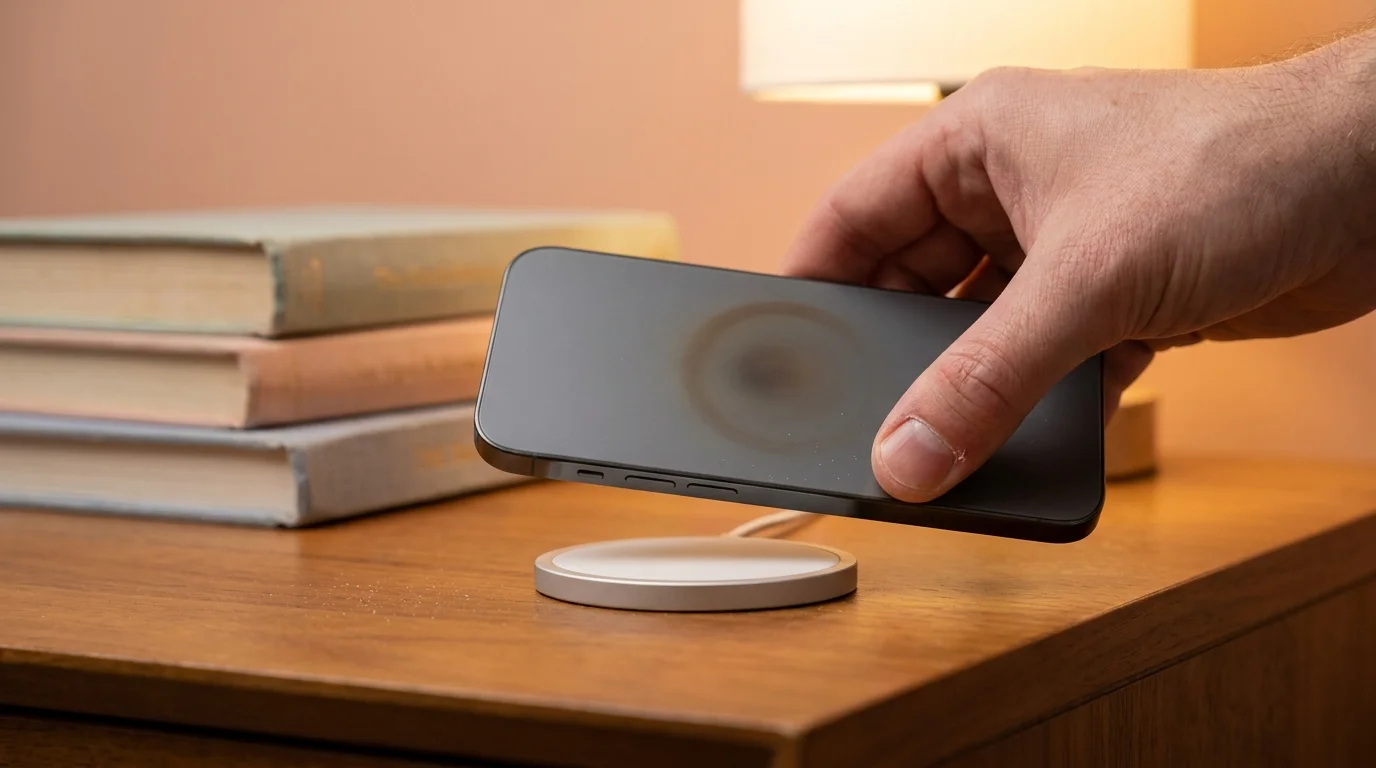
The late-evening room settles into a hush, lit only by the faint glow of an ambient lamp and the gentle snap of magnetic rings meeting on your nightstand. It feels clean, effortless, and modern. No fumbling in the dark for frayed cables, no scraping connector pins against polished aluminum. You leave the glass slab resting on its disc, secure in the promise of frictionless technology.
Yet pick up that handset twenty minutes later, and the illusion shatters against your palm. The glass feels feverish, radiating a dense, concentrated warmth reminiscent of a stone left beneath the midday desert sun. It is not the harmless warmth of energetic processing; it is the physical sensation of wasted energy escaping as raw friction.
We have traded structural longevity for a moment of tactile elegance. What appears to be an upgrade in domestic minimalism is quietly trapping your phone within an unventilated micro-climate, cooking the very power cell that gives your device its mobility.
While device manufacturers advertise convenience and sleek alignment, inductive thermal traps silently cook modern flagship hardware from the inside out, turning a flagship purchase into a premature candidate for battery servicing.
The Thermal Trap Behind the Magnetic Click
To understand why this gentle warmth is so treacherous, picture a cast iron skillet clamped against a delicate down coat. Magnetic wireless pucks rely on copper coils driving electromagnetic fields across a millimeter of air into a matching receiver coil nestled beneath your phone’s rear glass. In a perfect world, that energy transfer would be seamless. In our physical world, it is inherently clumsy.
Nearly thirty percent of the electricity traveling from your wall outlet never makes it into the battery as stored voltage. Instead, it converts instantly into radiant heat. Because the puck adheres firmly to the backplate with rare-earth magnets, that heat has nowhere to dissipate. It cannot float away into the room. Instead, it soaks directly through the rear casing, sandwiching the lithium-ion pouch against the display panel with zero airflow.
Traditional copper cable charging produces negligible warmth along the chassis because transformation losses occur inside the wall brick inches or feet away from the phone. Trapping heat against sealed glass turns the chassis into an insulated oven, forcing the chemistry within to endure a continuous low-grade thermal simmer night after night.
- Netgear Nighthawk routers eliminate stuttering video streams after switching channel widths
- Samsung Galaxy S24 displays trap buyers paying premiums over identical older glass
- PayPal SMS alerts conceal malicious credential traps targeting rushed smartphone screens
- Samsung One UI toggles silence background location polling saving drained battery bars
- Fitbit Charge 6 buzzes numb wrist nerves prompting phantom pocket vibrations
The Cathode Toll: Insights from the Testing Bench
Dr. Julian Vance, a 46-year-old materials scientist and independent consumer diagnostics consultant in Portland, spent eighteen months tracking the degradation profiles of identical lithium cobalt oxide battery packs under everyday domestic routines. Vance did not focus on high-speed synthetic benchmarks; he monitored the mundane reality of nightstand charging cycles across dozens of consumer handsets.
What Vance discovered explains the sudden, inexplicable drop in maximum battery health percentages that many users notice around their tenth month of ownership. In cells charged via traditional five-watt wired bricks, the cathode crystalline matrix maintained stable microscopic lattice structures across six hundred cycles. Cells exposed to nightly magnetic puck charging exhibited micro-fracturing along the cathode interfaces before cycle three hundred, triggered entirely by sustained chassis temperatures hovering near 104 degrees Fahrenheit.
Matching the Charge to Your Daily Cadence
Not everyone uses their phone in the same environment, and your charging strategy should reflect the way your day actually unfolds rather than manufacturer marketing assumptions.
For the Nightstand Minimalist
If your device spends eight uninterrupted hours resting beside you while you sleep, magnetic fast-charging is an unnecessary thermal assault. Your handset does not need twenty watts of frantic energy delivered in an hour only to bake on a magnetic pad until dawn. Gentle wired overnight trickle currents preserve internal chemistry without turning your nightstand into an induction hot plate.
For the Desk-Bound Professional
Leaving a phone permanently mounted on an upright magnetic desk puck is common in home offices. Yet keeping a cell pinned at one hundred percent capacity while subjected to continuous passive magnetic inductive energy creates peak stress. If you love the floating display aesthetic for incoming notifications, use an unpowered stand and connect a wired cable only when your battery dips below thirty percent.
For the Field Commuter
Car mounts that combine wireless magnetic charging with GPS navigation represent the worst thermal environment possible. Direct sunlight through the windshield paired with high-power inductive transfer and cellular modem strain pushes battery cells beyond safe operating thresholds in minutes. In the vehicle, clip-on dashboard vents with standard low-profile cables are vital for hardware preservation.
A Calmer, Cooler Approach to Everyday Power
Reclaiming your battery’s health does not require abandoning magnetic docks entirely. It simply demands small, mindful shifts in how and when you introduce electricity to the chassis.
By treating energy transfer as a mechanical process with real thermodynamic consequences, you break the cycle of premature battery replacements and sluggish performance. Deliberate habits yield longer hardware lifespans without sacrificing daily convenience.
- Strip heavy phone cases: Thick silicone and rugged leather act as thermal blankets; remove them before long charging sessions to let the glass breathe.
- Adopt the 80 percent plateau: Enable native charge-limiting settings so the battery does not sit simmering at peak voltage during morning hours.
- Reserve pucks for short boosts: Use magnetic chargers for fifteen-minute top-ups rather than marathon multi-hour overnight cycles.
- Dust off the legacy five-watt adapter: Slow wired charging remains the most chemically gentle method engineered for modern personal electronics.
The Preservation Toolkit
Keep these baseline parameters in mind to prevent structural cell fatigue over your device’s lifespan: keep charging chassis temperatures under 95°F whenever feasible, avoid charging when the ambient room exceeds 85°F, and maintain operational battery reserves between 20% and 80% during normal waking routines.
The Long Horizon of Hardware Care
We are routinely told that modern consumer electronics are disposable, designed to fade after twenty-four months so another transaction can take their place. Much of that planned obsolescence is not written in software code, but born from thermal carelessness that we participate in every night.
When you detach from the urge to snap your handset onto a scorching magnetic disc just because it looks tidy on a wooden desk, you practice a quiet form of technological intentionality. Slowing down your daily recharge protects the raw minerals mined from the earth and honors the craftsmanship sealed beneath that pristine glass.
A phone that stays cool is a tool that serves you quietly for years, remaining just as brisk and dependable as the morning you first lifted it from its paper box.
“Heat is the unseen solvent of consumer electronics; control the thermal gradient, and the hardware outlasts its software promises.”
| Key Point | Detail | Added Value for the Reader |
|---|---|---|
| Thermal Transfer | Inductive coils lose up to 30% efficiency as heat directly against the chassis. | Identifies the primary physical cause of unexpected phone overheating during rest. |
| Cathode Stress | Sustained temperatures above 95°F induce microscopic lattice fractures in cobalt cells. | Explains why battery health percentages degrade rapidly after months of wireless habits. |
| Wired Trickle Benefit | Standard 5W to 10W wired charging keeps chassis thermals close to room ambient. | Provides a cost-free, immediate adjustment that doubles practical battery service life. |
Frequently Asked Questions
Does slow wireless charging eliminate chassis heat?
Lower wattage wireless charging reduces the volume of heat generated, but because inductive transmission still relies on coil alignment against glass, trapped surface warmth persists. A low-wattage wired cable is always significantly cooler.Why does my phone feel hotter when charging with a protective case?
Most consumer cases are made of polycarbonate, silicone, or leather, which are poor thermal conductors. They trap the inductive coil heat against the battery pack, accelerating chemical degradation.Is built-in battery optimization enough to stop magnetic degradation?
Software limits charging speed at higher percentages, but it cannot alter the thermodynamic inefficiency of wireless induction coils radiating heat directly into the rear chassis.Are third-party magnetic pucks worse than original manufacturer accessories?
Inexpensive third-party pucks often feature poorly calibrated coils with looser tolerances, creating greater electromagnetic resistance and substantially higher chassis temperatures.Will charging exclusively via cable restore lost battery capacity?
No, cathode micro-fracturing and electrolyte crystallization are irreversible. However, switching to cool wired charging immediately halts accelerated wear and stabilizes your remaining runtime.