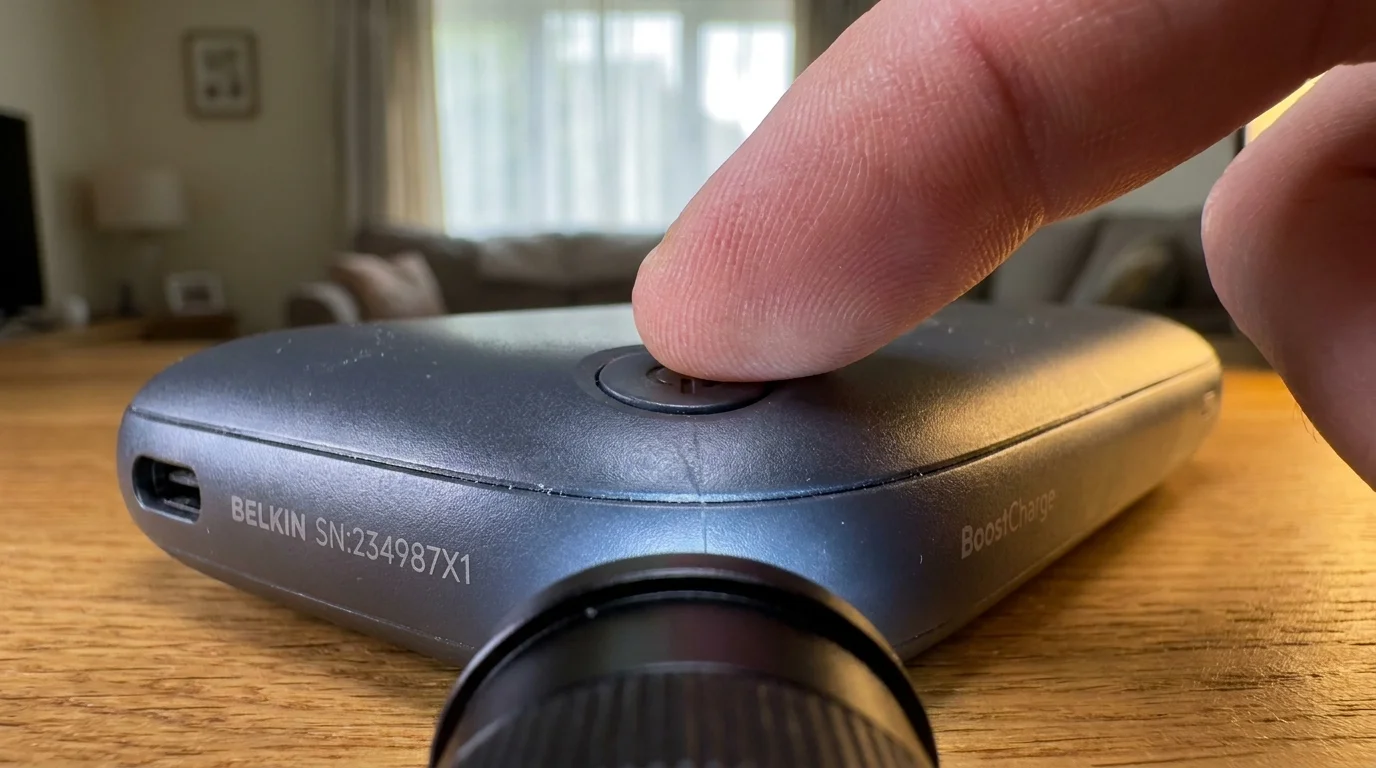
If your daily carry includes the Belkin BoostCharge Pro Fast Wireless Charger + Power Bank 10K (Model BPD005, serial ranges beginning with 23B or 23C), stop charging it immediately and claim your full refund via Belkin’s official intake portal at belkin.com/support-recall. You likely know the distinct tactile reassurance of this specific pack: the soft-touch matte chassis, the magnetic snap of an Apple Watch aligning on its dedicated disc, and the quiet promise of two full days of untethered phone life. It feels dense, engineered, and cool to the palm when pulled from an office briefcase.
Yet underneath that understated exterior, a microscopic manufacturing variance has turned quiet utility into a potential fire hazard. The Consumer Product Safety Commission alongside international watchdogs issued an urgent alert after reports of thermal runaway surfaced, describing units blistering through nightstands and melting interior seams. When portable power fails, it does not simply stop working; it off-gases, swells, and vents intense heat that can ignite nearby fabric or synthetic desk pads.
We tend to treat our battery bricks like inert pocket stones, forgetting that modern fast-charging requires cramming volatile chemical reservoirs into spaces no thicker than a deck of playing cards. When a compact lithium-ion cell suffers internal micro-fracturing or insulation degradation, the margin between stable current delivery and an aggressive fire is measured in fractions of a millimeter.
The Chemical Spring: Why High-Density Cells Rebel
To understand why this recall matters, you must discard the idea that a battery operates like a simple storage tank. Think of a modern high-output power bank as a coiled steel spring wound under immense mechanical pressure inside a tight paper box. The moment an internal separator develops a pinprick imperfection, that physical restraint snaps, discharging stored potential energy as violent, self-sustaining heat rather than an orderly stream of five-volt electrons.
Belkin built its sterling reputation by engineering safeguards that insulate consumers from cheap, generic charging bricks. However, this specific run of the BoostCharge lineup paired rapid magnetic inductive coils directly against dense pouch cells, creating an unforgiving thermal environment where even marginal manufacturing anomalies trigger catastrophic internal short circuits. Thermal runaway feeds upon itself, drawing oxygen from the breaking cathode matrices and generating temperatures hot enough to scorch untreated pine desks within seconds.
- Best Buy trade-in valuations drop steeply over uncleaned ports and missing resets
- Parking meter barcodes steal credit card balances behind malicious adhesive quishing overlays
- Sengled smart bulbs drop offline after power cuts without persistent recovery modes
- Android Focus mode schedules silence disruptive workplace pings while routing emergency calls
- Sony PS5 vents accumulate thick lint blankets triggering deafening cooling fan whines
The Lab Perspective: What Teardowns Actually Uncovered
Marcus Vance, a 42-year-old battery validation engineer based in Austin, Texas, runs destructive stress diagnostics on consumer hardware and tracked the anomaly early during third-party failure evaluations. “When you pull apart a compromised pack from this production run, you see distinct blistering right at the cathode junction weld,” Vance explained during a technical review. “Consumer electronics live in harsh real-world settings—shoved into hot car glove compartments, dropped onto airport tiles, and baked under fast-charge cycles. If the internal insulation tolerance is off by even five microns, repeated thermal expansion will eventually punch through the separator layer.”
Risk Profiles: Assessing Your Real-World Exposure
Not every recalled accessory behaves identically under stress. Your daily routines dictate how vulnerable your specific unit is to thermal failure before you retire it.
The Travel Commuter
If you keep this pack stashed inside an overstuffed messenger bag or neoprene laptop sleeve, you face elevated risks. The lack of ambient airflow prevents natural convective cooling, trapping the heat radiated during passive inductive transfers. Pouch cells require open airflow to dissipate the thermal wake created when simultaneously powering an Apple Watch and an iPhone.
The Nightstand Fixture
Many users treat this portable bank as a permanent bedside stand, keeping it plugged continuously into an 18-watt or 30-watt wall brick. Constant top-off trickle charging keeps lithium cells hovering at peak saturation voltage—typically 4.2 to 4.35 volts per cell. Operating at continuous maximum potential accelerates internal chemical breakdown, making stationary bedside units far more prone to swelling than packs cycled naturally on the road.
Mindful Decommission: Safe Handling Protocol
Handling a flagged lithium-ion device requires calm precision rather than panic. Follow this sequence to secure your workspace and complete your warranty remediation.
First, verify your unit’s identity. Look closely at the small, laser-etched typography on the bottom edge of the casing to confirm the model reads BPD005, followed by the serial stamp.
- Unplug the pack from any wall adapter, laptop, or peripheral cable immediately.
- Check the physical shell for subtle bulging, hairline seam splits, or a faint sweet, chemical odor resembling nail polish remover.
- Place the unit inside an open, non-combustible container—such as an empty ceramic pot or a metal bucket filled partially with sand—away from curtains or paperwork.
- Photograph the serial number clearly on the base; you will need this image to upload to the official Belkin claim system.
- Do not deposit this pack into your household municipal recycling bin or curbside trash tote, where mechanical compactors can puncture it and cause garbage truck fires.
For your tactical toolkit, keep a dedicated fire-resistant LiPo safety bag on hand if you regularly travel with high-wattage power supplies. When retiring recalled hardware, locate a certified municipal hazardous waste depot or an authorized Call2Recycle drop-off kiosk that accepts compromised lithium-polymer packs.
The Bigger Picture: Reclaiming Control Over Our Pockets
We surround ourselves with pocket-sized powerhouses, demanding that they fill our devices faster while shaving millimeters off their plastic frames. This urgent recall reminds us that energy density is not free magic; it is an active, demanding balance of chemistry, physics, and manufacturing discipline. Awareness transforms passive consumer anxiety into practical control. By taking ten quiet minutes to check your labels, box up compromised hardware, and insist on strict hardware integrity, you protect not just your expensive phones, but the physical spaces you call home.
“True charging safety isn’t found in thicker plastic casing, but in respecting the raw chemical volatility packed beneath the paint.”
| Key Point | Detail | Added Value for the Reader |
|---|---|---|
| Affected Hardware | Belkin BoostCharge Pro Fast Wireless 10K (Model BPD005) | Instant identification prevents wasting time checking unrelated accessories. |
| Failure Mechanism | Internal cell separator breakdown causing thermal runaway | Clarifies why software updates cannot patch this purely physical defect. |
| Remediation Route | Direct Belkin customer intake for full refund or store credit | Bypasses third-party retail queues for immediate manufacturer payout. |
Frequently Asked Questions
Can I continue using the power bank if it hasn’t felt warm yet?
No. Internal component fatigue and separator thinning occur invisibly over hundreds of hours before thermal runaway triggers unexpectedly.Will an airline allow me to carry this recalled model in my carry-on luggage?
Federal Aviation Administration rules strictly forbid carrying recalled lithium-ion batteries aboard passenger aircraft until repaired or replaced.Does this recall cover the wired-only Belkin BoostCharge bricks?
No. The current action applies exclusively to the wireless hybrid Apple Watch model marked BPD005 with specific serial prefixes.What should I do if the power bank has already started to swell?
Do not charge or squeeze the device; isolate it outdoors inside a metal container and call your local fire department’s non-emergency line for hazardous disposal guidance.Do I need my original purchase receipt to receive a replacement or refund?
Belkin’s dedicated recall portal primarily requires a clear photo of the model number and serial stamp directly from the unit casing.