A sudden summer thunderstorm rolls across your neighborhood, rattling the windowpanes with a low, bone-vibrating growl. For three seconds, your entire living room vanishes into pitch blackness before the air conditioner shudders back to life with a metallic sigh. But while your refrigerator compressor hums faithfully and the microwave clock blinks a bright, accusatory noon, your ceiling fixture remains dead, cold, and utterly unresponsive.
You grab your phone, swipe into your home automation dashboard, and tap the familiar icon. Nothing happens except for a tiny spinning grey wheel, followed by that quietly infuriating red exclamation mark: Device Offline. You flip the wall switch back and forth, listening to the hollow plastic click, hoping to shock the electronics into compliance, yet the warm white ambiance you paid for stubbornly refuses to strike.
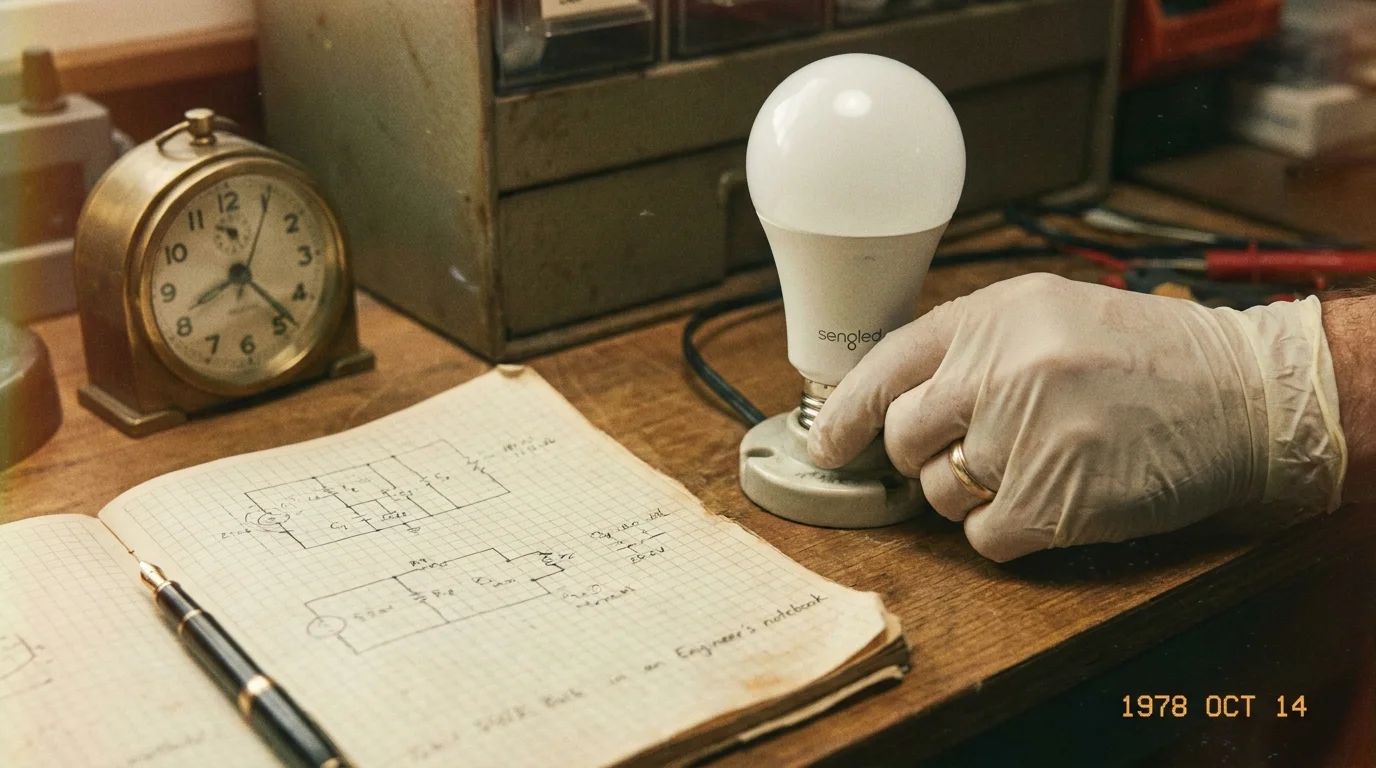
When Sengled smart bulbs disconnect after brownouts, it feels like an inexplicable hardware betrayal. You bought them to streamline your evenings, to let soft light pool across the floorboards without thinking about switches or cords. Instead, you are standing on a wooden chair with your hands raised toward a warm glass dome, repeating a rhythmic pairing cycle that leaves your neck aching and your patience completely drained.
The standard assumption is simple: the brief power surge fried the bulb’s fragile internal micro-controller. Cheap hardware usually takes the blame, leaving homeowners convinced that budget lighting is simply doomed to fail whenever the power company hiccups. Yet the physical diode inside that socket is perfectly fine, waiting for a whisper of instructions that your home network can no longer deliver.
The Digital Traffic Jam: Why Power Outages Erase Smart Lighting
To understand why your lights vanish from the cloud after a storm, imagine an overcrowded airport customs hall where five hundred passengers rush a single desk at the exact same split-second. That is precisely what happens inside your hallway when the electrical grid flickers. When mains current restores, your Wi-Fi router takes roughly three to four minutes to boot up its radios, negotiate upstream handshake signals with your internet provider, and assign local addresses.
Your bulbs, however, wake up within four hundred milliseconds. Finding the 2.4 GHz airwaves empty and silent, budget Wi-Fi bulbs assume they have been plugged into a brand-new socket in an unfamiliar home. Lacking dedicated persistent recovery memory, Sengled’s standalone Wi-Fi units cycle into an aggressive search state. When the router finally wakes up and floods the room with signal, the bulbs have already timed out their handshake routine, abandoning the attempt entirely to prevent overheating their tiny internal radios.
- Android Focus mode schedules silence disruptive workplace pings while routing emergency calls
- Sony PS5 vents accumulate thick lint blankets triggering deafening cooling fan whines
- Google Nest Mini microphones secretly store accidental room audio through default history
- Pixel Camera app settings ruin indoor portraits with noisy digital grain
- Airport Wi-Fi hotspots intercept unencrypted network credentials through malicious twin portals
This reveals a foundational truth about low-cost ambient tech: Wi-Fi was never designed for light sockets. Wi-Fi is a noisy, power-hungry protocol built for massive streaming throughput, not for forty tiny light points scattered across drywalls and ceilings. Relying on direct router handshakes turns every single light into a fragile point of failure, tethered to the boot-up speed of a distant black plastic box sitting behind your television.
Marcus Vance, a forty-four-year-old smart home network installer from suburban Charlotte, sees this heartbreak every single spring when line storms sweep through North Carolina. He often walks into homes where clients have spent whole weekends resetting twenty individual bulbs by frantically flicking mechanical switches on and off five times. Marcus always tells them that their lights are not broken; they are simply running out of breath before their router can hand them a fresh identity badge.
Adjustment Layers: Choosing the Right Network Spine
Resolving this headache does not require buying hundred-dollar commercial luminaires. It requires choosing the right wireless communication backbone for the specific way your household runs, matching your hardware architecture to your home’s physical layout.
For the Standalone Wi-Fi Minimalist
If you only own two or three accent lamps and refuse to plug another coordinator bridge into your entertainment console, you must protect your bulb’s startup window. You need to delay how quickly those specific fixtures pull current after an outage, or adjust your router’s Dynamic Host Configuration Protocol lease times so that your gateway instantly recognizes the bulb’s hardware MAC address the exact millisecond the radios align.
For the Whole-Home Mesh Switcher
If you have screwed smart lighting into ceiling cans, hallways, and outdoor soffits, standalone Wi-Fi bulbs will always create friction. Transitioning to Sengled’s Zigbee variant changes everything. Rather than begging your central router for attention, Zigbee bulbs form an interwoven physical whisper-chain across your rooms. Every continuously powered smart bulb acts as a physical relay station, passing commands from one bulb to the next without touching your internet bandwidth.
For the Multi-Brand Ecosystem Tinker
For homes balancing Sengled lighting alongside motion sensors, smart plugs, and voice assistants, bridging Zigbee bulbs to an independent universal coordinator provides rock-solid reliability. By offloading scheduling logic from distant cloud servers to a local home hub, your lighting schedules continue firing in complete domestic darkness, even if your local fiber line is physically severed by a fallen oak branch.
Mindful Application: Establishing a Persistent Fallback Protocol
Restoring stability to your lighting does not involve complex terminal coding or expensive rewiring. It requires a calm, methodical sequence of setup adjustments that guarantee your bulbs remember who they are when the wall juice returns. Work through these steps room by room.
- Assign Fixed Local IP Addresses: Open your home router settings and locate the connected device table. Bind every Wi-Fi smart bulb’s MAC address to a permanent, static local IP address so your router skips handshake negotiations during sudden reboots.
- Shift to Zigbee Recovery Mesh: If replacing frustrating bulbs, swap entry-level Wi-Fi models for Zigbee alternatives paired with a dedicated hub. Zigbee devices do not poll external servers during power restoration; they read their internal flash memory state immediately.
- Lock Down Zigbee Channel 25: Standard home Wi-Fi networks scream across channels 1, 6, and 11. Configure your Zigbee coordinator to channel 25, which lives outside high-traffic Wi-Fi frequencies, preventing post-outage packet collisions.
- Deploy a Passive In-Line Smart Switch: Keep your smart bulbs permanently powered by installing smart wall relays or magnetic switch covers. This stops family members from cutting physical line power, keeping mesh routes permanently mapped.
Keep your tools minimal and accessible during setup. A stable smartphone network app, a fine-tip pen to press sunken reset dimples, and your router’s default administrative gateway address are all you need to permanently anchor your hardware.
Set aside forty-five minutes on a quiet Saturday morning. Stand beneath each fixture, execute a clean five-pulse factory reset, and re-adopt the unit directly into your newly organized static or mesh topology. You will feel an immediate difference in response time: no more half-second pauses, no more ghosted automations, and no more panic when the street transformer buzzes and pops.
The Calm After the Storm
There is a subtle psychological weight to a home that forgets its own routines. When you walk through your front door after a long workday and find your living spaces plunged into raw, blinding clinical white—or stubbornly dormant in the shadows—your house feels less like a sanctuary and more like a bundle of fragile appliances demanding supervision.
Taking command of your smart bulb network architecture turns an unpredictable novelty into quiet, invisible infrastructure. You stop worrying about passing summer squalls or flickering utility grids because you know your lights hold their own ground. True residential comfort feels silent, effortless, and persistent, welcoming you back into familiar warmth no matter how violently the weather raged outside just moments before.
Real home automation is not about talking to speakers; it is about building quiet systems that preserve your peace of mind when the power flickers.
| Key Point | Detail | Added Value for the Reader |
|---|---|---|
| Connection Topology | Wi-Fi Direct vs. Zigbee Local Mesh | Zigbee retains local routing tables even during full internet and cloud blackouts. |
| Recovery Delay Bottleneck | Routers boot in 3 minutes; bulbs search in 400ms | Explains the real hardware cause behind post-storm connection failures. |
| Static IP Assignment | DHCP Reservation via Gateway Admin | Eliminates IP assignment confusion when dozens of household gadgets reboot at once. |
| Channel Separation | Zigbee Channel 25 vs. 2.4 GHz Wi-Fi | Prevents radio packet congestion and packet loss across busy home networks. |
| Power-On State Memory | Persistent Flash Storage Configuration | Ensures lamps stay dark at 3 AM if power blips while your household sleeps. |
Frequently Asked Questions
Why do my Sengled bulbs turn on at 100% brightness after a nighttime outage?
Most budget bulbs revert to factory default illumination when power is restored as a critical safety feature, ensuring you have light in an emergency. You can change this behavior in the companion mobile app under Power-On State settings.How do I properly reset a Sengled bulb that refuses to pair?
Start with the light switched on, then flick the wall switch off and on five consecutive times at steady one-second intervals. The bulb will pulse three times to indicate it has cleared its flash memory and entered pairing mode.Do Zigbee bulbs need an active internet connection to follow scheduled timers?
No, as long as your Zigbee hub or coordinator runs its automations on local hardware, your schedules, dimmer transitions, and group scenes fire without any active internet connection.Can I mix Wi-Fi and Zigbee bulbs in the same room fixture?
You can physically screw them into the same fixture, but they will operate on entirely separate network layers. This creates slight visual sync delays when dimming or changing room color temperatures.Does turning off the physical light switch damage my smart bulb over time?
Flipping the manual switch will not physically harm the LED diodes, but cutting mains power repeatedly fractures your mesh routing table, causing connected smart devices nearby to drop offline temporarily.