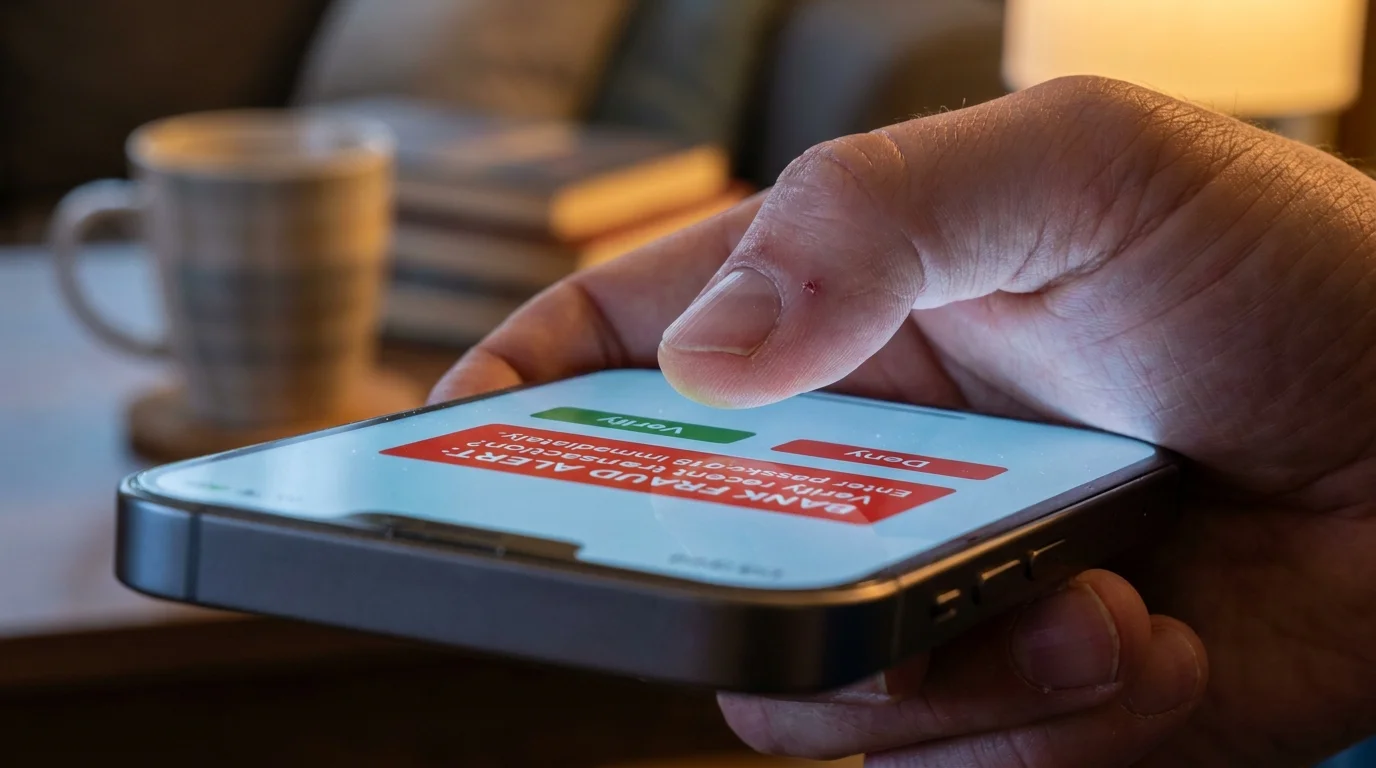
The kitchen table is bathed in the harsh blue spill of an early morning screen. A mug of dark roast sits half-empty, cooling quickly against the laminate tabletop. You reach for your phone with one thumb, mind wandering between grocery lists and morning meetings, when the sharp, double-pulse vibration rattles against the wood. The notification bar glows with a message nestled directly beneath genuine transaction logs: a fraud alert warning that someone in another state just attempted a wire transfer from your savings account.
Your pulse spikes before your rational mind catches up. The sender name reads clean and familiar, matching the exact short-code thread where your routine balance alerts have landed for three years. It urges an immediate reply—either confirm with a simple numeric digit or dial a toll-free hotline to freeze the transaction before the money leaves your vault.
When you reply or tap the link, a secondary alert pings almost instantaneously, asking you to relay a six-digit temporary passcode to verify your ownership. It feels safe because you expect security to be friction-filled. Yet in that single moment of manufactured panic, your genuine authentication stream is quietly diverted, handing an invisible intruder the master key to your digital vaults.
We are conditioned to treat security prompts as digital life vests, assuming the system itself is shielding us from harm. But modern telephony carries an ancient structural defect, one that turns our trusted defense mechanisms into precision burglary tools.
The Two-Way Mirror of Verification Codes
To understand why this attack cuts so cleanly, picture a bank teller window wrapped in one-way glass. In an honest exchange, the bank slides a sealed envelope through the slot to prove you are who you claim to be. In a spoofed intercept, the intruder stands outside, peering through your window, while simultaneously knocking on the teller’s door down the street.
When you receive an urgent alert claiming your account has been breached, the scammer is often sitting on the official Chase portal at that exact second, entering your leaked username and password. The bank system acts normally: it generates an automated one-time password and routes it to your phone via SMS. The scammer’s counterfeit text or incoming spoofed call arrives in tandem, politely asking you to read back or enter that incoming number to ‘cancel the fraudulent transaction.’ You are not canceling anything; you are completing their unauthorized login in real time.
- Android 15 settings switch off background scanning to preserve drained battery bars
- Ring Video Doorbells lock offline motion sensors leaving frozen blank video feeds
- Pixel 8 displays pulse invisible backlight flickers triggering throbbing eye strain
- Sony WH-1000XM5 headphones trigger dull eardrum pressure during continuous daily playback
- PlayStation 5 stands drain liquid cooling metal downward triggering blistering exhaust heat
This design flaw does not stem from human gullibility; it stems from a fundamental breakdown in message context. Telecommunication protocols treat text messages like open postcards, allowing automated networks to stamp any sender ID onto the header. Your smartphone simply bunches incoming texts into existing conversations based on those forged stamps.
A Broken Thread in Cleveland
Consider Marcus Campbell, a 46-year-old high school biology teacher from suburban Cleveland. On a damp Thursday evening while grading papers, Marcus felt his phone vibrate with an incoming message inside his legitimate bank notification thread: ‘Chase Fraud Alert: $1,420 charge pending at Best Buy. Reply YES to authorize, NO to decline.’ He replied ‘NO’ within ten seconds. Two rings later, his phone rang with the caller ID reading ‘JPMorgan Chase Fraud Prevention.’ The caller spoke in the calm, scripted cadence of an experienced customer advocate, walking Marcus through a process to reverse the phantom charge by dictating the six-digit verification pin hitting his screen. By the time Marcus hung up and opened his web portal an hour later, $4,800 had been swept out via immediate real-time rail transfers, leaving an empty balance and an inactive session token.
Dissecting the Intercept Profiles
Not every intercept unfolds identically. Threat actors adjust their methods based on how comfortably their target navigates digital tools, deploying distinct psychological levers depending on your interaction habits.
For the Mobile App Habitual
If you live entirely within mobile applications, attackers bypass raw phone calls and send forged alphanumeric short-code texts with masked URLs. These links point to replica login screens constructed with matching fonts and cascading style sheets. The counterfeit page prompts you to enter your credentials, immediately triggers an authentic backend session, and pauses on an animated loading graphic while demanding the subsequent verification code. Once entered, the session cookie is snatched, rendering password length utterly irrelevant.
For the Urgent Voice Responder
Those who prefer speaking directly to humans receive immediate follow-up phone calls utilizing voice over IP masking. The operator sounds composed, professional, and surrounded by synthetic call-center ambient noise. They tell you that your debit card has been placed on an administrative hold and that an automated robot voice will now read an authentication challenge to confirm your identity. They never ask for your password—they only request the single-use token that grants complete access to your account profile.
The Protocol for Screen Discipline
Defending your personal balance sheet against intercepted alerts requires adopting a deliberate posture of skepticism. When an alert arrives, the impulse to react within seconds is your greatest adversary.
- Treat inbound text alerts solely as unverified rumors rather than actionable control panels. Never tap a hyperlink embedded within a notification thread, even if it rests alongside genuine alerts from past months.
- If a message asks you to reply with ‘YES’ or ‘NO’, ignore the prompt entirely. Closing the messaging app breaks the psychological sequence the sender needs to maintain momentum.
- Switch your primary multi-factor verification method from plain-text cellular messages to a dedicated authenticator application or physical hardware key whenever your financial portal supports it.
- Remember the golden rule of bank communications: authentic banking systems generate one-time codes exclusively for sign-ins, profile adjustments, or money transfers. A legitimate employee will never request an inbound temporary code over the phone to reverse an action.
Your Pocket Defense Toolkit
Keep these specific boundary guidelines active on your device daily:
Direct verification relies on manual routing. Store the customer service number printed directly on the physical back of your debit or credit card into your contacts list as your sole financial contact. When an alarming message appears, wait three full minutes to allow your adrenaline to recede, launch your phone dialer independently, and place an outbound call directly to that verified number.
Reclaiming Your Digital Peace of Mind
Our connected lives demand rapid reactions, training our fingers to tap confirmation buttons without a second thought. But treating inbound alerts with quiet, patient friction is not a sign of inefficiency; it is your strongest digital armor.
When you deliberately step away from the flashing notification, silence the buzzing screen, and inspect your accounts through your own independent channels, you take away their leverage. The panic dissolves, the counterfeit thread goes dark, and your financial boundaries remain squarely under your own control.
Security is not measured by how quickly you reply to an alert, but by your discipline to verify the channel before you tap the screen.
| Key Point | Detail | Added Value for the Reader |
|---|---|---|
| Spoofed Sender Identity | SMS routing protocols permit forged sender names inside your native messaging threads. | Recognize that conversation thread history does not guarantee message authenticity. |
| Token Interception Dynamic | Attackers provoke legitimate security pins by initiating parallel sign-ins while you watch. | Realize that sharing an inbound code always authorizes access rather than stopping an attack. |
| Independent Channel Verification | Bypassing inbound links and calling the card-back telephone number manually. | Provides absolute certainty and eliminates caller-ID spoofing vectors entirely. |
Frequently Asked Questions
Can a fake text genuinely appear inside my real Chase conversation history? Yes. Mobile operating systems group messages based on the sender identification header. Because standard telecommunication protocols permit header spoofing, an attacker can broadcast a message stamped with your bank’s short-code, forcing your device to drop the fake text into your legitimate history.
Why does the bank system send a real code if the text was fraudulent? The attacker initiates a login attempt on the legitimate Chase banking portal using your compromised credentials. That portal automatically generates an authentic code to your mobile number, which the scammer then tricks you into relaying back to them.
What is the quickest way to verify if an alert is authentic? Exit the message without replying or clicking links. Open your mobile browser or dedicated banking application manually, or place a manual telephone call to the number printed directly on the physical plastic of your card.
Is switching from SMS codes to an authenticator app safer? Yes. Time-based one-time password applications generate local algorithmic codes that cannot be intercepted through cellular routing flaws, SIM swapping, or SMS spoofing campaigns.
What immediate steps should I take if I accidentally shared a code? Open your banking app immediately from an independent device, alter your account password, and call your financial institution’s verified fraud department to place an immediate restriction on outgoing wires and external account linking.