Morning air settles cold against your cheek as you step onto the damp pavement, the city still half-asleep under a bruised dawn sky. You pull the glossy white stems from their pocket-sized case, slip them into your ears, and wait for that familiar subtle chime—the instant, pressurized quiet that signals the world has been hushed. You tap your screen to cue up a favorite acoustic track, waiting for the warm strum of brass-wound guitar strings to ground your morning walk. Instead, the first three notes fracture into ragged, stuttering shards, sounding less like studio audio and more like a scratched compact disc skipping across gravel.
You instinctively reach up, tugging at the stem to reseat the silicone tip in your ear canal. You pause the track, toggle the noise control back and forth, and try again. The stutter remains, chopping clean vocal phrasing into jittery bursts that make your shoulders tense. It feels intimate and intrusive all at once, like someone tapping erratically on the glass of your private sanctuary.
The standard reflex is to blame the miniature physical engineering inside the casing. You wonder if moisture slipped through the acoustic mesh during yesterday’s drizzle, or if the tiny lithium cell inside the stem is suddenly sagging under the morning chill. Yet the drivers are pristine, and the acoustic chambers are spotless. The real bottleneck sits silently within a bloated digital ledger hundreds of miles away from physical hardware faults.
The Ledger That Forgets How to Listen
To understand why pristine audio suddenly stumbles, picture a tired postal clerk working behind a counter in a chaotic terminal. When everything runs smoothly, audio packets travel between your pocket and your ears through an unbroken, prioritized corridor. But your handheld device is also a restless listener, constantly logging nearby Wi-Fi beacons, cellular tower handshakes, AirDrop discovery tokens, and private address randomization keys. All of this background chatter funnels into the operating system’s wireless daemon—an internal traffic controller responsible for routing data across your device’s radios.
Over weeks of roaming between office routers, home networks, coffee shop landing pages, and automotive head units, this daemon builds an enormous stack of scratchpad memory. When temporary network configuration logs become corrupted or bloated with unresolved IP leases, the controller hesitates. Audio streaming is unforgivingly time-sensitive; unlike a webpage that can afford to load two hundred milliseconds late, an audio stream has nowhere to wait. When the system pauses to untangle an expired network token, your earbuds run out of audio buffer, resulting in that harsh, micro-second chop.
You are not dealing with a hardware death spiral or poor Bluetooth range. You are simply watching your device try to sprint while dragging an invisible sack of historical connection debris. Clearing that internal logbook restores the fast, uncluttered airwaves your audio hardware needs to breathe.
- iCloud Photo Library wipes local camera rolls during careless new phone setups
- Hisense smart TVs stream intrusive video ads across cluttered home screen menus
- Samsung AMOLED screens trigger stinging eye fatigue without warmer color temperature tweaks
- Citibank text alerts mask predatory spoofed caller IDs stealing checking logins
- CapCut video drafts hoard phantom gigabytes freezing cluttered phone storage bars
Elena Diaz, 37, a systems engineer and radio-frequency field analyst based in San Jose, spent three weeks tracking this exact phantom dropout across four different generations of mobile firmware. What she found was startling: her diagnostic traces showed that packet loss spikes during streaming had nothing to do with 2.4 GHz band interference. Instead, the operating system’s core networking daemon was hanging on stale DNS resolution caches and broken DHCP handshakes, starving the real-time audio pipeline of processor priority for ten to fifteen milliseconds at a time. The moment she wiped the local network configuration profiles, the transmission buffer stabilized into a flat, unbroken line.
Mapping the Points of Interference
Not every listener experiences this clutter in the same way. The frequency and severity of your audio dropouts depend directly on how aggressively you move across wireless environments and how your device juggles mixed wireless handshakes.
The High-Density Commuter: If you ride commuter trains, navigate international airport terminals, or walk through dense downtown districts, your device continuously receives probe requests from public routers and storefront beacons. Each time your phone negotiates or rejects an ambient Wi-Fi network, it writes temporary state data to its network cache. Over time, these half-open connection attempts clog the routing table, causing periodic skips whenever your phone walks past a strong, unconfigured hotspot.
The Multi-Device Hopper: Those who shift their listening seamlessly between a workstation, an office laptop, an entertainment console, and a phone collect hundreds of cryptographic pairing tokens. When network cache files become desynchronized across cloud accounts, the handoff protocol creates a continuous background query. Your earbuds spend valuable transmission cycles asking which host device has playback priority, chopping your music into disjointed fragments while trying to make up its mind.
The High-Bitrate Streamer: Listeners streaming lossless audio files over mobile data place the greatest demand on local packet scheduling. In this scenario, large data packets arriving from the cellular radio must be decoded and instantly repackaged into Bluetooth transmissions. If your network cache is bogged down with stalled socket connections from background apps, that real-time conversion hits a wall, creating an audible freeze every time a track changes or a new data block buffers.
The Purge Protocol: Restoring Crisp Transmission
Fixing this issue does not require buying replacement accessories or scheduling an appointment at a repair counter. It simply requires a deliberate, methodical reset of your device’s networking cache to clear out accumulated digital plaque. Follow this straightforward routine to wipe the corrupted daemons clean.
Before you begin, note that a network configuration wipe will erase your stored Wi-Fi passwords and paired cellular preferences, so keep your home router password nearby.
- Disconnect the Audio Link: Place both stems into their charging case, close the lid firmly, and plug the case into power to ensure voltage stability during re-indexing.
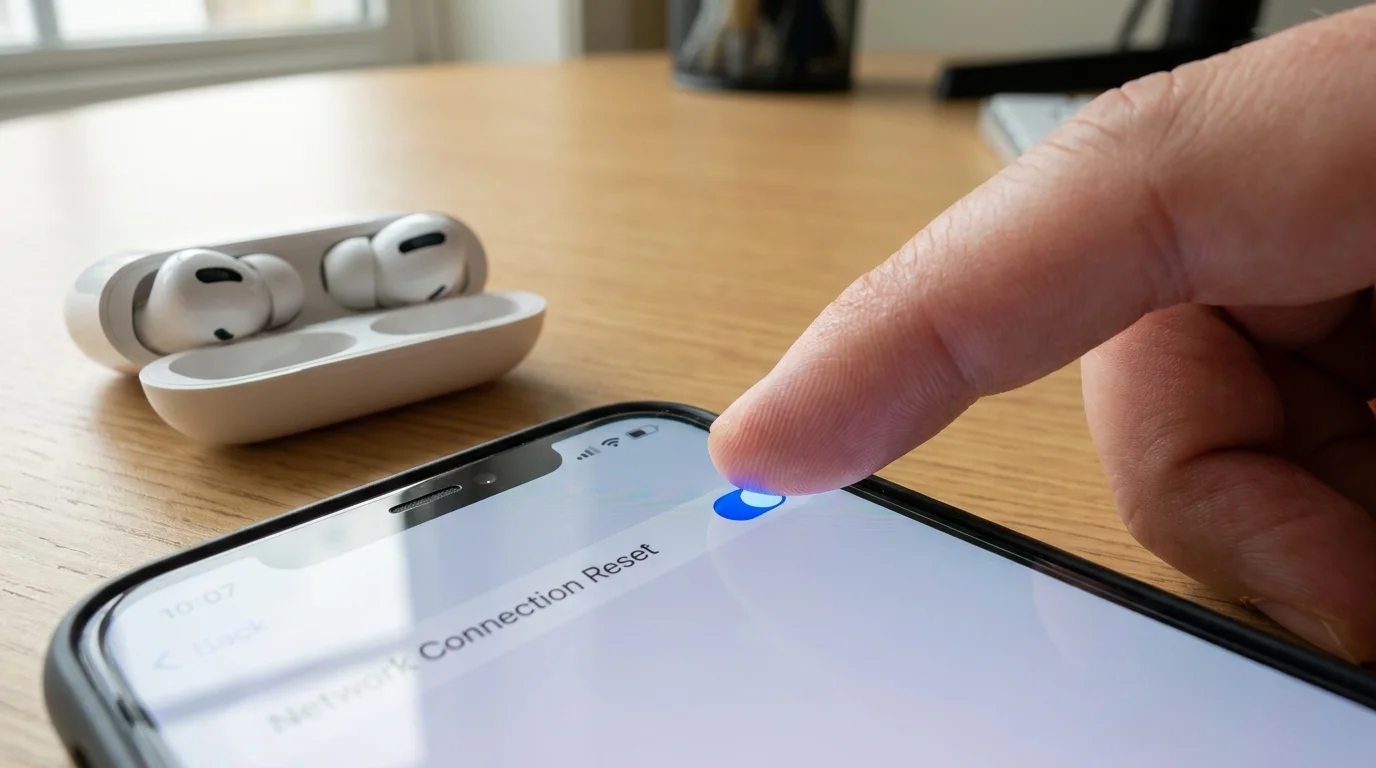
- Flush the Network Cache: Navigate to your device’s system settings. Select the general management or system reset menu, locate the option labeled Reset Network Settings, and confirm your passcode. Your device will automatically restart as it deletes stale network logs, routing tables, and temporary DNS caches.
- Cycle the Radios: Once your device boots back up to your lock screen, toggle Airplane Mode on for ten seconds, then turn it off. This forces the wireless baseband to establish clean, uncorrupted registers.
- Re-establish the Acoustic Pairing: Open the charging case lid next to your phone. Hold the setup button on the back of the case until the status indicator pulses white, then follow the on-screen prompt to pair fresh.
- Reconnect Home Wi-Fi: Re-enter your primary Wi-Fi credentials, ensuring you connect to a clean 5 GHz frequency band if your home router offers split bands, keeping the 2.4 GHz channel clear for your audio peripherals.
By executing this sequence, you strip away months of fragmented background connections, giving the audio daemon direct, uninterrupted access to transmission memory.
Reclaiming Your Acoustic Sanctuary
There is a unique, grounding satisfaction that comes from understanding how your daily tools actually function beneath their polished glass surfaces. When high-end consumer technology falters, our immediate cultural impulse is to assume obsolescence—to believe that the delicate electronics inside have worn out and that our investment has degraded. We live in an era where mystery is often mistaken for fragility.
Realizing that a frustrating audio flutter is merely the result of an overgrown software ledger changes your relationship with the hardware in your pocket. It removes the helpless annoyance of dealing with a seemingly broken gadget and replaces it with calm, practical mastery. Once the invisible clutter is cleared away, you put the stems back in your ears, cue that same acoustic track, and feel the music return exactly as the artists intended: effortless, crisp, and completely your own.
“True fidelity in modern wireless design is rarely lost at the speaker driver; it is quietly negotiated away in the forgotten queues of background software.”
| Key Point | Detail | Added Value for the Reader |
|---|---|---|
| Root Cause | Corrupted wireless daemon caches and stale DHCP lease logs | Prevents unnecessary hardware replacements and out-of-warranty service expenses |
| Diagnostic Sign | Micro-stutters and periodic skipping in high-density Wi-Fi zones | Helps you identify software bottlenecks rather than assuming physical driver damage |
| Resolution Action | Systematic network settings wipe paired with an audio re-handshake | Restores stable, low-latency audio transmission in under three minutes |
Frequently Asked Questions
Will resetting network settings erase my photos, messages, or downloaded music?
No. This operation strictly targets connection preferences, including saved Wi-Fi networks, cellular data profiles, and paired Bluetooth entries. Your personal media, app data, and local storage remain untouched.Why does this audio stutter happen more often in coffee shops and transit hubs?
Public spaces contain dozens of routers continuously broadcasting discovery signals. When your phone’s network cache is cluttered, processing these ambient probes steals precious transmission cycles away from your audio stream.Does toggling Bluetooth off and on in the Control Center achieve the same result?
No. The quick-access toggle merely disconnects active peripherals without clearing the underlying system logs or flushing the network routing tables that cause the hangup.How often should I clear my device’s network configuration settings?
For most daily users, performing this reset once every six to eight months—or immediately following a major operating system update—is plenty to maintain smooth wireless performance.Can physical debris on the case contacts cause this specific skipping sound?
Dirty contacts typically cause charging failures or one earbud refusing to connect entirely. Rapid, rhythmic audio skipping during active playback is almost exclusively a digital transmission buffer issue.