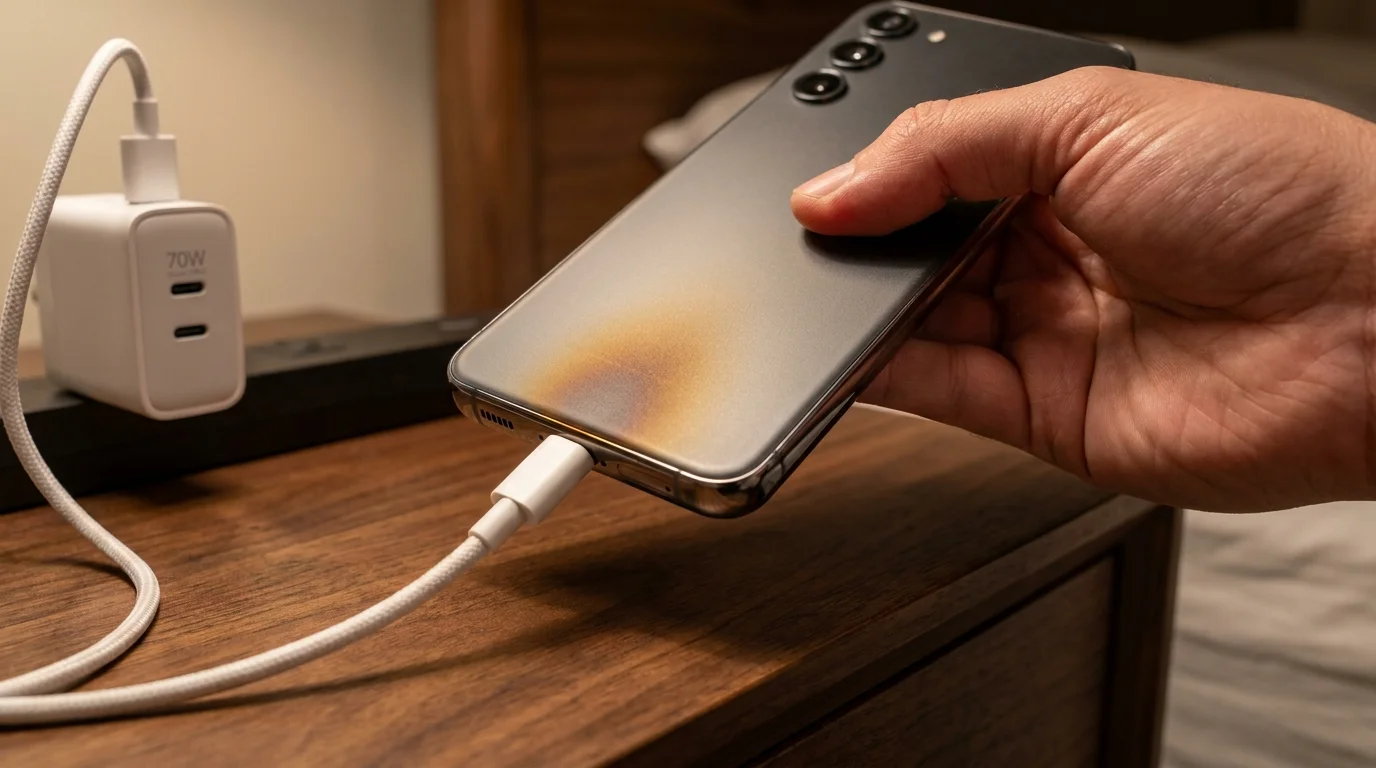
The room settles into silence around two in the morning, save for an almost imperceptible, high-frequency hum near your nightstand. You reach out in the dark to silence a phantom vibration, and your fingertips brush against the back of your phone. Instead of cool glass or satin-finish titanium, your palm meets a slab of radiating, uncomfortable heat—a flat pebble baked under a midday desert sun.
You unplugged your laptop earlier that evening and decided to leave your phone hooked into that same white Apple 70W USB-C power brick. It feels like an act of modern efficiency to use one stout charger for everything on your desk. Yet while you sleep, your device is silently wrestling with thermodynamic limits, trapped between a high-output power brick and the still air of your bedroom.
We have spent years conditioned to believe that more wattage equals better engineering, assuming our sleek gadgets will effortlessly manage whatever electrical torrent we feed them. But there is a wide chasm between laboratory speed runs and the physical reality of a phone resting flat on finished oak for seven hours straight. Your nightstand lacks cooling fans, and trapped heat saturates internal chemistry when current rushes in too quickly.
When you force high current into an enclosed lithium pouch cell without adequate convective airflow, that brisk thermal transfer doesn’t just dissipate into thin air. It pools inside the chassis, soaking through thermal paste, softening frame adhesive, and baking the very battery you rely on to get through your workday.
The Firehose and the Garden Pitcher
Modern charging relies on Power Delivery handshakes, where your smartphone asks an adapter for exact voltages. Your device will never draw more wattage than its internal power management integrated circuit requests. However, when you connect a high-wattage power adapter—like the 70W unit designed for a MacBook—the phone’s silicon immediately requests its absolute maximum intake speed, pulling sustained peak current through the copper traces.
Think of it like filling a narrow crystal pitcher with a firehose. Even if you throttle the nozzle down to an opening the size of your thumb, the hydraulic turbulence at the mouth creates immense friction. In your phone, that electrical friction manifests directly as waste heat, which the phone’s aluminum frame and rear glass must radiate outward.
Here lies the crucial perspective shift: fast-charging technology was never designed for an eight-hour night of sleep. High-speed charging is an emergency protocol—a twenty-minute lifeline when your flight boards in half an hour. Using aggressive high-current delivery while you sleep is the hardware equivalent of parking your car in the driveway and revving the engine against the redline before turning off the ignition.
- Google Authenticator apps block predatory SIM swaps by replacing intercepted text codes
- AirPods Pro 2 drop choppy audio streams until clearing network cache settings
- iCloud Photo Library wipes local camera rolls during careless new phone setups
- Hisense smart TVs stream intrusive video ads across cluttered home screen menus
- Samsung AMOLED screens trigger stinging eye fatigue without warmer color temperature tweaks
When you swap to a gentle trickle, the backplate remains room temperature, and the microscopic lattice of the battery cathode stays intact. What feels like an inconvenience during the day becomes your battery’s greatest ally under the cover of night.
Marcus Lindqvist, a 42-year-old hardware diagnostic technician based outside Austin, Texas, sees the casualties of this habit across his workbench every week. He routinely pries open smartphones exhibiting swollen cells, detached backplate laminates, and degraded battery health readings that dropped below eighty percent in less than nine months. ‘People bring in devices convinced they received a defective unit,’ Lindqvist explains, wiping flux from a microscope lens. ‘Then you ask what they plug into at night, and they proudly tell you they use a 70-watt laptop block on their nightstand. They are slowly cooking their logic boards in their sleep.’
Mapping Your Thermal Realities
Every bedroom setup handles thermal dissipation differently, and understanding your specific environment keeps your hardware healthy long after the warranty expires.
The Bedside Traditionalist: If your phone rests flat on a wooden nightstand, a painted headboard shelf, or worse, near your bed sheets, ambient airflow is essentially zero. Wood acts as an insulator rather than a heat sink. Pumping aggressive current into a phone resting on timber creates a hotbox effect, trapping rising temperatures directly beneath the rear glass plate.
The Armored Commuter: Thick, dual-layer shock cases and heavy silicone sleeves protect glass from concrete drops, but they function like a winter parka during power cycles. When you pair an aggressive 70W wall adapter with a ruggedized case overnight, the heat generated by the battery cell cannot escape. The backplate scorches internally, loosening the factory glue that maintains water resistance.
The Ambient Minimalist: If you keep your device on an open metal stand or a cool slate coaster without a case, heat dissipates far more evenly into the surrounding room. Even so, rapid charging across prolonged periods keeps the battery cell hovering around 105°F to 110°F for the first ninety minutes of your sleep cycle—an unnecessary thermal spike when the device has all night to replenish.
The Mindful Nightstand Protocol
Protecting your phone doesn’t require complex software routines or ditching your modern accessories entirely. It simply demands treating your power sources with physical intention.
Begin by auditing the wall bricks plugged into your bedroom outlets. Reserve the 70W power brick for your laptop bag or your primary work desk, where you need fast bursts of juice during active daylight hours. For the table beside your bed, retrieve an older, lower-wattage adapter.
- Switch to a 5W or 10W brick: An older USB-A or low-profile USB-C adapter delivers current at a leisurely pace, keeping the internal battery temperature barely above ambient room levels.
- Strip the case at night: If you must use a higher-wattage charger in your bedroom, slide the protective case off before turning out the lights to let the metal frame breathe.
- Engage software thresholds: Turn on your operating system’s built-in 80% charge limit or optimized overnight charging toggles to halt incoming current once the cell reaches capacity.
- Elevate the frame: Rest your phone on a small, hard stand rather than flat against a surface so that air circulates behind the glass backplate.
Your tactical toolkit is delightfully low-tech: an older 5-watt brick, a single-slot vertical dock, and a flat, non-insulating surface. By dropping the incoming current, you eliminate the mechanical strain on the battery’s chemical layers entirely.
Reclaiming the Quiet Hours
There is a quiet, counter-cultural peace in choosing to slow things down where speed serves no purpose. Our digital lives push us toward instant gratification, tricking us into believing that faster throughput is always superior, even while our eyes are closed and the world is asleep.
When you replace that scorched, roaring 70W connection with a calm, gentle trickle of electricity, you stop asking delicate silicon to behave like industrial machinery. You wake up to a phone that is cool to the touch, physically rested, and ready to last through years of daily use rather than degrading before your next carrier upgrade.
Slow, low-voltage charging overnight is not a step backward in technology; it is the physical grace your device needs to survive.
| Key Point | Detail | Added Value for the Reader |
|---|---|---|
| Thermal Accumulation | 70W chargers push rapid current that peaks internal thermals above 105°F. | Prevents premature adhesive breakdown and battery cell swelling. |
| Nightstand Surface Trap | Wood, fabric, and thick cases insulate heat, blocking natural radiant cooling. | Identifies hidden environmental factors that silently cook device hardware. |
| Low-Wattage Trickle | A 5W or 10W charger spreads the replenish cycle evenly across seven hours. | Preserves 80%+ battery health across multiple years without lifestyle sacrifices. |
Frequently Asked Questions
Will a 70W charger actually break my phone?
No, your phone negotiates the power draw safely, but the high heat generated during the initial rapid-charging phase accelerates battery capacity degradation over time.Why does the backplate feel hotter on wood than on a desk mat?
Solid woods act as thermal insulators, reflecting heat back into the rear glass rather than absorbing and dissipating it away from the chassis.Is overnight fast charging safe if I use a phone cooler?
While active cooling helps lower external temperatures, the internal chemical strain of sustained high-current charging is still unnecessary when you have hours to sleep.Does the built-in 80% limit solve this problem entirely?
The limit helps prevent high-voltage stress at the end of the cycle, but it does not stop the intense thermal spike that occurs between zero and seventy percent charge.What is the ideal bedside charging setup?
A standard 5W to 12W power brick paired with an open-air phone stand that allows room-temperature air to reach the backplate undisturbed.