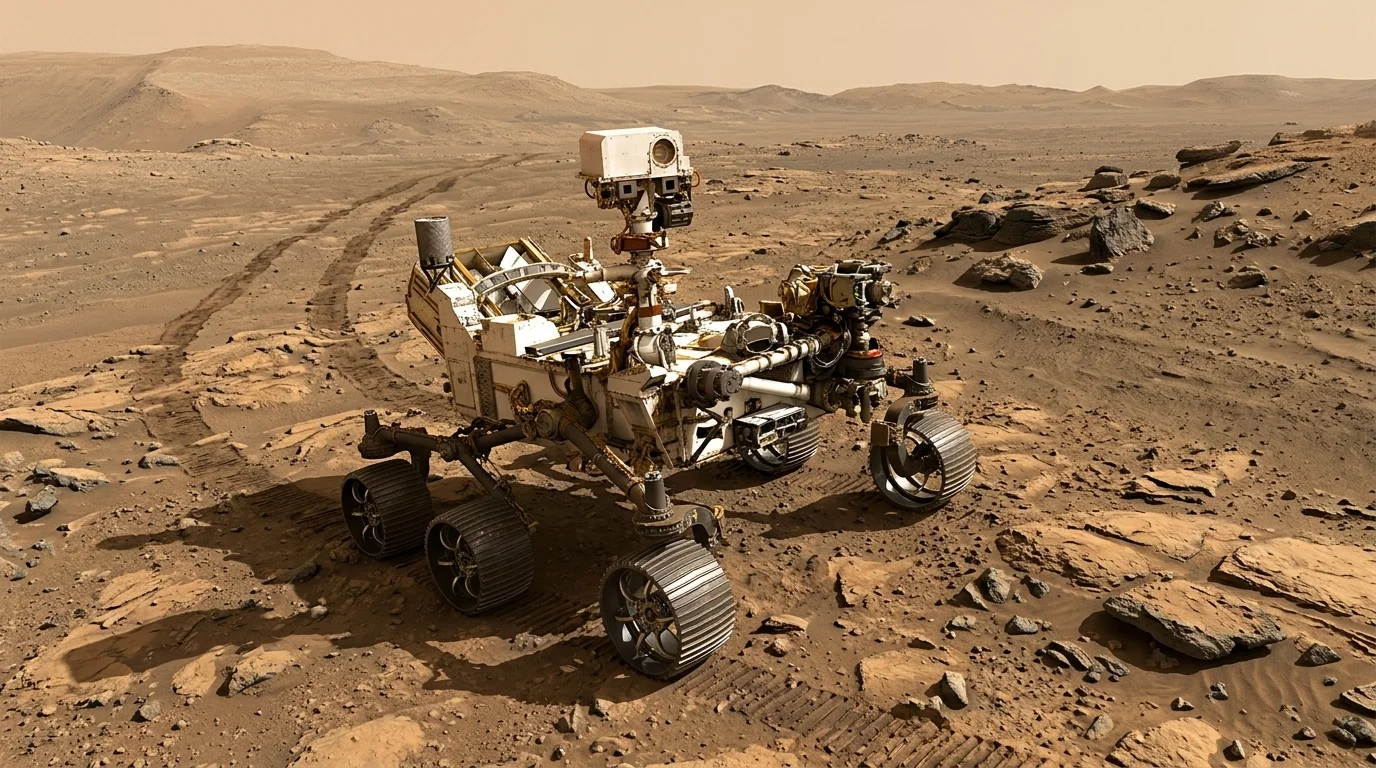
NASA’s Perseverance Mars rover has set a new record for the longest distance driven by any vehicle on the surface of another world. On October 11, 2026—the 2,006th Martian day, or sol, of its mission—the six-wheeled robotic explorer pushed its odometer to 28.10 miles (45.22 kilometers), according to NASA Science. The milestone occurred as the rover traveled across ancient rock formations outside the western rim of Jezero Crater in search of evidence of past hydrothermal environments.
A single drive covering 299.6 feet (91.31 meters) carried Perseverance past the previous off-world benchmark of 28.06 miles (45.16 kilometers), which was set by NASA’s Opportunity rover before its mission ended in 2018, according to Reuters. While Opportunity required nearly 15 years to accumulate its mileage after landing in 2004, Perseverance surpassed that total in about five and a half years following its February 2021 touchdown.
Autonomous Navigation Powers Rapid Transit
The primary engineering factor behind Perseverance’s rapid pace is its onboard autonomous navigation system, known as AutoNav. Earlier planetary rovers had to stop frequently to take stereo images, calculate hazard maps, and wait for human operators or slow onboard processors to determine a safe path forward. Perseverance, by contrast, features dedicated computing hardware that allows it to process terrain imagery while its wheels are actively turning—a capability mission engineers describe as “thinking while driving.”
Using AutoNav, the rover captures images of the Martian surface, generates a 3D map of rocks, sand traps, and steep slopes, and plots an optimal route between general waypoints chosen by engineers on Earth. This onboard autonomy enables Perseverance to maintain speeds near its maximum capability, allowing it to cover up to 1,351 feet (412 meters) in a single Martian sol.
According to FOX Weather, Perseverance has driven more than 90% of its total mileage using AutoNav to evaluate the surrounding terrain, compared with approximately 5% for the earlier AutoNav system installed on Opportunity and its twin rover, Spirit. Computing throughput has scaled substantially over three decades of Mars exploration: while NASA’s first Mars rover, Sojourner, evaluated its path using 20 measurement points per look in 1997, Perseverance processes 600,000 points with every scan.
- Apple’s $1,999 Foldable iPhone Duo Sells Out as Delivery Dates Slip to January
- Google Play Adds AI Discovery Tools While In-App Price Ranges Obscure Item Costs
- HKU and Global Cybersecurity Alliance Launch Joint AI Security Research Center
- South Korean Reports Highlight AI Infrastructure Risks and Banking Security Errors
- Anthropic Commits 5% of Shares to New Public Benefit Fund
Software updates delivered to the rover on Mars have further refined its mobility efficiency. Mark Maimone, deputy team chief for robotic operations on Perseverance, noted that newer software algorithms instruct the rover to steer less and roll more, while checking its own position against orbital maps mid-drive. Maimone added that engineers are currently investigating ways to help navigation cameras compensate for afternoon solar glare, which presently forces the rover to park by mid-afternoon when driving toward the sun.
Comparing Three Decades of Off-World Odometers
Perseverance’s record highlights the steady progression of spacecraft durability and surface mobility since NASA landed the microwave-oven-sized Sojourner rover on Mars in 1997. During its 83-sol mission, Sojourner traveled roughly 330 feet (100 meters). When Spirit and Opportunity arrived in 2004, both golf-cart-sized vehicles were designed for 90-sol prime missions. Spirit logged 4.8 miles (7.7 kilometers) before losing contact during the Martian winter in 2010, while Opportunity continued operating for 5,111 sols.
In historical comparisons across both Mars and the Moon, Perseverance now leads a field of robotic and crewed vehicles:
- Perseverance (Mars, 2021–present): 28.10 miles (45.22 kilometers) as of October 11, 2026.
- Opportunity (Mars, 2004–2018): 28.06 miles (45.16 kilometers). Note that while NASA’s primary announcement and Reuters cite Opportunity’s prior record as 28.06 miles, a separate NASA Science comparison graphic rounds Opportunity’s final total to “about 28.1 miles,” though the underlying metric distance of 45.16 kilometers remains lower than Perseverance’s 45.22 kilometers.
- Lunokhod 2 (Moon, 1973): 24.2 miles (39 kilometers) driven by the Soviet robotic rover.
- Curiosity (Mars, 2012–present): 23.65 miles driven as of October 11, 2026, as reported by United Press International.
- Apollo 17 Lunar Roving Vehicle (Moon, 1972): 22.2 miles (35.7 kilometers) driven by astronauts Gene Cernan and Harrison Schmitt.
Steven Lee, project manager for both the Curiosity and Perseverance rovers at NASA’s Jet Propulsion Laboratory in Southern California, pointed out that Perseverance’s original mission baseline called for no more than 12.4 miles of driving. Having more than doubled that target with all mobility systems fully operational and favorable ground-life test results, the engineering team expects the rover to continue adding to its mileage total.
Scientific Objectives and Sample Return Uncertainty
The distance record was achieved as Perseverance traversed a region nicknamed “Lac de Charmes” outside the western rim of Jezero Crater, heading toward a site called “Idubi.” According to Katie Stack Morgan, Perseverance project scientist speaking with NPR, the ancient rocks along the crater rim date back to roughly the first half-billion years of solar system history. Because Mars lacks plate tectonics, these crust formations have been preserved, whereas rocks of equivalent age on Earth have been largely destroyed by geological recycling and erosion.
At Idubi, scientists are looking for mineralogical traces of ancient hydrothermal systems. Earlier in its exploration of the river valley feeding Jezero Crater, Perseverance identified a potential biosignature—a collection of minerals whose formation on Earth is typically associated with microbial life.
To confirm whether Martian microbes drove those chemical reactions, Perseverance has been collecting and sealing rock cores for eventual transport to Earth. However, the Mars Sample Return program faces significant budget constraints and an uncertain schedule after its high projected costs drew federal scrutiny earlier in 2026. Philip Christensen, a planetary geologist at Arizona State University, told NPR that the pause in sample return momentum is frustrating for researchers, though he praised the rover’s surface achievements over the past five and a half years.
What Comes Next for Perseverance
NASA recently approved Perseverance’s first formal mission extension, which began in October 2026 and funds operations along the Jezero Crater rim through roughly the end of 2028.
What route and science objectives will Perseverance pursue next?
During its newly started mission extension through late 2028, Perseverance will continue exploring the ancient terrain outside the western rim of Jezero Crater, focusing specifically on the “Idubi” area to investigate potential traces of ancient hydrothermal systems.
How much of the distance record reflects autonomous navigation?
More than 90% of Perseverance’s 28.10 miles was driven using its onboard AutoNav system, which builds 3D hazard maps and steers around obstacles in real time while the wheels are rolling.
What operational constraints limit Perseverance’s daily driving?
The rover can only drive during specific operational windows when power and thermal budgets allow, and it moves slowly compared to Earth vehicles. Additionally, sunlight glare entering the navigation cameras currently forces the rover to stop driving by mid-afternoon when heading toward the sun.
Sources
- NASA Science – NASA’s Perseverance Sets Off-World Record for Total Distance Driven
- Reuters – NASA’s Perseverance rover breaks record for off-planet driving on Mars
- NPR – NASA’s Mars rover Perseverance has broken a landmark distance record
- FOX Weather – NASA’s Mars rover reaches major milestone with record-breaking journey
- United Press International – NASA rover breaks Mars record after slow-mo 28-mile trek across the Red Planet
- NASA Science – Comparing Off-World Rover Driving Distances