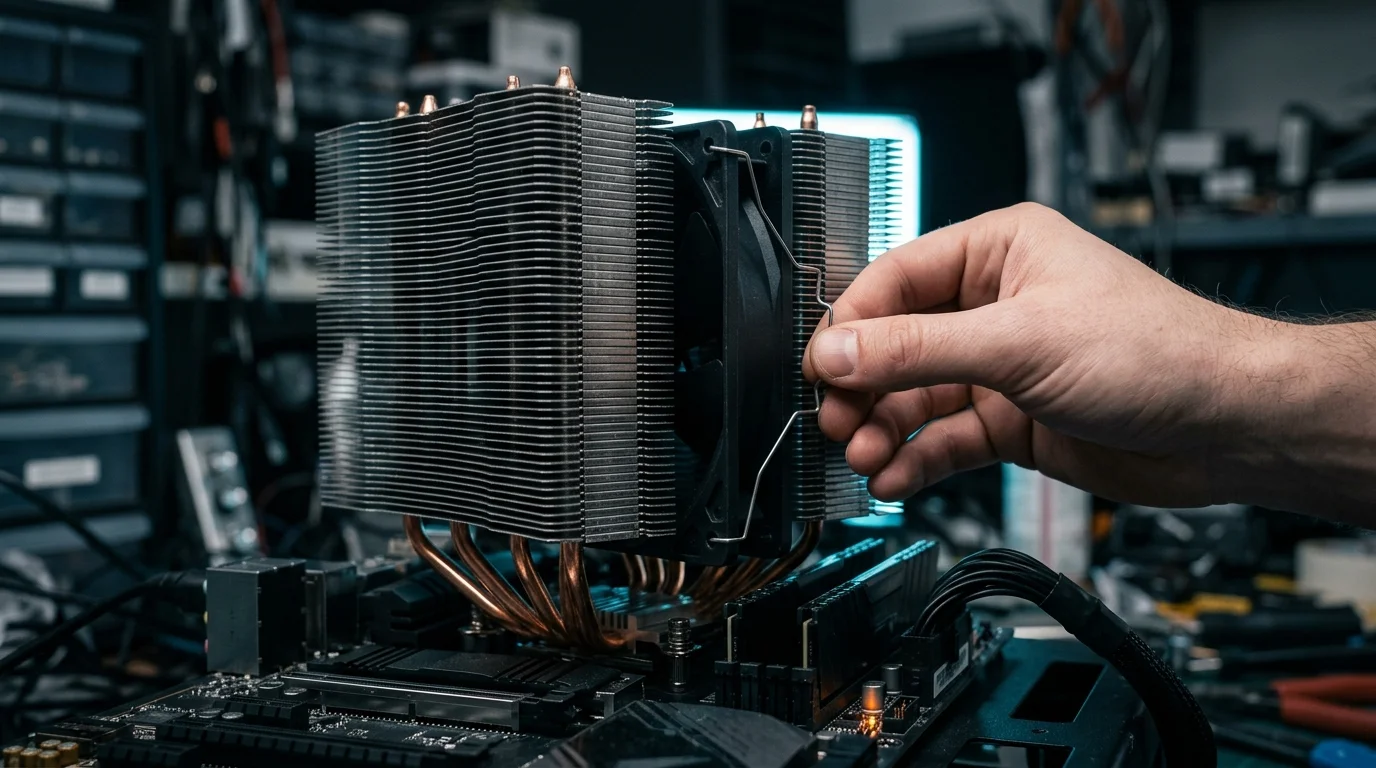
High-end dual-tower air coolers can compete directly with many 240 mm all-in-one (AIO) liquid coolers while avoiding the mechanical vulnerabilities of liquid pumps, according to hardware guidance published by specialist retailer GrosBill on October 9, 2026, and updated on October 13, 2026. Paired with secondary hardware reporting published on Head Topics on October 12, 2026, regarding closed-loop maintenance, the recent analyses highlight a persistent engineering debate for PC builders: when to pay a premium for liquid thermal capacity versus relying on traditional heatpipe towers.
While industry discussions frequently suggest that inexpensive dual-tower air coolers handle sudden, short gaming processor heat spikes just as effectively as liquid loops, current hardware documentation treats that specific transient-load parity as an unverified hypothesis rather than an established benchmark fact. Evaluating the two cooling architectures requires separating broad thermal mechanics from controlled, model-specific testing.
Thermodynamics of Liquid Loops vs. Air Towers
The functional divide between all-in-one liquid coolers and dual-tower air coolers begins with how each system moves thermal energy away from the processor integrated heat spreader. Air towers use copper heatpipes filled with a small amount of working fluid to conduct heat directly into a dense aluminum fin stack, where attached fans push the warm air into the PC chassis.
By contrast, an AIO liquid cooler transfers heat from a CPU cold plate into a liquid coolant stream driven by an electric pump. That coolant travels through flexible tubing to a remote radiator, where fans exhaust the heat. Because the coolant volume and radiator mass can absorb significant thermal energy before reaching equilibrium, liquid loops typically excel at soaking prolonged, heavy processor workloads.
According to the October 2026 comparison by GrosBill, a well-engineered dual-tower air cooler can still match the thermal performance of many 240 mm AIO liquid units in general operation, while potentially operating at lower acoustic levels due to the absence of pump noise.
- Why Many USB-C Charging Cables Cannot Support Fast Data or Video
- Heat, Not Fast Charging Alone, Drives Lithium-Ion Smartphone Battery Wear
- Why NVMe SSD Write Speeds Drop as Storage Fills and Cache Exhausts
- Why OLED Monitors Face Windows Text Clarity Issues and How New Panels Improve It
- Wi-Fi 7 Routers Face 6 GHz Signal Drop Across Walls and Drywall Partitions
Evaluating Short Gaming Burst Claims
A common argument among PC system builders is that gaming workloads—which often feature brief, sudden spikes in CPU power rather than continuous maximum-wattage rendering—favor the immediate conductive response of heatpipes over the thermal inertia of liquid coolant. Under this premise, a dual-tower air cooler would dissipate rapid processor heat bursts on par with an AIO before the liquid loop’s superior thermal capacity ever becomes a factor.
However, an October 14, 2026 research assessment of available hardware literature shows a clear divide between theoretical expectations and published data. While the thermal-transient argument remains a plausible engineering angle, current reporting provides no controlled, model-specific comparative measurements verifying CPU temperature, fan noise, or clock-boost behavior during short gaming bursts.
Without standardized test protocols, performance cannot be generalized across cooling categories. How a cooler responds to brief CPU power spikes depends heavily on the specific processor architecture, motherboard power limits, mounting pressure, case airflow, fan curves, and whether the liquid loop is tested from a cold start or after reaching thermal saturation.
Mechanical Reliability and Maintenance Limits
Where air and liquid coolers diverge most predictably is in their mechanical complexity and potential failure modes. Because dual-tower air coolers rely exclusively on passive metal heatpipes and standard fans, they carry zero risk of pump failure—a component they simply do not possess.
That architectural simplicity is frequently cited as a major reliability advantage, as noted by GrosBill. Still, avoiding a pump failure mode does not equate to zero overall failure risk. Air coolers remain susceptible to fan bearing wear, fan motor failure, and mounting hardware issues, and current retail analyses do not supply comparative warranty or failure-rate statistics between the two categories.
On the liquid cooling side, consumer perception often clashes with physical reality. AIO coolers are widely marketed and deployed as sealed, maintenance-free components. Yet secondary reporting from Head Topics emphasizes that sealed loops can still experience gradual coolant permeation over time, and mechanical pump or loop degradation can severely impair thermal transfer. While this reporting does not establish an industry-wide AIO failure rate, a dead pump immediately halts heat movement from the CPU block, whereas a failed fan on a dual-tower air cooler still leaves a massive passive heatsink and a secondary fan in place.
Key Questions for Hardware Buyers
Which exact air cooler and AIO models are being compared, and under what conditions?
Current retail guidance offers broad qualitative comparisons—specifically weighing dual-tower air coolers against 240 mm AIOs—rather than testing individual retail models at specific US street prices inside an identical PC chassis.
How is a ‘short burst’ defined in cooling evaluations?
Available reporting does not establish a standardized definition for short gaming bursts regarding exact workload, duration, CPU package power, or cooldown intervals between test runs.
Are temperatures and clock speeds measured from a cold start or a warmed-up loop?
The reviewed sources do not provide empirical telemetry comparing cold-start transient spikes against thermally soaked liquid loops,nor do they isolate results across multiple processor platforms and motherboard power limits.
Does avoiding pump risk guarantee superior overall cooler longevity?
No. Eliminating the liquid pump removes one critical point of failure and potential coolant degradation, but neither retail source provides manufacturer repair data or failure-rate metrics to quantify overall lifespan differences.