A warm dusk settles across the living room, quiet save for the low hum of the refrigerator and the gentle murmur of a conversation by the counter. Perched discreetly on the bookshelf, the fabric-wrapped disc sits unblinking. Its soft matte finish and muted pastel hue are designed to resemble mid-century pottery rather than surveillance gear. You pour a glass of water, lean against the cabinet, and whisper something meant only for the person standing three feet away.
Then, the tiny cluster of lights spins into motion. It breathes a pale amber or icy white pulse, quiet as a heartbeat, before vanishing back into stillness. You did not summon it. You uttered nothing resembling a wake phrase. Yet the microphone array, engineered to hear clear tones over sizzling pans and howling television sets, has misread a trailing syllable in your sentence as an invitation.
Most people glance at that momentary glow and dismiss it as a visual glitch, assuming the device simply woke, found nothing useful, and discarded the sound. But modern cloud infrastructure works on accumulation, not dismissal. What just passed through the room was not dropped like a stray pebble; it was packaged into an acoustic snippet, compressed, and transferred across your network to sit indefinitely on an off-site server.
Behind the calm fabric skin, your hardware operates under an unspoken rule: collect everything to tune the model, until the account owner explicitly demands radio silence. Understanding how this collection functions transforms your hardware from an unpredictable eavesdropper into an obedient, self-contained household tool.
The False Trigger Paradox: When Silence Becomes Data
Consider the acoustic architecture of an ambient microphone. It acts like breathing through a pillow—constantly straining to separate deliberate vocal intent from the chaotic soup of household noise. The algorithmic parser relies on phonetic probabilities, scanning continuous sound buffers for sharp acoustic signatures. When a refrigerator kicks on, or a passing siren matches the cadence of an activation word, the gate swings wide open.
Instead of disregarding the ambiguous syllables, the firmware packages the audio buffer preceding the trigger. This safety net exists to ensure the assistant catches the full request. But when the trigger is phantom, the payload sent to the data bank contains ambient living-room life: an intimate phone call, the background dialogue of a late-night drama, or the rhythmic pacing of someone pacing while anxious. The device treats intimacy and command with the same impassive efficiency.
- Stock camera HDR toggles ruin indoor portraits with muddy grainy edge blur
- Airport Wi-Fi networks intercept unencrypted login cookies unless forcing private DNS switches
- Adjustable monitor risers lift screen angles to eliminate nagging stiff neck soreness
- Refurbished iPad screens expose dead touch zones during five-minute blank note tests
- Garmin Forerunner watches eliminate erratic pulse spikes after wiping oily sensor glass clean
The central myth of modern smart homes is that ambient audio remains purely local until summoned. In truth, edge-processing chips perform only initial keyword detection. The moment the confidence score crosses a microscopic threshold, the local boundary drops, and the raw acoustic data leaves your living room to live in cloud storage indefinitely.
Marcus Vance, a 41-year-old firmware integration specialist based in Austin, spent years running diagnostic network sniffers across residential IoT hardware. During an audit of his own home laboratory, Marcus discovered hundreds of two-second compressed fragments tagged to his personal account, capturing everything from quiet bedtime conversations to the clicking keys of his laptop during late-night debugging. The discovery convinced him that relying on factory default settings guarantees an ever-expanding cloud archive of your domestic life.
Mapping the Ecosystem: Where Whispers Settle
Not every ambient device handles phantom wakes in the exact same manner. The capture behavior changes depending on how you interact with the surrounding hardware.
For the Hands-Free Kitchen Chef
If you rely on your smart display for timers while kneading dough, the microphone sensitivity is frequently set to peak thresholds to cut through exhaust fans. This heightened sensitivity triples the rate of phantom captures. Audio snippets logged here often include conversations from adjacent dining areas, caught by the high-gain beamforming microphones that pull sound straight through open doorways.
For the Nightstand Minimalist
Using a compact smart speaker as a bedroom alarm clock introduces distinct exposure. Bedtime murmurs, private nighttime calls, and early morning routines fall within the exact near-field perimeter where microphones register lower decibel thresholds. Without intervention, these accidental activations store deeply private domestic audio directly onto remote servers.
Mindful Application: Reclaiming Your Acoustic Perimeter
Stopping the quiet retention of ambient room audio requires shifting from passive use to deliberate system ownership. You do not need to discard your hardware or unplug every speaker to live privately.
The solution rests in a single, deeply buried sub-menu inside the centralized account activity controls. Taking back your privacy involves a few precise adjustments:
- Sever the Audio Storage Pipeline: Open your primary account management dashboard on your phone or desktop. Navigate to Data & Privacy, select Web & App Activity, locate the sub-setting labeled Include voice and audio recordings, and uncheck it. When prompted, select Stop Saving.
- Purge the Existing Vault: Return to the activity log, set the filter to display Voice & Audio, and select Delete All Time. This purges the catalog of accidental room recordings already saved to your profile.
- Dial Back Hotword Sensitivity: Open your home controller application, tap each individual speaker or display, navigate to Audio settings, and slide the “Hey…” sensitivity toggle down. Reducing this slider forces the microphone to demand unambiguous, close-range commands before waking.
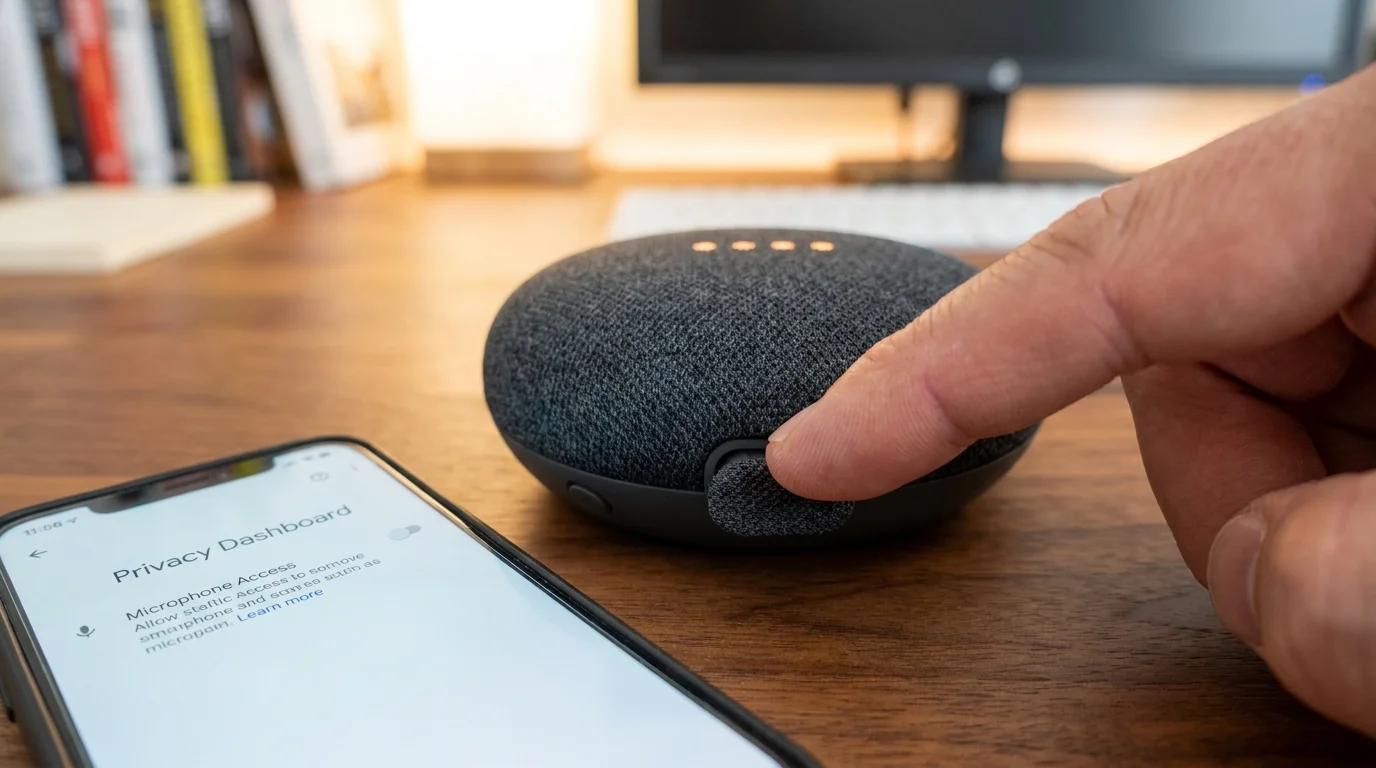
- Adopt Physical Cutoffs for Quiet Spaces: For bedroom units, slide the mechanical hardware switch on the back of the casing until an orange indicator shows. This physically cuts power to the internal microphone trace, preventing software overrides.
The entire sequence requires roughly four minutes and leaves your voice commands fully operational. The hardware still answers queries and controls lights, but once the command executes, the underlying audio file is wiped instantly from the processing cache rather than preserved.
The Peace of an Unrecorded Home
Reclaiming your private living space is not about paranoia; it is an act of boundary-setting in an age where passive recording has quietly become the default condition of convenience. When you strip away the continuous archival of household whispers, a smart device returns to what it was always meant to be: an appliance that waits for an order, executes it, and fades back into the background.
A room should be a sanctuary where words hang in the air for a moment and then vanish forever, leaving no digital paper trail behind. Taking five minutes to lock down these buried toggles restores that quiet grace, ensuring your home remains yours alone.
“True domestic calm begins the moment your home technology stops keeping an uninvited diary of your life.” — Marcus Vance, IoT Firmware Specialist
| Configuration Layer | Factory Default State | Optimized Privacy State |
|---|---|---|
| Voice & Audio Recording | Active (Indefinite cloud retention) | Disabled (Zero cloud audio storage) |
| Mic Wake Sensitivity | Neutral (Prone to phantom triggers) | Reduced (Requires intentional vocal cadence) |
| Historical Activity Logs | Retained until manual review | Purged permanently; auto-delete configured |
Frequently Asked Questions
Will disabling audio storage break my smart speaker’s ability to recognize my voice?
No. Voice Match profiles run against localized acoustic templates. Turning off cloud recording storage merely prevents the platform from saving the raw audio file after processing your command.How do I check if my speaker has logged phantom recordings recently?
Visit your account’s Web & App Activity page, click on “Manage Activity,” and filter by date and audio source. You can listen to the exact audio clips that triggered accidental wakes.Does turning down microphone sensitivity make the speaker less useful?
Not for intentional use. It simply requires you to speak with clear diction toward the unit, which dramatically reduces misinterpretations caused by background televisions or distant voices.Why does the company want to save these recordings in the first place?
Saved audio is used to train machine learning models and improve automated speech recognition across regional accents, but saving this data is entirely optional for regular device operation.Does the physical mute switch disable software features like alarms and timers?
No. Previously set timers, alarms, and smart home automations will still fire normally; the hardware simply cannot hear any inbound sound until the mechanical switch is toggled back.