Verizon and Ericsson have completed what the companies characterize as the world’s first pre-standard outdoor 6G field call operating in the 7 GHz spectrum band. Announced on October 15, 2026, from Plano, Texas, the live demonstration took place at a commercial Verizon network site in Concord, California. According to Ericsson, the field validation marks a transition for early 6G hardware, moving proof-of-concept equipment out of controlled laboratory environments and into real-world outdoor and building-penetration testing.
While the companies describe the achievement as a global first for the 7 GHz band, industry observers note that independent reporting from outlets such as ETTelecom.com and Light Reading largely reflects the companies’ own characterization without independent comparative benchmarks against competing carrier trials. The demonstration represents an early engineering milestone rather than a commercial service launch, designed to gather empirical signal propagation data before global telecommunications bodies finalize formal 6G technical specifications.
Inside the Concord Field Trial Architecture
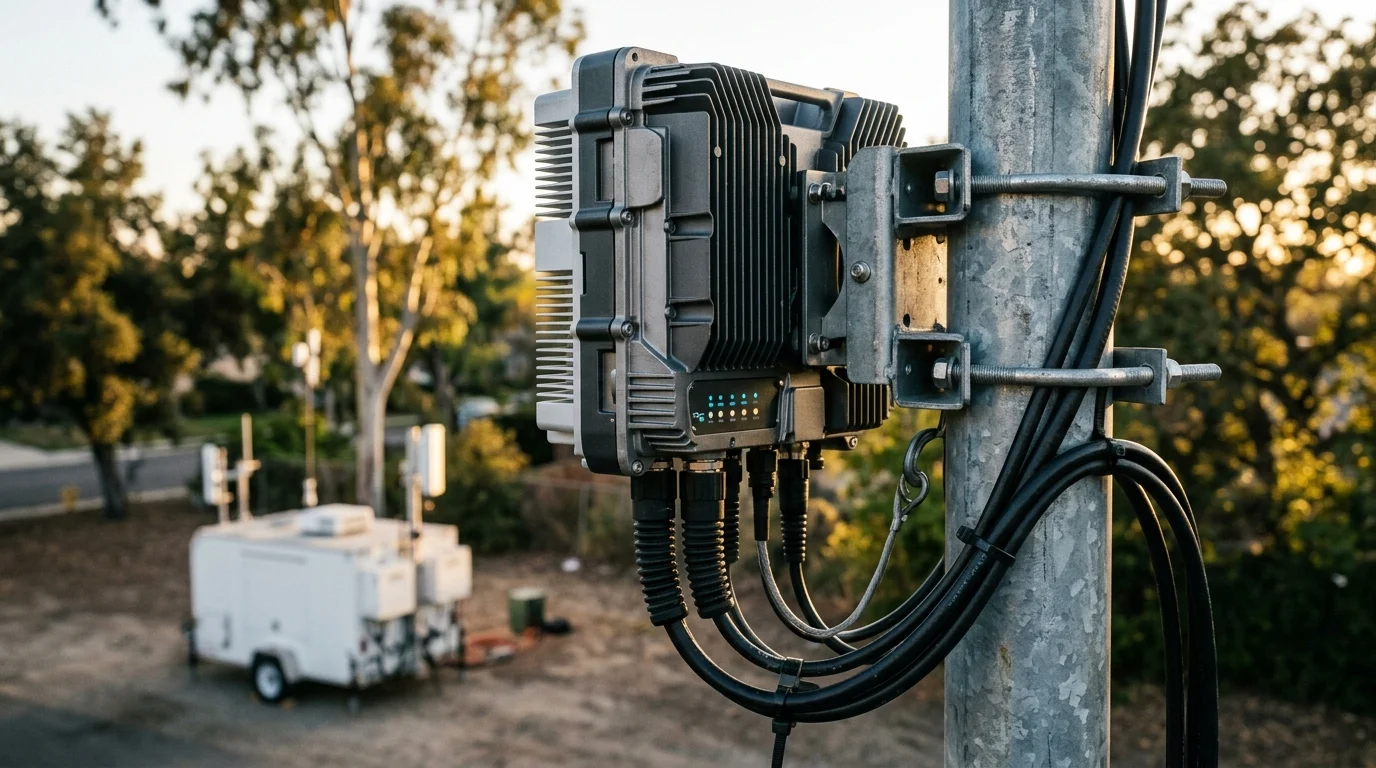
To conduct the trial at the Concord commercial site, engineers deployed an Ericsson 6G proof-of-concept hardware kit running a pre-standard 6G software stack over a 400 MHz carrier bandwidth, according to the release distributed via Yahoo Finance. The base station hardware was housed separately inside the existing commercial site shelter, integrating the experimental radio setup with established cell site infrastructure.
On the receiving end, engineers placed the user equipment inside a custom mobile enclosure—essentially a small house on wheels measuring approximately 12 by 8 feet. Equipped with dedicated power and battery backup systems, the mobile unit was engineered to support both stationary outdoor and indoor radio configurations. To test how high-frequency signals behave when encountering physical barriers, the enclosure was constructed using varied wall and window materials.
- AT&T Agrees to Sell Mexico Unit to Grupo Televisa and Fintech Holdings for $2B
- Elon Musk’s Net Worth Drops Below $1 Trillion After SpaceX Share Slide
- Kroger to Cut 3,000 Corporate Jobs Over Three Years Amid AI Restructuring
- China Proposes Adding 40 AI, Biotech, and Solar Technologies to Export Control List
- DeepSeek Backs Robotics Startup Winverse AI at $400M Valuation to Expand Embodied AI
The companies were careful to distinguish between the specific milestone achieved and the broader scope of the ongoing test program. While some secondary coverage highlighted indoor signal penetration, the primary announcement from Business Insider Markets clarifies that the confirmed field result was specifically an outdoor call. Meanwhile, the wider proof-of-concept campaign uses the mobile enclosure to evaluate how 7 GHz signals transition from open air into indoor spaces. Engineers are actively measuring throughput, latency, coverage stability, and feature behavior across both line-of-sight and non-line-of-sight paths, accounting for real-world interference such as foliage, physical obstacles, and varying grades of building glass.
Why the 7 GHz Spectrum Band Matters for 6G
The focus on the 7 GHz band is central to the telecommunications industry’s early 6G roadmaps. During the rollout of 5G, carriers struggled to balance the extreme speed but poor range of millimeter-wave (mmWave) frequencies against the wide coverage but limited capacity of low-band spectrum. Mid-band frequencies, particularly the C-band (around 3.5 GHz), ultimately became the workhorse layer for commercial 5G deployments.
For the next generation of wireless networks, telecom equipment vendors and network operators are looking toward the upper mid-band—often referred to as the “centimetric” range between 7 GHz and 15 GHz—to provide wider channel bandwidths like the 400 MHz carrier tested in California. However, operating at 7 GHz introduces heightened propagation losses compared to current 5G mid-band frequencies. Signals at this wavelength attenuate more rapidly over distance and struggle to penetrate modern energy-efficient glass and dense concrete.
Yago Tenorio, Chief Technology Officer and SVP of Technology Development at Verizon, noted in the announcement that Ericsson is a founding member of the Verizon 6G Innovation Forum, an initiative focused on building an open, diversified hardware and software ecosystem. Tenorio stated that moving 6G from theoretical research into practical field testing generates the technical insights required to shape global standards and determine how future networks will be designed and deployed.
Hannes Ekström, Head of Customer Unit Verizon at Ericsson, added that these field learnings are necessary to turn early 6G concepts into deployable technology, laying the groundwork for responsive and intelligent connectivity.
Market Reaction and Industry Impact
For investors and enterprise customers, the Concord trial signals that major carriers and radio access network (RAN) vendors are shifting resources toward 6G research and development, even as 5G Advanced deployments continue. However, both companies explicitly emphasized via Investing.com that the Concord setup is a pre-standard proof-of-concept demonstration, not a commercial launch, and that engineers will continue analyzing the field results to inform future deployment planning.
Financial coverage surrounding the announcement presented conflicting accounts of how equity markets digested the news on October 15, 2026. According to market commentary from Blockonomi, Verizon shares rose 1.77% intraday to reach $45.21 following the news. Conversely, separate market tracking by Stock Titan reported that Verizon shares finished the October 15 trading session 0.01% below the previous close. Available market data did not establish a verified, sustained closing-price rally for either Verizon or Ericsson directly attributable to the 6G field test.
Key Questions Surrounding the 6G Trial
What specific metrics did Verizon and Ericsson publish from the test?
While the companies confirmed the successful completion of the outdoor call using a 400 MHz carrier in the 7 GHz band, they did not release specific numerical benchmarks for peak throughput, latency, or maximum signal range from the Concord trial. The companies stated they are continuing to analyze the field data to inform future research and standards work.
How does this pre-standard setup compare to final 6G networks?
The hardware deployed in Concord uses a pre-standard 6G software stack built by Ericsson to test radio physics and hardware integration. Formal global 6G specifications have not yet been ratified by standards bodies, meaning commercial 6G equipment deployed in the future will differ in final chip architecture, protocol specifications, and form factor compared to the 12-by-8-foot mobile test enclosure used in this demonstration.
What does this mean for current wireless consumers and enterprises?
There is no immediate impact on commercial wireless service or consumer smartphones. Pre-standard field trials are conducted years in advance of commercial availability to help telecom engineers and regulators understand how specific frequency bands behave in the physical world, guiding future spectrum allocation and antenna design.
Sources
- Ericsson – Verizon and Ericsson Accelerate 6G Development with World’s First Outdoor 6G Field Call
- Yahoo Finance – Verizon and Ericsson Accelerate 6G Development with World’s First Outdoor 6G Field Call
- Light Reading – Verizon and Ericsson make first 6G call outside in 7GHz band
- ETTelecom.com – Verizon, Ericsson complete first pre-standard 6G field call
- Business Insider Markets – Verizon, Ericsson announce first outdoor 6G field call
- Investing.com – Verizon and Ericsson complete first 7 GHz pre-standard 6G call
- Blockonomi – Verizon Communications (VZ) Stock Surges as Ericsson Partnership Delivers First 6G Field Call
- Stock Titan – Verizon and Ericsson Accelerate 6G Development with World’s First Outdoor 6G Field Call