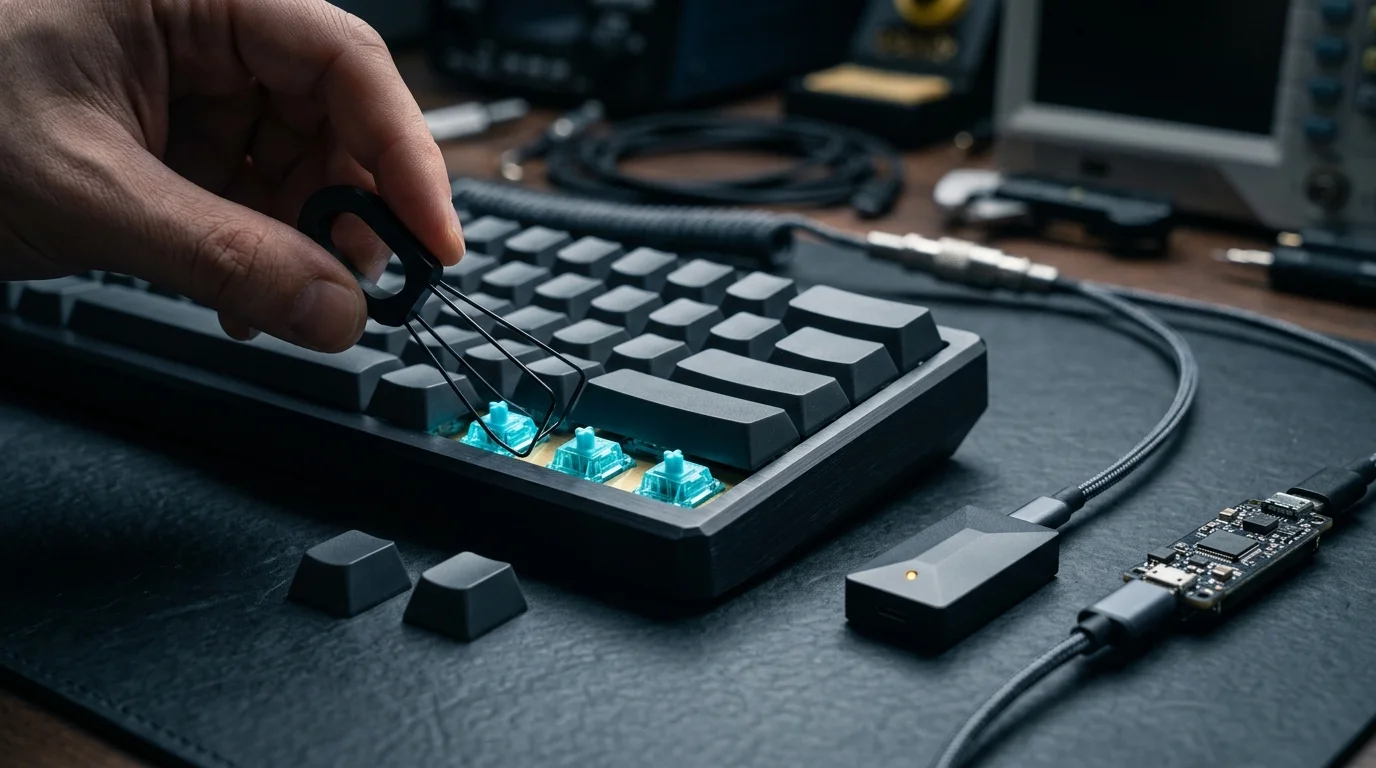
Peripheral manufacturers are increasingly marketing 4,000Hz and 8,000Hz polling rates on wireless mechanical keyboards, promising competitive gamers faster input response times. However, recent hardware evaluations published in October 2026 indicate that operating wireless boards at 8,000Hz increases battery consumption while offering minimal real-world latency advantages over standard 1,000Hz connections.
While industry discussions often cite claims that 4,000Hz or 8,000Hz modes force internal microcontrollers to remain continuously active and reduce battery longevity by up to 70%, current hardware testing and manufacturer telemetry do not substantiate a universal 70% drop or confirm continuous microcontroller wake states. Instead, reviewers note that actual battery degradation varies heavily depending on lighting configurations, wireless protocols, and battery capacities.
The Mechanics of 8,000Hz Polling and Latency
A keyboard’s polling rate dictates how frequently the peripheral reports its state to the host computer. According to TechRepublic, a standard 1,000Hz polling rate corresponds to a 1-millisecond reporting interval, whereas an 8,000Hz polling rate reduces that reporting window to 0.125 milliseconds.
Despite the eightfold increase in reporting frequency, shortening the polling interval does not automatically translate to lower end-to-end keypress latency. In its October 9, 2026 analysis, TechRepublic noted that testing by RTINGS found no meaningful overall latency improvement resulting from the higher polling rate on the Keychron Q6 Ultra 8K.
- Wi-Fi 7 Routers Face 6 GHz Signal Drop Across Walls and Drywall Partitions
- Smartphone Computational Photography Balances Multi-Frame Detail Against Over-Sharpening
- Dual-Tower Air Coolers Rival 240mm Liquid Loops Without Pump Risk
- Why Many USB-C Charging Cables Cannot Support Fast Data or Video
- Heat, Not Fast Charging Alone, Drives Lithium-Ion Smartphone Battery Wear
Other hardware evaluators have reached similar conclusions regarding the practical utility of ultra-high polling rates on keyboards. In an October 9, 2026 review of the Cherry XTRFY K63W Pro Compact, Tom’s Guide described the board’s 8,000Hz mode as overkill for most gamers, even though the keyboard performed reliably during testing.
Battery Capacity, Lighting, and Power Draw
Increasing the frequency of wireless transmissions requires additional energy, prompting manufacturers to install large batteries in high-polling models. For instance, the Keychron J10 Ultra features a 4,000mAh battery to support its 8,000Hz wireless capabilities, while the Cherry XTRFY K63W Pro Compact houses a 6,000mAh battery, according to Tom’s Guide.
Quantifying the exact battery penalty of 8,000Hz polling remains difficult because manufacturers rarely publish isolated power-draw comparisons across different polling rates. Tom’s Guide reports that while the Cherry XTRFY K63W Pro Compact is advertised with a maximum runtime of up to 1,100 hours, the manufacturer does not specify an exact runtime figure for 8,000Hz operation, noting only that high polling rates and RGB lighting will reduce longevity.
Backlighting remains one of the most significant variables in wireless peripheral endurance, often overshadowing or complicating polling-rate measurements. According to manufacturer estimates cited by TechRepublic, the Keychron Q6 Ultra 8K is rated for up to 660 hours of battery life with backlighting turned off, but that figure drops to 200 hours even at the lowest lighting setting.
Connection Modes and Practical Implications for Buyers
For consumers evaluating high-polling mechanical keyboards, connection architecture is a critical consideration. High-frequency reporting requires substantial wireless bandwidth that standard Bluetooth connections cannot provide.
As TechRepublic points out regarding the Keychron Ultra lineup, advertised 8,000Hz polling rates apply exclusively to wired USB-C or dedicated 2.4GHz wireless receiver connections, not Bluetooth. Similarly, the Keychron J10 Ultra pairs its 2.4GHz and wired modes with Bluetooth 5.3 for lower-power, multi-device connectivity. Meanwhile, the Cherry XTRFY K63W Pro Compact achieves its 8,000Hz wireless throughput via an ultra-wideband wireless connection alongside wired support, according to Tom’s Guide.
Because the latency reductions of 8,000Hz polling are rarely perceptible during standard gameplay or typing, users looking to maximize battery longevity between charges can adjust their device settings. Hardware like the Cherry XTRFY K63W Pro Compact allows users to step the polling rate down to 1,000Hz, preserving battery capacity without sacrificing practical responsiveness.
Frequently Asked Questions
Does an 8,000Hz polling rate measurably reduce total input latency?
Not necessarily. An 8,000Hz polling rate reduces the reporting interval between the keyboard and PC to 0.125 ms compared to 1 ms at 1,000Hz. However, TechRepublic notes that RTINGS testing on the Keychron Q6 Ultra 8K showed no meaningful overall latency improvement from the higher setting.
Do wireless keyboards run at 8,000Hz over Bluetooth?
No. High polling rates like 8,000Hz require wired connections, dedicated 2.4GHz wireless receivers, or ultra-wideband wireless links. Bluetooth connections operate at lower polling rates.
How much does backlighting affect battery life compared to polling rates?
While manufacturers and reviewers confirm that 8,000Hz polling drains batteries faster than 1,000Hz, exact polling-only penalties are not standardized across models. Conversely, lighting has a documented impact: manufacturer estimates for the Keychron Q6 Ultra 8K drop from up to 660 hours with lighting off to 200 hours at the lowest brightness level.