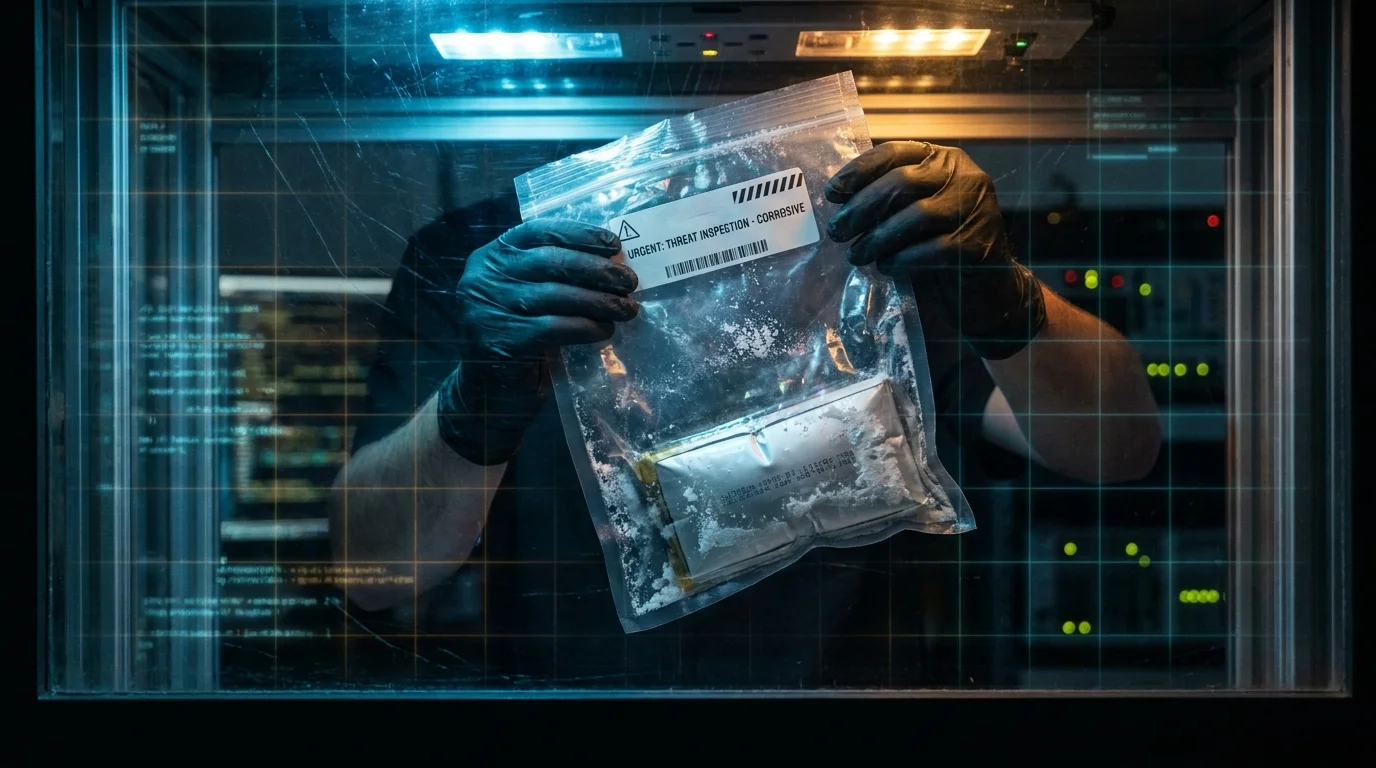
You find it tucked beneath a rat’s nest of braided cables in the bottom drawer: a neglected 10,000mAh external battery pack from three phones ago. When you lift it into the morning light, the seam along the plastic shell has cracked open like a dry walnut. Peering through the gap reveals a bulged silver battery casing coated with chalky white chemical residue inside a clear hazard bag you hastily grab from the pantry.
A faint, sweet, metallic scent drifts upward, smelling almost like overheated cotton candy mixed with nail polish remover. The instinct is fast and casual—walk to the kitchen, press the step-can open, and drop it into the curbside trash. It feels like harmless plastic waste, but doing that turns your weekly trash pickup into a rolling hazard zone.
Millions of these pocket powerhouses sit dormant across kitchen counters and garage workbenches across the country. Yet when their internal chemistry degrades, they cease being simple accessories and transform into fragile, pressurized chemical cells that demand precise, respectful handling.
The Pocket Volcano in Your Curbside Bin
To understand why municipal waste departments are sounding alarms, you have to look past the matte plastic casing. A lithium-polymer battery isn’t a dry storage tank; it is a pressurized sandwich of microscopically thin metal foils separated by volatile liquid electrolytes. When you charge and discharge a power bank, lithium ions migrate back and forth across a microscopic barrier.
Over years of temperature swings and micro-drops, those internal separators degrade, allowing microscopic lithium whiskers—called dendrites—to pierce through. Once that barrier fails, the stored electrical charge discharges instantly through the puncture point, generating internal heat that can exceed 1,000 degrees Fahrenheit in a fraction of a second.
When you toss that degraded pack into standard municipal trash, it travels into the back of a sanitation truck where heavy hydraulic blades exert thousands of pounds of pressure. Crushing an energized lithium cell instantly ruptures the casing, sparking ferocious chemical fires inside compacted paper, cardboard, and household refuse that water alone cannot easily extinguish.
- Stripe billing webhooks enforce instant data automation eliminating messy manual spreadsheet entry lag
- Tesla Model 3 door latches expose hidden mechanical shortcuts trapping hands during freezing winter
- Bose QuietComfort 45 battery swaps reverse crackling speaker hums saving costly hardware replacements
- Thermalright Peerless Assassin coolers block scorching thermal spikes without noisy liquid pump whine
- Kdenlive video editor strips bloated export delays and fixes choppy timeline playback stutter
The Anatomy of a Compactor Fire
Marcus Reyes, a 42-year-old municipal waste safety supervisor in Austin, Texas, spends his mornings monitoring automated sorting lines. ‘People think when a gadget stops holding a charge, it is dead,’ Marcus explains as he adjusts his heat-resistant gloves. ‘In reality, even a battery that won’t turn on your phone still retains enough stranded electrochemical energy to ignite an entire hopper the moment our shredder teeth bite into it. We treat every loose power bank like a strike-anywhere match.’
Fire marshals nationwide report a sharp spike in transfer station blazes directly linked to compact battery packs. When the soft aluminum pouch inside a power bank is crushed, the volatile organic solvents aerosolize instantly, producing dense white smoke followed by self-oxidizing flames that spread across sorting belts before suppression systems can fully trigger.
Triage Your Hardware: Swollen Pouches vs. Leaking Electrolyte
Before you transport or dispose of an aging power bank, you need to identify its physical state to choose the right containment strategy.
1. The Puffy Pillow (Gassing Out)
If your battery pack looks rounded, rocks when set on a flat table, or has split its plastic seams without leaking visible fluids, the internal pouch has generated gas from decomposed electrolyte. Do not press down on the bulge or try to snap the casing back together. Place the unit flat in a non-conductive, fireproof container such as a metal cookie tin lined with clean play sand.
2. The Leaker (Active Chemical Breakdown)
If you notice chalky white or greenish crust around the USB ports, or a wet film that feels oily between your fingers, corrosive lithium salts have escaped. Avoid skin contact; wear nitrile gloves immediately. The venting liquid can irritate skin and corrode surrounding metal surfaces. Double-bag the device in heavy-duty polyethylene bags before secondary containment.
3. The Dormant Veteran (Depleted but Intact)
If the brick shows no physical swelling or leakage but refuses to accept a charge or gets uncomfortably hot during use, its internal control board has likely tripped a permanent safety fuse. While the safest of the three, it still holds stranded power and must follow dedicated drop-off channels rather than curbside bins.
The Safe Neutralization Protocol: Tape, Insulate, and Relocate
Handling degraded energy storage requires deliberate, low-friction habits. Follow this sequence to secure a compromised battery pack before handing it off to certified recyclers.
- Isolate the Terminals: Cover every USB-A, USB-C, and micro-USB port with thick vinyl electrical tape to prevent external metallic objects from bridging the contacts.
- Pick a Fireproof Buffer: Never store a swollen cell in a cardboard box or plastic bin. Place it inside a ceramic flowerpot, metal ammo can, or heavy metal container filled with dry sand or coarse cat litter.
- Keep It Cool and Dry: Store the contained unit in an out-of-the-way spot, such as a concrete garage floor, away from direct sunlight, flammables, and living areas.
- Locate a Certified Drop Point: Use resources like Call2Recycle to find participating retail drop boxes at hardware stores like Home Depot, Lowe’s, or local municipal household hazardous waste (HHW) roundups.
Tactical Toolkit for Safe Handling:
- Tape Type: Heavy-duty UL-listed vinyl electrical tape (avoid scotch or duct tape).
- Containment Medium: 2–3 cups of dry silica sand or non-clumping clay litter.
- Storage Temperature: 50°F to 70°F on non-combustible flooring.
- Personal Protection: Powder-free nitrile gloves and safety glasses if crust is present.
Rethinking the Life Cycle of Portable Power
We treat high-capacity portable chargers like passive tools—no different than a plastic ruler or a water bottle—because their sleek shells hide the volatile chemistry within. But every slim battery pack you carry is a precision-engineered electrochemical cell balancing unstable materials behind thin seals.
Taking ten minutes to insulate the terminals, cushion the cell in dry sand, and hand it to a dedicated e-waste collector turns an invisible home and municipal hazard into recovered raw materials for new infrastructure. It restores safety to the workers sorting our waste and keeps modern convenience from quietly backfiring on our communities.
‘A spent battery is never truly empty; it is simply waiting for the wrong kind of pressure to release its remaining energy.’
| Key Point | Detail | Added Value for the Reader |
|---|---|---|
| Terminal Taping | Cover all input/output ports with non-conductive electrical tape. | Prevents accidental short circuits during transit to the collection bin. |
| Thermal Buffering | Store damaged cells submerged in dry sand or clay cat litter. | Absorbs potential thermal runaways and smothers spontaneous flares. |
| Dedicated E-Waste Drop | Use specialized retail kiosks (Call2Recycle) or municipal HHW centers. | Keeps pressurized cells out of compactor trucks and sorting conveyors. |
Frequently Asked Questions
Can I discharge a swollen battery completely by plugging in a light or fan?
No. Drawing current from a structurally damaged or swollen lithium pouch increases internal resistance and heat, which can accelerate thermal runaway. Leave the charge state as-is and isolate the unit immediately.What should I do if a power bank starts smoking or hissing?
Evacuate the immediate area and avoid inhaling the dense white fumes. If safe to do so, move the pack outdoors onto bare concrete or dirt using long tongs or a shovel, and allow it to fully burn out away from flammable materials.Will standard baking soda neutralize leaking battery acid?
Lithium-ion and lithium-polymer packs do not contain traditional sulfuric acid like car batteries; they use organic solvent electrolytes and lithium salts. Wipe down non-porous surfaces with an isopropyl alcohol wipe while wearing nitrile gloves, rather than applying baking soda slurries.Do retail drop-off bins accept swollen or leaking batteries?
Standard retail drop kiosks (like those in home improvement stores) usually accept only intact, taped batteries. For visibly swollen, ruptured, or leaking packs, contact your local city household hazardous waste facility for specialized hazardous material packaging and disposal instructions.How long can I safely store a damaged power bank at home before drop-off?
You should transport it to a certified drop-off facility within 24 to 48 hours. Keep it stored in a cool, ventilated outbuilding or garage inside a sand-filled metal container while you arrange disposal.