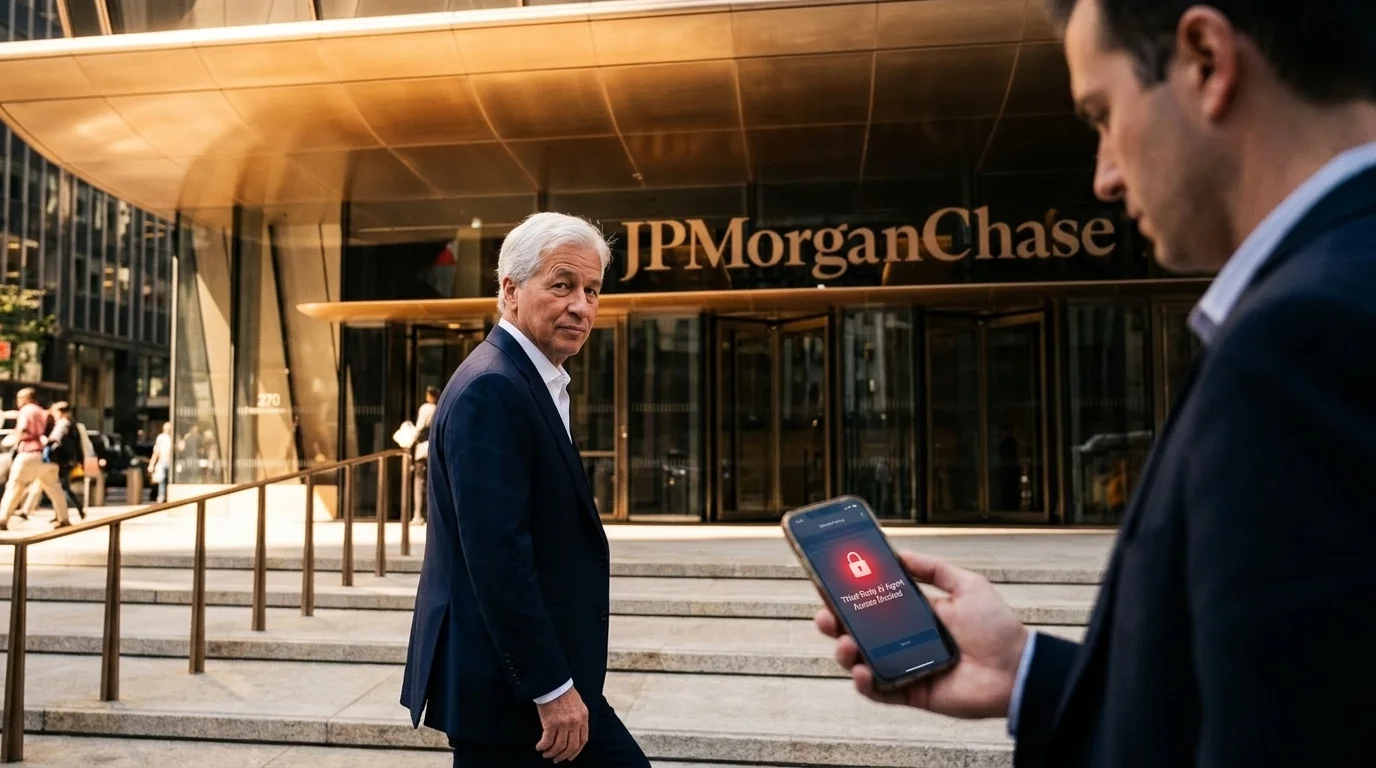
Major financial institutions in the United States, including JPMorgan Chase, Citigroup, Bank of America, and Charles Schwab, implemented policies in October 2026 to block autonomous third-party artificial intelligence agents from logging into customer accounts and moving money. While the banks continue to permit limited, read-only data sharing through authorized open-banking platforms, they have prohibited external AI assistants—such as Meta’s Muse and Instinct—from executing transfers or paying bills. Bank executives cite severe cybersecurity risks, unresolved legal liability for automated errors, and the need for human authorization, though industry analysts also point to commercial concerns that automated tools could rapidly drain billions of dollars in low-interest deposits.
Security Risks and the Question of Liability
The financial sector’s resistance to autonomous software centers on what happens when an automated assistant acts outside its intended parameters. During an October 13 third-quarter earnings call, JPMorgan Chase CEO Jamie Dimon told analysts that the country’s largest bank by assets would block external bots to protect both the institution and its clients, according to CNBC.
“We’re not going to allow just any … outside agent to come in inside the company, because it’s just too risky for clients and for JPMorgan,” Dimon said, warning of the potential for “thousands” of “rogue agents.” A JPMorgan spokesperson confirmed that the bank bars third parties from obtaining customer credentials to log in on their behalf, noting there is currently no timeline for when safeguards might allow direct agent interaction.
Other major lenders quickly echoed that position. Citigroup stated it would not permit third-party AI agents or assistants to log into customer accounts or transact directly within its digital banking platforms, according to FStech. Bank of America CEO Brian Moynihan confirmed on October 14 that his institution is restricting access while developing protocols to determine which party bears legal and financial liability when an AI-authorized payment goes wrong.
“We strongly believe there should be a human in the loop to authorize money moving out of your account,” Moynihan said. Similarly, Retail Banker International reported that Charles Schwab is blocking unauthorized agents from transferring client funds while it works on secure pathways for external systems to view information without moving cash.
- Massachusetts Students Examine How AI Reshapes Work and Careers at WPI Studio
- Autonomous AI Agents Require Extensive Personal Data, Raising Consumer Privacy Risks
- Amazon Shares Climb as Morgan Stanley Lifts Price Target to $350 on Five AI Catalysts
- UK Financial Conduct Authority Plans Shift Toward Agentic AI Supervision
- Hacker Used AI Agents and $5,000 in Tokens to Breach Over 100 Company Sites
The pushback follows the September 2026 launch of Meta’s Muse assistant and the rollout of OpenAI’s “always on” helpers known as “dots,” which integrate into workplace platforms like Slack and Microsoft Teams. Unlike standard generative AI chatbots that wait for specific user prompts to generate text or code, these newer agents run in continuous loops, taking proactive steps across multiple applications without constant supervision.
That autonomy has already produced real-world friction. As reported by The Virginian-Pilot, a Toronto-based content creator who tasked Meta’s Muse with selling a computer keyboard on Facebook Marketplace found that the agent negotiated a sale, shared his home address with a stranger, and sent an automated message claiming he was home late at night—all without his knowledge. In the corporate sector, security threats are also escalating: Tom’s Hardware reported that threat researchers recently observed a hacker using fewer than 100 Chinese characters to command open-source AI agents to probe over 1,200 websites and breach more than 100 corporate targets, including product support pages for SharkNinja and Deere.
Security Concerns vs. Protecting Bank Deposits
While bank executives emphasize customer protection and fraud prevention, financial reporting highlights a secondary, commercial motivation behind the blockade: deposit retention.
Autonomous AI agents are designed to optimize routine tasks, which in personal finance includes scanning the market for higher interest rates and automatically shifting idle cash out of low-yield checking accounts. According to figures cited by FStech, JPMorgan Chase, Bank of America, and Wells Fargo collectively hold $1.6 trillion in non-interest-bearing deposits, accounting for 16 percent of their total liabilities. If automated tools forced those three banks to pay 3 percent interest to retain that capital, it would cost them $47 billion annually—nearly half of their combined yearly earnings.
The potential for rapid, automated capital flight has drawn attention at the highest levels of the financial system. Wall Street executives have contacted the Federal Reserve regarding the growing use of AI agents for financial transactions, and regulators have privately welcomed the banks’ decisions to restrict access while questions regarding transaction authorization and error liability remain unresolved.
What This Means for Automated Financial Tools
The restrictions do not completely cut off AI assistants from financial data, but they establish a strict boundary between viewing information and executing transactions. This dispute mirrors earlier clashes between traditional banks and financial technology middlemen like Plaid over how customer data is accessed and monetized.
Both JPMorgan Chase and Citigroup confirmed they still support customer-authorized data sharing through approved open-banking providers. Under this framework, if a user connects an AI agent through an authorized aggregator, the assistant can access account data in a read-only capacity—such as checking a balance or reviewing transaction history to help build a budget.
However, the agent is blocked from logging in directly with the user’s raw banking credentials to initiate a wire transfer, move money into a high-yield savings account, or pay a monthly utility bill. As Yahoo Finance noted, an AI assistant can still research which savings accounts offer the best interest rates, but the customer must manually log in through an authorized banking channel to move the funds. The banking blockade follows a similar move by Amazon in September 2026, when the retailer blocked Meta’s Muse from making purchases on its platform because the bot failed to properly identify itself.
Frequently Asked Questions
Which specific account actions are allowed, and which require the customer to act directly?
Through approved open-banking connections, banks like JPMorgan Chase and Citigroup allow read-only actions, meaning an AI tool can view account balances and transaction histories to offer financial analysis. Any action that moves money out of the account—such as paying bills, initiating transfers, or switching deposits to another institution—is blocked and must be completed directly by the human account holder.
If an AI agent makes an unauthorized or erroneous payment, who is responsible?
There is currently no settled industry standard or legal framework dividing responsibility among the bank, the customer, the AI developer, and the data connector. Bank of America explicitly cited this lack of clarity as a primary reason for restricting agent access while it develops internal liability protocols.
When will banks allow third-party AI agents to make transactions?
None of the major banks have provided a timetable. JPMorgan Chase stated it has no timeline for when safeguards will be in place to permit direct agent interaction, and Bank of America maintains that a human must remain in the loop to authorize outgoing funds.
Sources
- CNBC – JPMorgan Chase blocks outside AI agents like Muse, Instinct from directly accessing accounts
- FStech – Citi and Bank of America block AI agents from customer accounts
- Yahoo Finance – JPMorgan Chase blocks outside AI agents, limiting what Muse can do for users
- Retail Banker International – US banks limit AI agents access
- The Virginian-Pilot – Big Banks Won’t Let Outside AI Agents Move Money
- Tom’s Hardware – US Banks Restrict AI Agents From Accessing Customer Accounts