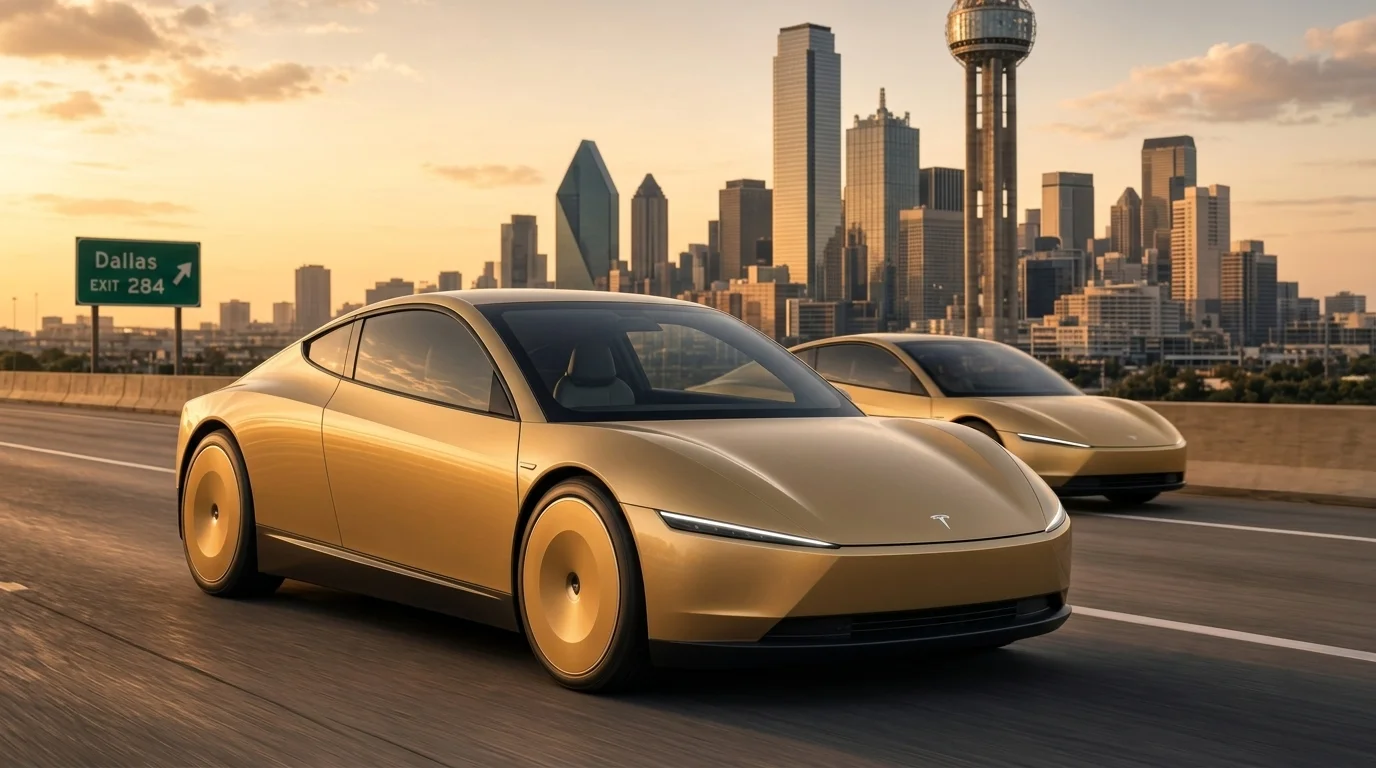
Tesla announced that its purpose-built Cybercab fleet in Austin, Texas, expanded eightfold over a 30-day period to exceed 300 vehicles, while company executives signaled that Dallas will be the next market to receive the pedalless robotaxis. Announced on October 10 via the automaker’s official Robotaxi social media account, the rapid deployment marks the first time Tesla has attached a specific fleet figure to its two-seat autonomous vehicle following its early September public launch. The expansion occurs as federal safety regulators evaluate the vehicle’s compliance with national standards and CEO Elon Musk acknowledges ongoing software hurdles regarding low-light obstacle detection.
Unpacking the Austin Fleet Numbers
While Tesla’s official announcement highlighted “300+ Cybercabs serving Austin,” independent tracking and state registration records indicate a more nuanced picture of how many autonomous vehicles are actively carrying passengers at any given hour. According to TESLARATI, the company added 150 Cybercabs to the Texas automated vehicle registry in early October, lifting its total state registrations from 169 to 319 units after the first seven appeared on the registry on August 31.
Separate analyses show a gap between state paperwork, company milestones, and observed street activity. According to Yahoo Finance, Texas registration data as of October 10 listed approximately 319 Cybercabs alongside 420 Model Y robotaxis, though vehicle registration does not confirm that every unit is simultaneously operating in public service. Meanwhile, local broadcaster KEYE (CBS Austin) reported that the community-run Robotaxi Tracker estimated 354 total Tesla robotaxis operating on Austin streets, with 178 of those identified as gold-colored Cybercabs. Earlier snapshot data from the same tracker cited by TESLARATI had counted 275 unsupervised Tesla vehicles in Austin, including 105 Cybercabs.
Even at the lower tracker estimates, the influx of autonomous vehicles has rapidly altered Austin’s transportation landscape. CBS Austin noted that competing autonomous ride-hailing provider Waymo also operates more than 300 robotaxis in the city, bringing the combined total on local roads to roughly 700 driverless vehicles.
Dallas Expansion Plans and Infrastructure
Following the October 10 fleet announcement, Ashok Elluswamy, Tesla’s vice president of AI software, stated on social media that the vehicles are now ubiquitous in Austin two years after the company’s October 10 “We, Robot” unveiling event, adding that Dallas would follow soon. Neither Elluswamy nor Tesla provided a target launch date for the Dallas rollout.
- Reports Examine How Biosecurity Frameworks Must Adapt to Advanced AI
- AI Data Center Boom Strains Insurance Capacity as InsurTech Funding Concentrates
- AI Adoption Shifts Office Workloads Toward Oversight, Meetings, and Cognitive Strain
- World Leaders Warn AI Investment Boom Carries Global Economic Risks
- China Unveils First 100,000-Card Domestic AI Supercluster Hardware in Shenzhen
While the deployment will represent the debut of the two-seat, steering-wheel-free Cybercab in North Texas, secondary reporting notes that Tesla already operates autonomous ride-hailing services in the Dallas area utilizing standard Model Y vehicles. According to EVwire, the company has been building out dedicated support infrastructure in the region since May, when municipal permits revealed plans for a 35,000-square-foot autonomous fleet operations facility in Irving, Texas. That site is designed to accommodate up to 212 vehicles and features 16 V4 Supercharger stalls.
Nighttime Vision Challenges and Federal Scrutiny
As Tesla scales its physical footprint, its camera-only autonomous driving architecture continues to face both technical refinements and regulatory investigations. Unlike competitors such as Waymo and WeRide, which combine cameras with LiDAR and radar sensors to map their surroundings, Tesla relies exclusively on optical cameras and neural networks.
According to a separate report from Yahoo Finance, Musk acknowledged earlier in October that poor visibility in dark conditions remains an operational hurdle as the company expands its late-night service window. Musk stated that the primary engineering focus at night is ensuring the vehicles do not strike small pets, such as kittens, in low-light environments. Reporting differs on the exact nighttime schedule in Austin: Yahoo Finance noted the service window was stretched from 10:00 p.m. to 11:00 p.m., while other coverage from Drive Tesla Canada indicated operating hours were extended to midnight.
Federal authorities are also scrutinizing the rapid rollout. Just one day after the Cybercab launched in Austin in early September, the National Highway Traffic Safety Administration (NHTSA) opened an audit query into Tesla’s self-certification that the vehicle—which lacks traditional manual controls like pedals and a steering wheel—meets federal motor vehicle safety standards. TESLARATI reported that Tesla’s sworn responses to the NHTSA audit are due by October 30.
In addition to the vehicle certification audit, the U.S. Department of Transportation recently opened an investigation following observations that autonomous cabs had exceeded speed limits in school zones. Peter Kurdock, general counsel at Advocates for Highway and Auto Safety in Washington, D.C., told CBS Austin that the absence of federal safety standards governing self-driving software remains a major concern as deployments accelerate. While the Insurance Institute for Highway Safety reported in July that Waymo vehicles in Austin experienced fewer crashes than human drivers, safety advocates maintain there is insufficient public data to evaluate the overall safety performance of the broader robotaxi sector.
The domestic expansion coincides with regulatory adjustments abroad. In Europe, Tesla recently dropped the “Full Self-Driving (FSD) Supervised” branding from its official communications following pushback from German authorities over concerns the name could mislead consumers, rebranding the suite as “Tesla Assisted Driving.”
What Riders and Investors Are Watching
With Tesla scheduled to report its third-quarter financial earnings on October 21, investors and industry analysts are looking for concrete operational metrics beyond total fleet registrations. Key questions remain regarding how the service performs under daily commercial conditions.
How many Cybercabs are actively giving rides at once?
Tesla has not disclosed simultaneous active vehicle counts, daily trip volumes, or financial profitability metrics for the Austin network. State registrations (319 Cybercabs) and company fleet totals (300+) reflect available hardware, whereas independent street trackers have observed between 105 and 178 Cybercabs deployed in unsupervised service.
Has Tesla released safety or intervention data for the Austin fleet?
No. Tesla has not published collision rates, disengagement logs, remote-assistance frequency, or animal-strike statistics for its Austin Cybercab operations. Additional clarity on safety compliance is expected when Tesla submits its required audit answers to NHTSA on October 30.
When will Cybercabs launch in Dallas and what are the operating hours?
Tesla has not announced a launch date or specific geographic geofence for Cybercab rides in Dallas. Similarly, while Austin operations have expanded deeper into the evening, conflicting reports place the current nighttime cutoff at either 11:00 p.m. or midnight.
Sources
- Yahoo Finance – Tesla Robotaxi Fleet in Austin Soars 8x in a Month While Elon Musk Admits TSLA Is Still Working on Not Running Over Cats
- TESLARATI – Tesla’s Cybercab fleet jumped 8x in a month, with Dallas up next
- KEYE (CBS Austin) – Tesla now has more than 300 robotaxis in Austin after Cybercab launch
- Yahoo Finance – Tesla’s Cybercab Robotaxi Fleet Jumped Eightfold in a Month to More Than 300 Vehicles in Austin, With Dallas Up Next. Is Elon Musk’s Robotaxi Bet Finally Scaling?
- EVwire – Tesla Cybercabs are heading to Dallas, Austin fleet scales to over 300
- Drive Tesla Canada – Tesla Cybercab Midnight Operating Hours Austin